
CHAPTER 1: THE PERSISTENCE OF FRICTION
“Don’t touch me again,” the younger man said.
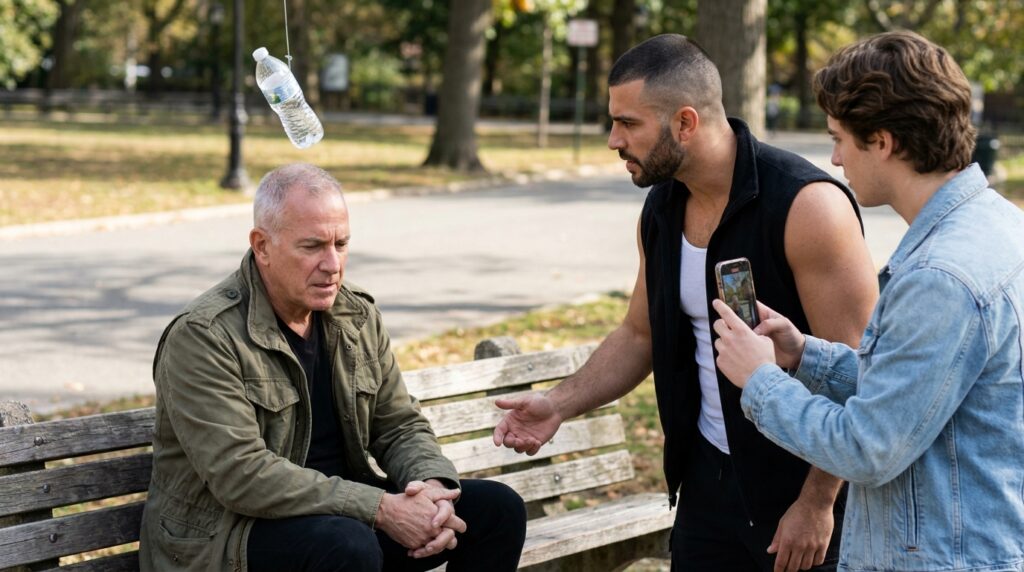
The voice was too loud, artificially clear, pitched for the microphone array of the phone held three feet to the right. The air in the municipal park smelled of dry pine needles and stagnant pond water, a heavy, desaturated heat that seemed to stick to the weathered fabric of Arthur’s olive field jacket. Arthur didn’t look up immediately. He kept his eyes fixed on the cracked concrete beneath the park bench, tracing a jagged line where a stubborn weed had forced its way through the aggregate.
The primary aggressor leaned closer, his shadow falling directly across Arthur’s knees. The black sleeveless vest he wore smelled of synthetic laundry detergent and stale sweat. He shifted his weight, his boots grinding a small pebble into dust. Above them, suspended from a low-hanging oak branch by a length of clear monofilament fishing line, a plastic water bottle swayed gently in the humid breeze. It was a crude mechanism, a cheap setup designed to drop and startle an old man for the amusement of a digital audience that existed only as numbers on a screen.
“I asked you a question, old man,” the voice came again, sharper this time, probing for the micro-expression that would validate the stream. “You think you can just put your hands on people out here?”
Arthur’s hands remained flat near his knees. Against his left wrist, the dead weight of his mechanical watch felt cold, a static block of stainless steel with a deeply scratched crystal face. The internal balance wheel had stopped ticking eight years ago, but he still wore it every morning. It was a silent ballast against the heat rising in his chest. His posture was deliberately small, narrowed to suggest a vulnerability he didn’t possess. He was calculating the distance between the aggressor’s lead boot and the iron frame of the bench—exactly twenty-two inches.
The younger man with the phone laughed, a thin, detached sound that didn’t match the heavy silence of the clearing. There were no other witnesses. The municipal park was wide, desaturated under the gray afternoon sky, its distant pathways empty.
Arthur drew a slow, deliberate breath through his nose, filtering the smell of iron and dry earth. He felt the specific friction of his black shirt against his shoulder blades as his muscles compressed. The restraint was a physical pressure, a domestic boundary he had spent a decade fortifying with gardening tools, grocery receipts, and quiet television sets at dusk.
“Look at the camera when I’m talking to you,” the bearded man commanded, his hand moving toward Arthur’s collar, the fingers curved like a claw.
The movement was inefficient. It lacked the economy of someone who understood what happened when skin met bone at high velocity.
Arthur rose. He didn’t scramble or lunged; he simply corrected his posture, his solid frame unfolding from the wooden slats with the heavy momentum of a counterweight. The physical space around the bench compressed instantly. Before the bearded man’s hand could close on fabric, Arthur’s left palm struck the inside of the man’s forearm, clearing the interaction lane with a dull, wet slap. His right heel drove downward into the arch of the lead foot, anchoring the aggressor to the concrete while his shoulder shifted into the man’s chest.
It took less than three seconds. The bearded man hit the ground first, his breath escaping in a sharp, guttural whistle as his spine met the dirt. The phone-wielding accomplice didn’t even have time to lower his arm before Arthur’s hand closed around the plastic chassis of the device, twisting it cleanly from the slim fingers with a short, metallic snap of the casing. The young man stumbled backward, his denim jacket scraping against the rough bark of the oak tree as he collapsed beside his partner.
Arthur stood composed over them, his pulse steady beneath the dead watch. The gravelly texture of his voice felt foreign even to his own ears as he broke his long silence. “You crossed the line. Back away now.”
The primary aggressor was clutching his ribs, his mouth open but silent, his eyes wide with the sudden, disorienting realization that the elderly target had evaporated. The accomplice remained frozen, his empty hand still shaped around a phone that was no longer there.
Arthur didn’t wait for a reply. He dropped the cracked device onto the gravel, his boot heel coming down once with a heavy, administrative crunch that pulverized the lens module. “We’re done here. Leave.”
He turned away from the bench, his olive jacket rustling slightly as he set his pace toward the western exit of the park. His hands went back into his pockets, fingers brushing against the cold ridges of his apartment key.
He didn’t look back until he reached the perimeter fence, where the desaturated asphalt of the street began. On the lower rail of the chain-link gate, partially obscured by a rusted bolt, a small piece of blue surveyor’s tape had been tied in a double knot—the exact marking he had removed from his porch railing three days ago.








