
CHAPTER 5: THE DESATURATED LINE
The latch clicked, and the narrow hallway died.
Arthur did not look back at the heavy oak door as it settled into its warped frame. He descended the stairs one half-pace behind the man in the gray canvas coat, his boots falling into the worn hollows of the timber with a heavy, deliberate rhythm. The air in the stairwell grew colder with every riser, losing the faint, domestic smell of fried cabbage and taking on the raw, wet humidity of the street-level vestibule.
Outside, the rain had turned into a fine, gray mist that hung between the brick buildings like smoke. The delivery van waited by the curb, its side panels covered in streaks of dry highway salt from some distant northern run. The passenger door was already unlatched, vibrating slightly against its rubber dampeners.
Arthur climbed into the cab. The interior smelled of old coffee grounds, damp floor mats, and the sharp, chemical tang of unrefined diesel exhaust. He did not fasten the seatbelt immediately; his left arm remained flat against his flank, his fingers naturally finding the space between his hip and the seat bolster where a weapon would have sat if he were still on the company payroll.
The driver—the man with the sharp jawline Arthur had observed from the kitchen window—put the vehicle in gear before the door had fully clicked into the lock. The transmission whined in reverse, a high, metallic protest that echoed off the damp bricks of the alleyway, before the van lunged forward onto the desaturated asphalt of the avenue.
“The bridge at the river is closed for maintenance,” the driver said. He did not turn his head; his eyes stayed locked on the sweep of the wiper blades across the glass. “We’re taking the old commercial route past the tanneries.”
The man in the gray coat sat in the jump seat behind them, his boots scratching against a corrugated steel tool box. “The tanneries are dead, Miller. The county tore down the culverts three winters ago.”
“The gravel path is still clear enough for the axles,” Miller replied.
Arthur looked out the passenger window. The city was thinning out, its brick storefronts giving way to low, cinderblock warehouses and chain-link compounds where rusted machinery sat under tarps. The dead wristwatch against his skin felt like a lead weight, its frozen balance wheel a silent contrast to the crisp, rhythmic ticking of the new timepiece he had left on the hallway table. They had wanted him to take it. The watch was a token, a small piece of corporate property meant to signal the reinstatement of his schedule. Leaving it behind was his only remaining luxury.
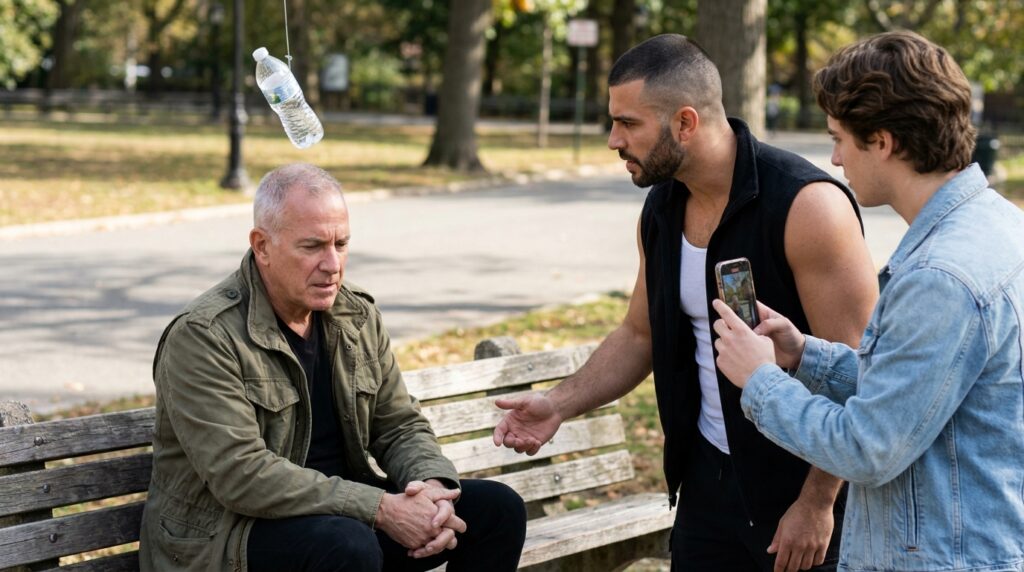
“Who authorized the proximity test in the park?” Arthur asked. His voice was low, gravelly, competing with the wet hum of the tires against the road.
The man in the back did not answer immediately. A heavy canvas gear bag shifted against the steel toolbox as the van bounced across a deep pothole in the asphalt. “The evaluation came from the regional office, Arthur. You know how the insurance underwriters operate after an infrastructure shift. They don’t take the word of a fifteen-year-old ledger. They wanted eyes on the asset before they signed the mobilization order.”
“The two boys weren’t investigators,” Arthur said. “The slim one didn’t know how to hold his weight. His shoulder was forward before he even started the video.”
“They were local talent,” Miller said from the driver’s seat, his thumbs hooked over the steering wheel. “Cheap. Disposable. The kind of people who think everything that happens in a public square is a game for an audience. If you had broken the bearded one’s neck, the county would have called it an old man’s panic and buried the police report in the regional archive. But you didn’t. You kept the leverage localized. That’s what the underwriters paid to see.”
The van turned off the hardtop, the tires dropping onto a packed gravel track that ran parallel to the old industrial drainage canal. The water in the ditch was thick, grey, covered in a yellow foam that gathered around the wooden pilings of the abandoned processing docks. In the distance, rising through the mist like the ribcage of a dead whale, the high steel superstructure of the Blackwood Estuary barge began to resolve against the horizon.
Arthur watched the silhouette grow. The three hundred monthly wire transfers from the Delaware trust had felt like an escape, but as the van’s suspension bottomed out against the wet gravel, he realized the distance had never changed. He had spent fifteen years walking around a square park bench, but the circle had always been anchored right here, in the salt mud where the concrete met the tide.








