
CHAPTER 5: THE REMNANT IN THE DUST
The exit door didn’t slam; its hydraulic arm was leaked out, coated in a thick, velvety layer of oil-soaked grit that caught the midday sun. It closed with a slow, heavy hiss that smelled of hot rubber and baked asphalt. Arthur stepped out onto the gravel perimeter lot, the transition from the air-conditioned store to the ninety-degree heat hitting his lungs like a mouthful of dry wool.
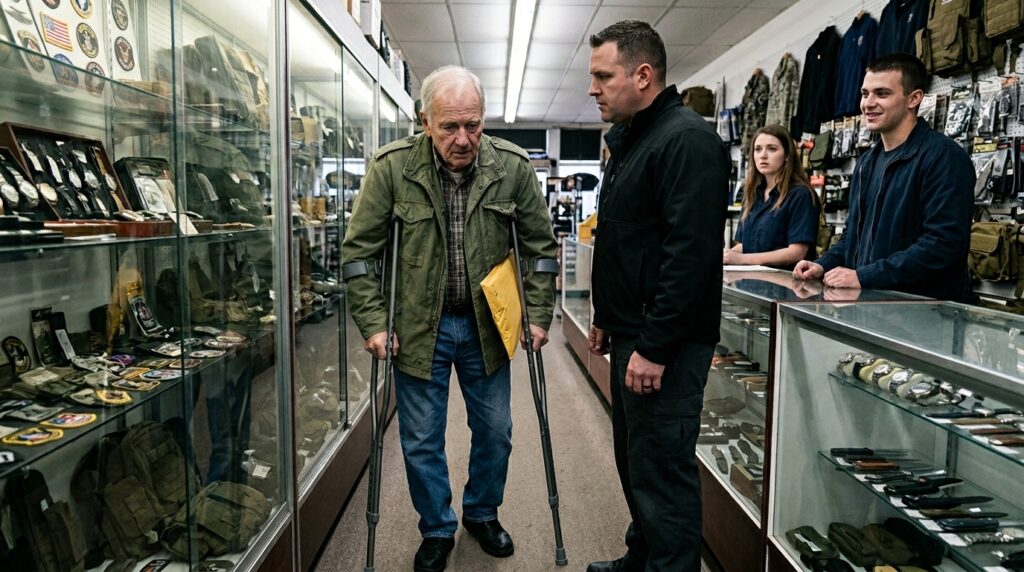
Behind him, through the sun-bleached plate glass window, Vance Miller remained motionless by the knife display. His phone was still pressed to his ear, his sharp profile silhouetted against the dim fluorescent grid inside, but his eyes were no longer on his screen. He was watching the space where the boilerplate safe had been exposed—the dark, square gap in his inheritance that no amount of corporate landscaping could cleanly pave over.
Arthur tucked the yellow envelope deeper beneath his armpit, his ribs pressing against the stiff cardboard insert. The skin of his forearm was raw where the unpadded steel cuff of his right crutch rubbed against his wrist, leaving a gray, metallic smudge across his tendons. Every step forward was a calculation of friction: the raw aluminum tip of his left crutch found purchase in the coarse limestone gravel, grinding with a dry, crunching shuck-scritch that vibrated straight through his collarbone.
“Arthur.”
The voice was light, raspy with the dry dust of the stockroom. He didn’t turn around—the pivot required too much momentum on the loose stones—but he stopped, setting the bases of his crutches wide to lock his frame into a stable tripod.
Janie came up on his left side. She wasn’t running, but her breath was short, her cheeks flushed the color of raw brick under her pale skin. She had her denim jacket thrown over one shoulder, her nametag missing from her shirt. In her hand, she held a single, narrow strip of fabric—the faded olive ribbon with the unlisted silver bar that she had pulled from the lowest tray of the iron lockbox before Vance could log the contents.
“He’s already calling the state registry to lock the archive files,” she said, her voice dropping into the quiet space between the passing highway trucks. “The holding company has three more properties flagged on the county line. My dad’s old house is one of them. He’s clearing the whole grid.”
“He’s balancing his books,” Arthur said. He looked down at the ribbon in her hand. The edges were frayed, the green weave choked with the fine gray dust of the subfloor safe. “Your grandfather knew how to balance ’em too. He just used a different kind of ink.”
“This belongs with the envelope,” she said, extending her hand. The silver ring in her lip caught the glare off the gravel, casting a tiny, sharp needle of light across his olive jacket. “If they clear the cabin on Monday, nobody else is going to look at these names. Gary’s down at the service station right now talking to his cousin, but the paperwork… the paperwork has Vance’s corporate stamp on it.”
Arthur reached out, his thumb—calloused and dry as old harness leather—brushing her palm as he took the ribbon. He didn’t drop it into the yellow envelope. Instead, he turned it over, his nail catching on the small, hand-stamped lead rivet on the reverse side. The metal was white with oxide, but the initials J.M. were still legible, pressed into the lead with an old armory die.
“John Miller,” Arthur murmured. “Your uncle didn’t just sign the manifest. He kept this one back because he knew the short shells came from his own depot allocation. He didn’t want to forget what the profit looked like.”
He laid the ribbon back into Janie’s palm, his fingers closing her hand over the metal bar until the edges bit into her skin. “Keep it,” he said. “The envelope goes into the ground behind the timberline before the graders get there on Monday. But the store’s still standing. You look at that floor every time you walk in.”
Janie looked down at her closed fist, the green fabric disappearing into her grip. The silence between them grew long, filled only by the heat rising from the hoods of the parked trucks and the distant, rhythmic thud of a diesel engine idling near the bypass.
“What are you going to do when the tractors come?” she asked.
Arthur adjusted his grip on the aluminum cuffs, the cold metal fitting into the grooved calluses of his palms like a key into a worn lock. He looked past the gravel lot, past the faded plastic sign of the surplus store, to the blue, heat-shimmered ridge where the pine woods began.
“A man who’s lived in the dirt knows how to move when the wind changes,” Arthur said, his gravelly voice dropping into a level, pragmatic cadence. “But I aren’t done checking the ledger.”
He shifted his weight, the shoeless crutch digging into the limestone with a sharp, iron-scented crunch, and began the long, slow march back toward the edge of the asphalt.








