
CHAPTER 1: THE FRICTION OF IRON
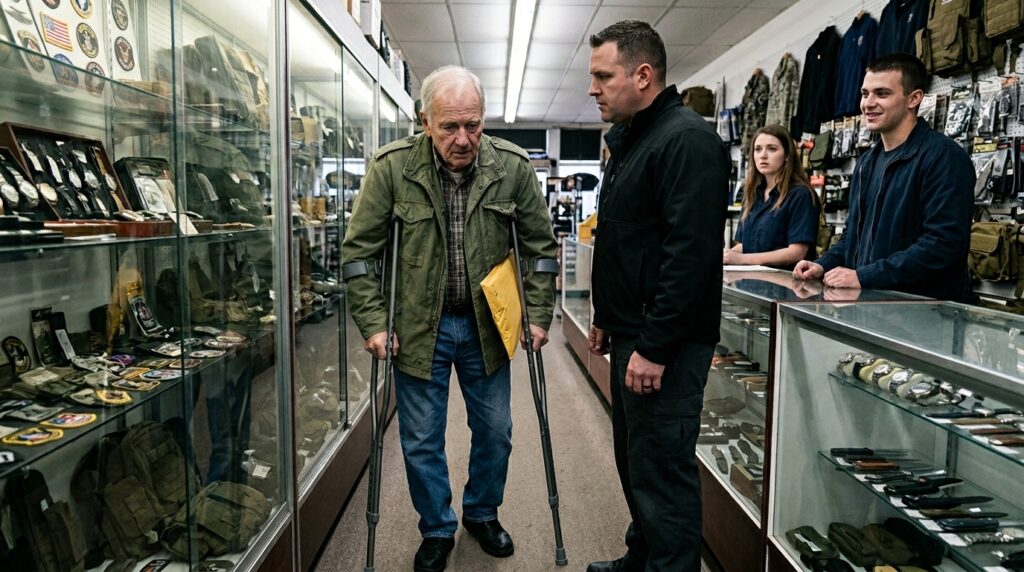
The bare aluminum tube of the left forearm crutch lacked its rubber shoe. Every three feet, when his weight shifted forward, the raw metal bit into the grease-yellowed linoleum with a dry, screeching shuck. It was a sound that set teeth on edge—the small, violent friction of things wearing down to the bone.
“Hey, pop,” a voice called out from the back wall. It came from a kid in a polyester track jacket who was leaning his hips against a case of replica tactical folding knives. He didn’t look up from his thumbing a small, blue-lit screen. “Aisle’s for moving traffic. Some of us got places to be before the century ends.”
Arthur didn’t turn his head. His thinning white hair was damp against his scalp from the noon heat off the highway outside, the strands clinging like wet thread to his liver-spotted skin. He kept his eyes on the glass below him. The display cases were choked with grease-stained compasses, old canvas webbing that smelled of dry rot, and rows of heavy steel watches whose ticks didn’t align. The whole place was an attic for things that had outlived their purpose but refused to rot cleanly into the dirt.
Under his right arm, pressed hard against the faded cotton of his olive-drab field jacket, was a yellow padded envelope. It was thick, stiff with old cardboard inserts, the corners dark from the grease of his own palms.
“I said hold up right there.”
The boots came first—heavy, black leather with thick rubber tread that didn’t give an inch to the linoleum. The security guard was broad, late thirties, with a neck that overfilled the collar of his gray corporate uniform shirt. He didn’t touch Arthur, but he didn’t have to. He planted himself three feet across the aisle, blocking the exit toward the main register counter where a young girl with an unblinking stare was slowly scanning a box of rusted carabiners.
“You’re blocking the display, sir,” the guard said. His voice had the flat, practiced weight of a man who spent his days moving vagrants off commercial concrete. “Store policy says no loitering by the high-value cases. If you’re not purchasing, I need you to step toward the entrance.”
“I’m looking for the owner,” Arthur said. His voice was too dry, the gravel in his throat catching on the syllables. He tried to adjust his grip on the aluminum cuffs, but his fingers were stiff from the drive, the knuckles swollen and gray like river stones. “The name on the sign outside. Miller.”
“Miller’s been dead six years,” the guard replied, his hand resting automatically near the heavy plastic flashlight on his belt. He didn’t look at Arthur’s face; he looked at the crutches, calculating the balance, the slow pivot of the old man’s hips. “His nephew runs the inventory from an office in the city. He isn’t here. You need to move along.”
Behind the counter, the girl stopped her register. The barcode scanner emitted a single, high-pitched beep that hung in the silence between them. She reached up, her fingers nervously twisting a small silver ring through her lower lip, her eyes shifting from the guard’s wide back to the yellow envelope under Arthur’s arm.
“The nephew doesn’t know the stock,” Arthur muttered. He felt the heat rising from his collar—not the hot flash of anger, but the cold, greasy sweat of a man who knew his legs were beginning to give out. The iron in his blood felt heavy, dragging his chin down toward his chest. “He wouldn’t know what these are.”
“Doesn’t matter what they are,” the guard said, taking one step forward, his chest nearly brushing the stiff yellow paper of the envelope. “We don’t buy from walk-ins without an appointment, and we don’t allow solicitors. Out.”
Arthur didn’t back up. He couldn’t. To turn around meant pivoting on the shoeless crutch, a maneuver that would send his hip against the sharp corner of the knife case. Instead, his fingers, hooked and stiff like old iron wire, tore at the top of the yellow envelope. The fiberglass staple holding the clasp gave way with a dry snap.
He didn’t pull the contents out. He simply tipped the heavy package over the glass, letting the interior slide into the harsh, direct glare of the overhead fluorescent tubes.
Three bronze discs slid onto the glass, their silk ribbons frayed at the edges, the color of dried brick. But it wasn’t the metal that made the guard’s mouth close with a small, audible click. It was the small, black-bordered card that slid out behind them—a military death certificate with the official seal of a department that had changed its name forty years ago, bearing three names struck through with a heavy, purple ink stamp that read: REMOVED BY ORDER.
The girl behind the counter leaned forward, her palms flat against the wood, her eyes wide as she read the upside-down print. “What did you do to those?” she whispered.








