
CHAPTER 3: THE FLOORBOARD TRUTH
The metal panel behind the gray fuse box didn’t want to budge. Janie used the flat edge of an old iron scraper, digging it into the seam where forty years of gray industrial paint had sealed the steel latch shut. A shower of dry, oxidized flakes fell onto her sneakers as the latch gave way with a sharp, metallic crack.
“The grease is dry,” she muttered, her fingers searching the dark recess until they clicked against a heavy, brass-headed key. It was covered in a dull green skin of copper carbonate. She held it out toward the guard, but his hands stayed firmly at his sides, his eyes tracking the dark grease smudges on his own uniform.
“This is past store boundaries, Janie,” the guard said, though he didn’t step back toward the front door. He stood near the end of the aisle, his bulk screening them from the front windows where the heat from the concrete parking lot shimmered like oil over water. “If the regional manager runs a remote log on the register and sees the lane closed for more than twelve minutes, it flags a security anomaly. My name is on that log.”
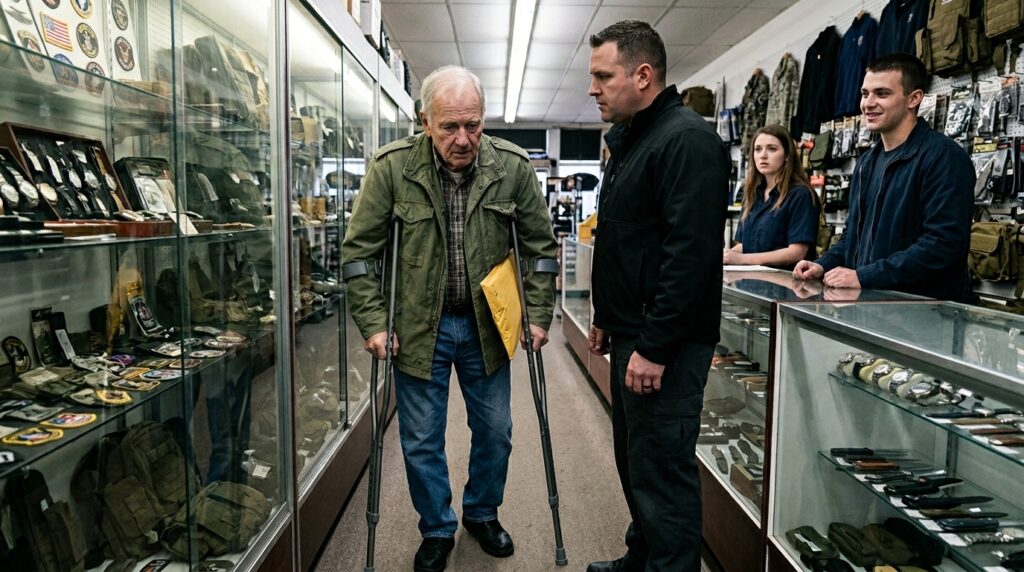
Arthur didn’t listen to the back-and-forth. His focus was fixed on the floorboards beneath the heavy oak desk at the back of the counter. The wood there was different—older, wide-plank pine that had never been covered by the corporate linoleum. It was stained dark with old machine oil and the salt of thirty winters’ worth of boot-tracks. He leaned his weight forward onto his right crutch, using the bare metal tip of the left to tap a hollow square in the flooring. The clack was dead, resonant, lacking the solid thud of the joists.
“Move the desk,” Arthur said.
The guard hesitated, his tongue running over his teeth as he calculated the risk. Then, with a low grunt that sounded like gravel grinding in a concrete mixer, he shoved his shoulder against the oak frame. The old desk shrieked as its cast-iron rollers dragged across the pine, exposing an iron ring bolt countersunk into a heavy metal plate. The plate was encrusted with a red-brown skin of rust that flaked off in scabs under the pressure of Arthur’s crutch.
Janie dropped to her knees, ignoring the grime that blackened the knees of her jeans. She jammed the green-encrusted key into the small keyhole beside the ring bolt. It didn’t turn at first. She had to use both hands, her silver lip ring catching the glare of the fluorescent tubes as she strained against the frozen tumblers. With a dull, wet pop, the internal mechanism sheared through decades of dust.
“Help me lift it,” she said, looking up at the guard.
The guard looked toward the front door one last time, then reached down and wrapped his thick fingers around the iron ring. Together, they pulled. The square section of the floor came up with the heavy, stubborn weight of a cellar door, releasing a draft of cold, dead air that smelled of damp limestone, sulfur, and rotten paper.
Inside the shallow pit sat a small, square safe made of riveted boilerplate iron. Its combination dial was brass, greened with age, its numbers nearly illegible beneath a film of dried tallow. But it wasn’t the combination lock they needed; the key override Janie held clicked into a secondary barrel at the base of the dial.
Arthur leaned over the opening, his breath coming short and ragged. The field jacket hung loose around his shoulders, the yellow envelope still gripped tightly under his arm like a shield. “Open it,” he whispered.
The door of the safe didn’t swing; it slid sideways on a pair of iron tracks that groaned under the accumulation of rust. Inside lay three ledgers with canvas covers, their bindings rotted into loose strings, and a single, heavy steel lockbox painted the same olive-drab as Arthur’s old field jacket.
Janie reached in, her fingers coming away gray with graphite dust, and pulled out the top ledger. The paper inside was thick, blue-lined, filled with the cramped, precise handwriting of Miller, the store’s founder. The entries from the early nineteen-seventies didn’t list boots or knives. They listed serial numbers—hundreds of them—stamped with the same legal-cap format as the foreclosure notice currently sitting on the display case above.
“This isn’t a retail inventory,” Janie murmured, her finger trailing down a column of dates that matched the winter of Arthur’s deployment. “These are ordnance receipts. Heavy mortar shells. Demolition charges. All marked as SURPLUS – DEFECTIVE – RETURNED TO DEPOT.”
Arthur’s hand went out, his fingers trembling so hard they struck the steel box inside the safe with a sharp ping. “He didn’t return them,” Arthur said, the realization hitting him like a physical blow to the sternum. He looked at the ledgers, then at the olive box. “He bought the scrap allocation from the depot. He sold the bad lots back to the division under a secondary contract to clear his own debt with the state.”
The guard leaned in, his face going gray as he stared at the handwriting. His eyes fixed on a specific signature at the bottom of the page—the officer who had certified that the ammunition was safe for field use despite the depot rejection. The name typed below the line was Captain R. Miller.
“The nephew didn’t buy this place from a stranger,” the guard said, his voice flat, completely stripped of its professional veneer. He looked at Arthur, the weight of a different kind of shame settling into the lines around his eyes. “The family didn’t just inherit the store. They inherited the money from the contract that put those short shells in your mortar pits.”
Arthur didn’t answer. He reached down and flipped the latch on the olive lockbox. Inside was no hidden cash, no secret treasury. There was only a second copy of the foreclosure notice, dated three weeks ago, addressed directly to the Miller Estate from the same asset management firm that was taking Arthur’s cabin. Attached to it was a private letter, signed by the nephew, offering the store’s historical land registry as collateral to protect the family’s city holdings.
The decoy was clear now: the nephew wasn’t running a modern business; he was liquidating the evidence of an old crime to save his own skin, and Arthur’s home was simply the first piece of perimeter brush being cleared to bury the trail.
Before Janie could speak, the front bell chimed. It wasn’t the light ring of a customer entering. The glass door was thrown back so hard it struck the concrete wall outside with a dull thud, and a sharp, high-pitched voice echoed down the main aisle.
“Janie? Gary? Why the hell is the register lane closed on a Saturday afternoon?”








