
CHAPTER 2: LAYERS OF OXIDE
“They didn’t do anything to them,” Arthur said. The words came out thin, scraping against the dry roof of his mouth like sand over iron. “The army did.”
The guard didn’t move, but his weight shifted. The heavy black leather of his boots groaned against the linoleum, a dull, compressed sound. His eyes stayed fixed on the paper—the sharp, violet ink of the REMOVED BY ORDER stamp that looked indecently bright against the yellowed, water-stained parchment of the death certificates. The text underneath the ink was faint, typed on an old manual ribbon that had been striking dry for years.
“Sir,” the guard said, his voice dropping an octave, losing the flat, retail authority he had used moments before. He looked around the aisle, his gaze lingering on the kid in the track jacket, who had finally lowered his phone. The kid’s face had gone slack, his mouth slightly open, the bored malice draining out of him to leave only the blank confusion of the uninitiated. “Sir, we can’t have these out on the glass. It’s… we have a policy about handling unverified documents over the counter.”
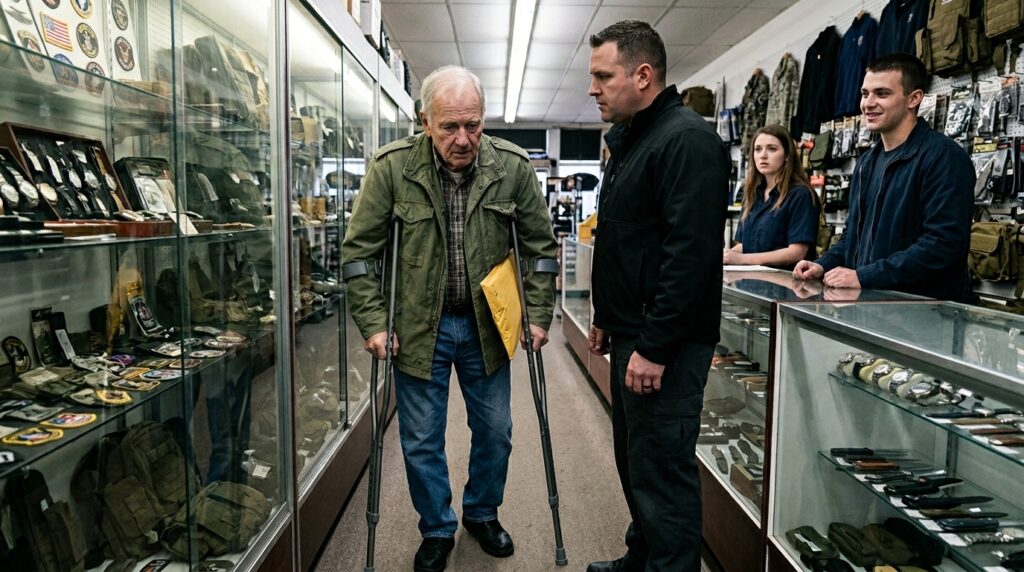
“They’re verified,” Arthur said. He leaned heavily onto the right crutch, the metal tube flexing slightly under his jacket. He used his left hand, the skin stretched thin over blue, winding veins, to slide one of the bronze stars an inch closer to the guard. The medal made a dry, hollow clink against the scratched glass casing. “That’s the Silver Star. That one belonged to Miller. Not the nephew. The uncle. The one who built the brick mortar on this place before the county put the bypass through.”
The clerk behind the counter didn’t look at the medal; she was looking at Arthur’s hands. She saw the gray grime under his fingernails—not from neglect, but from the fine, greasy dust of an old engine block, the kind of dirt that takes three days of scrubbing to dislodge from the creases of the skin.
“My grandfather had one of those,” she said softly. Her voice was too light for the room, cutting through the smell of Cosmoline and dry-rotting canvas. “In a cedar box in the attic. It didn’t look like that, though. It didn’t have the black border on the paper.”
“Your grandfather was probably in a unit they counted,” Arthur said. He didn’t mean it as an insult, and his voice carried no heat, only the flat, pragmatic weight of a man stating the price of timber. “The Seventy-Second didn’t get a box. They got the stamp.”
The guard took a slow breath, his chest expanding against his uniform. He reached down to his belt, his thumb hovering over the plastic clip of his radio, then stopped. The instinct to clear the aisle was still there—the rigid, corporate metric that demanded thirty-inch clearance for retail carts—but it was twisting against something older, something rusted and heavy in his own gut.
“Look,” the guard muttered, his voice dropping further, almost transactional now. “The office tracks the time these aisles are blocked. If the regional camera sees a crowd forming by the knives, I get a write-up. We can move this to the back breakroom. You can sit down.”
“I don’t need to sit,” Arthur said.
He reached into the yellow envelope again. His fingers missed the medals this time, sliding past the cold bronze to the stiff cardboard liner underneath. When he pulled his hand back out, he wasn’t holding another piece of military brass. He held a folded sheet of legal-cap paper, its edges crisp and white, completely free of the dust that coated the rest of his life. It was a three-page document, the top header bearing the name of a private asset management firm based out of the state capital.
The guard glanced down, his eyes scanning the bold, block letters at the top: NOTICE OF FORECLOSURE AND IMMEDIATE VACATE ORDER.
“I don’t have forty-eight hours,” Arthur said, his voice level, eyes locked on the guard’s silver nameplate. “The county sold the tax lien on the cabin to a firm that puts up data centers. They don’t care about the Seventy-Second either. But I aren’t leaving the papers in the wood-box for the bulldozers to chew up.”
The clerk leaned over the counter until her shirt-front brushed the glass. “Is that why you brought them here? To sell them?”
“No,” Arthur said. He looked at the long row of replica knives beneath his crutch—cheap stainless steel made in overseas foundries, stamped with fake digital camouflage patterns to look modern. “You don’t sell things that don’t exist on the ledger. You find someone who knows the names. I thought Miller’s place… I thought there’d be an old logbook. Something with his signature from the depot.”
The kid in the track jacket let out a short, dry sound—not a laugh, but a nervous clearing of his throat. He took two steps backward, his sneakers squeaking against the linoleum, before turning and walking quickly toward the front doors, the bell above the frame chiming twice as he pushed into the heat outside.
The guard didn’t watch him go. He was looking at the purple stamp on the death certificate again. His brow furrowed, his thumb finally dropping away from his radio. “My dad was ninety-two when he passed,” the guard said, his voice bare, stripped of the security-chief persona. “He had an old sea-bag in the garage. Had names written on the inside of the canvas in indelible pencil. Some of ’em were crossed out just like this. He never would tell me why.”
“They cross ’em out when the story changes,” Arthur said. He began to gather the medals back up, his rough fingers clumsy against the silk ribbons. “When the colonel writes the report and realized the mortars were set five hundred yards short of the ridge. You don’t leave the names on the list when the names died from your own steel.”
The clerk reached out, her small, pale hand crossing the boundary of the counter, her fingers resting lightly on the edge of the white foreclosure notice. “Wait,” she said, her voice tightening as she looked toward the back office door behind her. “Don’t put them away yet. There’s… there’s something in the old inventory files from the seventies. Before the nephew bought the digital system. My dad used to say the old man kept a second set of books in the iron safe under the floorboards.”
Arthur stopped his hand, his thumb resting on the cold rim of the third Star. The room seemed to grow smaller, the smell of old iron and dry floorboards sharpening between them.
“The safe?” the guard asked, his head turning sharply toward the girl. “That’s company property, Janie. We don’t have the combination for that. The corporate office in the city keeps the codes.”
“The corporate office doesn’t know about the floorboards,” Janie said, her voice hard with a sudden, pragmatic resolve. She looked at Arthur, her ringed lip pulling tight. “But I know where the key-override is hidden behind the fuse box.”








