
CHAPTER 6: THE SUBTERRANEAN BASELINE
The truck’s brakes groaned, a long metal-on-metal squeal that died the moment the rear bumper cleared the overgrown privet hedge blocking the cul-de-sac’s view. John didn’t kill the engine. He let the V8 idle, its rough vibration keeping the transponder signal pinned to a static location while he dropped out of the high cab, his boots sinking two inches into the sun-baked dust of the side yard.
The white utility van was already at the mouth of the cul-de-sac, its tires crunching onto the asphalt header, its headlights unlit but its chassis leveled by heavy payload springs. They were setting the cordon. He had precisely four minutes before the secondary vehicle closed the southern lane behind the wood-framed garage.
John didn’t go through the front door. He moved to the rear porch where the foundation concrete was exposed—a low, desaturated slab pockmarked by the aggregate he had mixed himself under the winter rain of 2019. The access hatch was hidden behind a rusted iron wood-box. He kicked the frame aside, the dry pine boards splitting with a loud snap, and reached into the dark cavity of the crawlspace.
The air inside smelled of damp lime and old lime-wash, cold and entirely insulated from the three-digit heat of the suburban afternoon. He slid in headfirst, his shoulder blades scraping the rough joists of the kitchen floor overhead. The linoleum above him gave a slight, familiar groan as the weight of his old home settled into his spine.
“Three blocks down,” he muttered, counting the pillars by touch.
His fingers, slick with grease from the truck latch, found the corner of the fourth structural support. It looked like solid poured masonry, but when his knuckles tapped the center, the sound wasn’t the flat thud of granite; it had the faint, hollow ring of reinforced plate.
The lock cylinder was a corroded zinc plug countersunk into the mortar joint. It had been salvaged from a scrap yard in a naval shipyard three hundred miles away, its internal pins worn down until they required a specific, double-turn sequence that only a heavy, notched brass key could actuate. John didn’t use a key. He pulled a short, four-inch length of hexagonal steel rod from his dark jeans pocket—the ground-down remnant of a structural bolt—and jammed it into the keyway.
He twisted with his whole wrist, his knuckles scraping the jagged edge of the concrete block until the skin split, leaving a dark, wet smear across the lime-wash. The cylinder gave—a heavy, rusted click that echoed through the narrow crawlspace like a pistol shot.
The front face of the block swung inward on an internal sleeve hinge. Inside the dry cavity sat a olive-drab transit case, its fiberglass skin scarred by old salt-water pitting and the black stencil of a logistics task force that had been officially disbanded before the turn of the decade. The latch mechanism was covered by a layer of yellowed cosmoline that smelled of heavy mineral oil and dead mechanics.
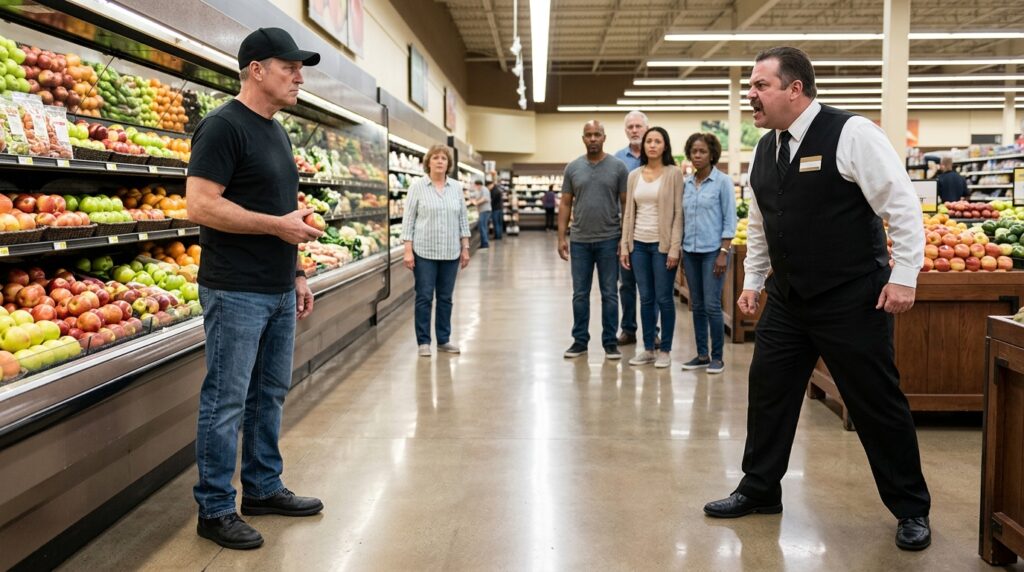
John dragged the box into the dirt between his knees. His breath was shallow now, his ribs aching from the compact strikes he had taken in Aisle 4. Overhead, the floorboards gave a sudden, sharp creak—not the natural expansion of wood under the heat, but the distinct, rhythmic press of a heavy boot crossing the kitchen threshold directly above his head.
They were inside the perimeter. The gray-jacketed man hadn’t waited for the legal waiver or the transit units; they had initiated the clearing protocol the moment his truck’s tires stopped rotating in the yard.
He popped the case’s primary latches. The fiberglass lid came away with a dry suction pop, exposing the grey foam lining. Inside lay a short-barreled carbine, its receiver finished in a matte gray parkerization that lacked any manufacturer markings or commercial serial numbers, and three aluminum magazines bound together by faded green sniper tape.
Beneath the weapon’s barrel, tucked into a small recess in the lower foam tier, sat a secondary object: a small, silver-plated data drive with a cracked glass display. The drive was active, its tiny red LED indicator blinking three times every six seconds—a self-contained transponder that was drawing power from an internal lithium cell that should have died five years ago.
John didn’t pick up the gun first. He reached for the drive, his thumb rubbing the cracked glass until the small digital manifest appeared through the dust. It wasn’t his service record. It was an active tracking manifest showing forty-seven identical profiles across seven suburban counties—all of them former members of the same naval task force, all of them currently flagged by Vanguard Logistics as inventory items scheduled for structural liquidation before the end of the fiscal quarter.
The store manager hadn’t been the hunter. He had been the sensor. And the file wasn’t an audit; it was a harvest log.
Overhead, the footsteps stopped directly above the foundation vault, followed by the dull, metallic click of a nine-millimeter slide chambering a round.








