
CHAPTER 2: THE BACKROOM AUDIT
“Pick up the lemons, Miller.”
The voice came from the threshold of the employee-only corridor, flat and scrubbed of any regional accent. The man standing there wore a gray utility jacket that lacked a store logo but had the reinforced stitching of an executive protection detail. His skin was the color of skim milk, his fingers long and grease-free as he held open the swinging stainless-steel door.
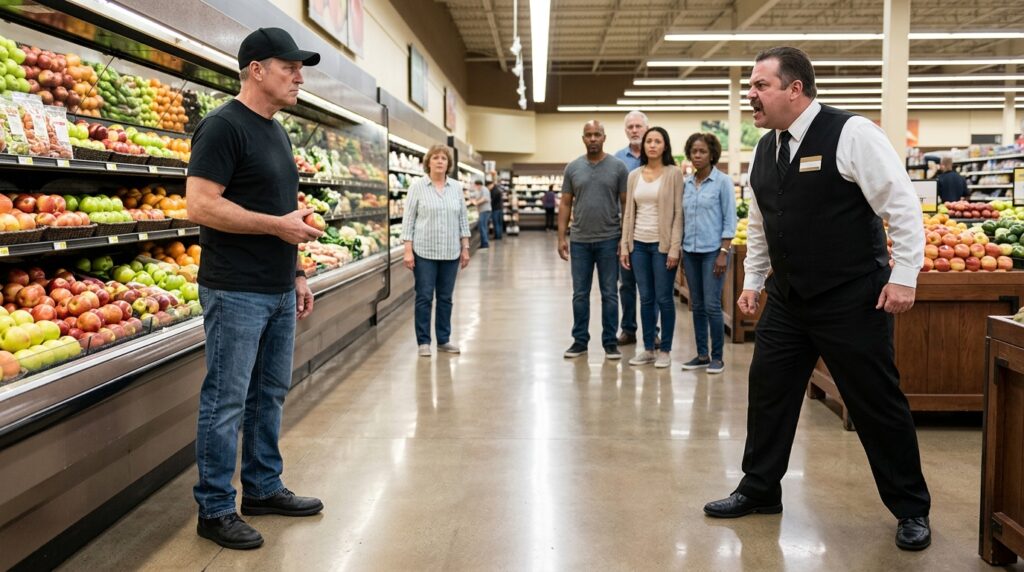
John didn’t move from the center of Aisle 4. His boots remained planted in the grit, his center of gravity low, his eyes tracking the new arrival while keeping Miller—the manager—within his lower peripheral vision. Miller was still groaning against the baseboard, his hand clutching his ribs where John’s two compact strikes had turned the white polyester fabric into a bruised, wrinkled mess.
“I said pick them up,” the man in gray repeated, his eyes not once shifting toward John. He was looking exclusively at Miller’s broken form. “The corporate audit requires a clean floor state before the county transit units arrive. You know the metrics.”
Miller scrambled up with a wet gasp, his face a mottled plum color. He didn’t look at John either. The arrogance that had fueled his stride three minutes ago had vanished, replaced by a frantic, submissive haste that looked far more dangerous than his initial anger. He began grabbing the rolling lemons, his thick fingers shaking as he stuffed them back into the green plastic racks. As he bent over, a heavy, rubber-armored tablet shifted within the internal pocket of his black vest. It didn’t look like an inventory scanner; it was twice as thick, its screen dead-black but vibrating with the dull, persistent pulse of an encrypted data sync.
John watched the vibration through the frayed fabric of Miller’s vest pocket. “Who’s the transit unit?” John asked. His voice was low, the tone raspy from years of salt air and deliberate silence.
The man in gray finally looked at John. His eyes were small, pale, and entirely devoid of curiosity. “Loss prevention. We handle asset discrepancies within the suburban franchise sectors. You’ve exceeded your standard dwell time in this lane, sir. We need to clear the log.”
“The woman at the end of the aisle,” John said, his chin tilting toward the shopper with the smartphone. “She’s still recording.”
“She isn’t,” the gray-jacketed man said simply.
John looked past his shoulder. A second store employee, younger and wearing a blue utility apron, was already standing over the woman with the cart. He wasn’t reaching for her phone. He was holding a small, matte-black diagnostic wand—the kind used to test automated checkout frequencies—six inches from her purse. The screen of the woman’s phone flickered once, the green recording dot twisting into a gray line before the display died completely, leaving her staring at a blank sheet of Gorilla Glass with a look of confused, soft-jawed helplessness.
“Data scrub,” John muttered, his fingers tightening against the seams of his dark jeans. “That’s not retail policy.”
“Local compliance is changing,” the man in gray said, stepping forward until he was three feet from the split Gala apple John had dropped. He reached down, picked up the rusted half with two fingers, and tossed it into a gray waste bin attached to his belt. “Mr. Miller here has a tendency to over-correct when he encounters non-standard profiles in the aisles. But his instructions were clear. Create a disturbance, document the structural resistance, and clear the lane for the regional contract transition. You provided the resistance.”
Miller was on his feet now, his breath whistling through his nose, his hand pressed firmly against the heavy tablet vibrating in his vest. He looked like an animal that had successfully completed a trick but hadn’t been fed yet. “He attacked me,” Miller wheezed, his mustache twitching toward the gray-jacketed man. “I gave the verbal warning. It’s on the regional manifest. I told him to move.”
“You did your job, Miller. Go to the security cage and upload the incident log from the local unit,” the man in gray replied. His hand slipped into his own pocket, his knuckles forming a sharp angle under the fabric. “Sir, if you’ll follow me to the administrative office. We have a corporate release form that requires a physical signature before you leave the premises. It saves the county sheriff the trouble of an off-site filing.”
John didn’t answer. He looked at the floor between them—the gray concrete, the small white lines where the salt had dried into crusts, the broken plastic teeth of Miller’s name badge. Every instinct he had spent fifteen years burying was screaming that the gray jacket wasn’t local security. The man’s stance was too balanced, his weight distributed perfectly across his heels, his fingers positioned too close to his hip pocket where the outline of a compact nine-millimeter frame was visible only to someone who spent half a lifetime carrying one.
“I don’t sign corporate paper,” John said.
“This paper isn’t corporate, John,” the man said softly, using the name before John had ever produced an ID or spoken to anyone in the town. “It’s institutional. And the office is cooler than this aisle.”
John’s eyes locked onto the gray jacket’s collar. There was a small, three-digit number stamped onto the internal lining where the fabric had begun to fray from use—a contract identifier from a defense logistics firm that hadn’t existed on public record since the winter of 2018.








