
CHAPTER 10: THE ROOT COMPLIANCE
The corrugated iron intake pipe didn’t widen; it terminated at a heavy, bolted cast-iron sump flange directly beneath the supermarket’s northern freight lift. John didn’t waste time on the bolts. He drove theGrounding steel bar between the iron rim and the wet masonry of the shaft wall, throwing his shoulder into the lever until the rusted seal cracked with a wet, flat pop that smelled of sour milk and old cardboard pulp.
He hauled himself up into the grease-filmed dark of the elevator pit. Above him, through the gaps in the steel safety mesh, the dull, rhythmic thrum of the store’s primary electrical transformers rattled his teeth. The air was thick, suffocatingly hot, and saturated with the ozone sting of overloaded server stacks.
The countdown terminal in his pocket gave one long, continuous vibration that died instantly. Zero.
The screen didn’t go dark. It transitioned to a solid, desaturated white display with a single line of black text pulsing across the top: Sync Intercept Complete. Regional Ledger Locked.
John pulled himself through the trapdoor of the administrative floor, his boots leaving dark, oily streaks across the pristine gray linoleum of the back corridor. He was directly behind the security cage—a narrow, floor-to-ceiling vault enclosed by heavy wire mesh and locked behind a corporate security keypad. Inside, three columns of industrial processing blades were humming, their cooling fans exhausting a steady blast of parched, metallic air toward the low ceiling.
Miller wasn’t there. The office was empty, but a half-filled paper cup of cold chicory coffee sat on the edge of the desk, its surface skin wrinkling under the steady draft from the servers.
John walked to the primary terminal rack at the end of the aisle. He didn’t check the diagnostic screen; his eyes locked onto a physical, recessed cavity hidden behind the main circuit breaker box—a small, solid iron wall-safe that predated the store’s modern corporate renovation. The safe’s door was finished in a rough, desaturated zinc plating, its center stamped with the original, raised insignia of his defunct naval task force.
It wasn’t a standard corporate infrastructure node. The privatized defense firm hadn’t just built a data network over the town; they had repurposed his old unit’s forward tactical staging vault—the subterranean communications depot that had been buried beneath the regional logistics hub before the suburb was ever gridded out.
“The store was the cover,” John whispered, his hand catching the cold edge of the zinc door.
He jammed the silver-plated data drive into the safe’s secondary maintenance interface. The small red LED didn’t blink three times; it went solid, the cracked glass screen turning dark as the internal lithium cell finally discharged its final reserve into the store’s terminal architecture.
On the main processing rack, the columns of amber lights didn’t flicker; they dropped instantly to a dead, unblinking gray. The rhythmic hum of the cooling fans died with a long, wheezing rattle that left the back corridor entirely silent under the glare of the unshielded fluorescent tubes.
Through the glass panel of the rear security door, the parking lot was visible—a flat, desaturated sheet of asphalt under the late afternoon sun. The white utility van was still idling by the drainage canal, its hazards flashing, but the secondary transit carrier had stopped fifty feet from the curb, its pneumatic brake lines hissing as the automated network dropped the vehicle’s transmission into emergency lockdown mode.
The local ledger was dead. The three hundred and twelve profiles on the harvest manifest wouldn’t sync to the central directory; the unredacted files had been overwritten by the task force’s original, hard-coded decommissioning sequence—the digital self-destruction protocol he had carried in his crawlspace for six years.
John didn’t wait for the gray-jacketed man to clear the fence. He turned away from the dead servers, his fingers releasing the warm plastic grip of the matte-gray carbine, letting the weapon drop onto the linoleum with a heavy, metallic clink that echoed down the empty corridor. He adjusted the brim of his black cap, his boots slow and deliberate as he walked past the silent self-checkout lanes toward the front glass doors.
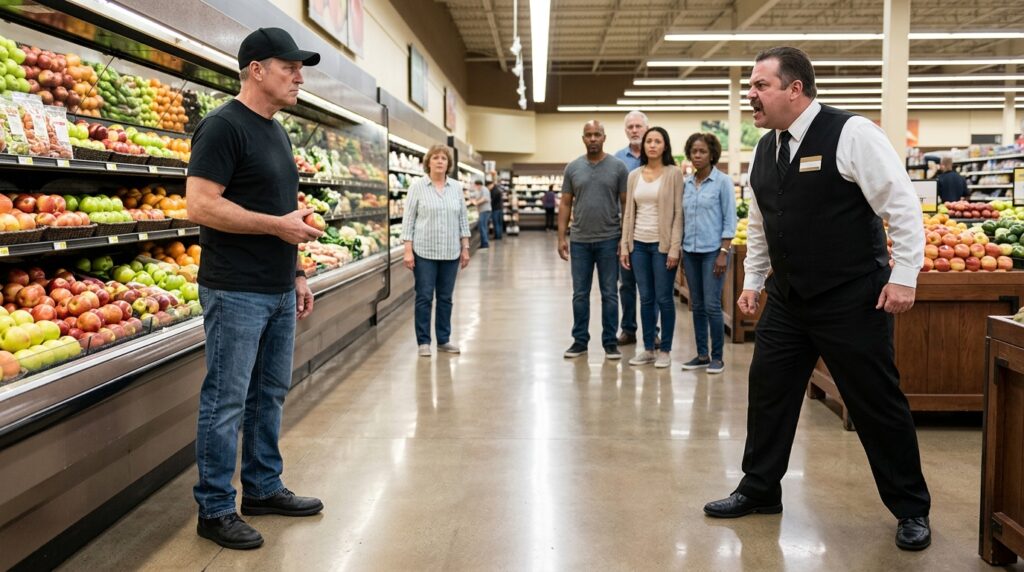
The produce aisle was still empty, the split Gala apple still sitting in the gray waste bin near the cooler wall, but the silence hanging over the lanes no longer felt like a containment vessel. It was just the ordinary, heavy stillness of a small town grocery store at five o’clock on a Wednesday afternoon.
John pushed through the automated doors, his face tightening as his skin hit the dry, natural heat of the exterior sidewalk. He didn’t look at the white van or the frozen transit carrier. He walked toward his truck, his strides steady, his mind entirely clear of the ledger as he reached into his pocket for his keys.








