
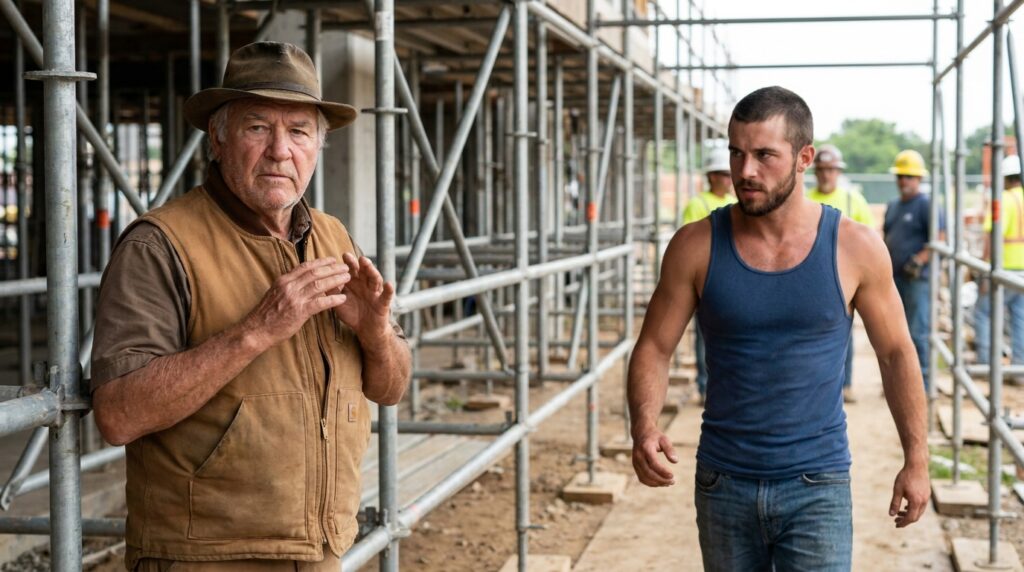
CHAPTER 6: THE BLOCKADE
The first raindrop hit the hood of Henderson’s truck with the sound of a spent casing hitting concrete. Within seconds, the gray heartland sky opened up, turning the dry dust of the industrial lot into a slick, treacherous slurry. Miller didn’t hesitate. He slammed the truck into reverse, the transmission screaming in protest as he swung the heavy steel bumper across the only entrance to the records lot.
The tires churned into the mud, biting deep until the truck sat at a forty-five-degree angle, a three-ton barricade of rusted American iron.
“What are you doing?” Henderson yelled, his voice cracking as the first flash of a strobe light cut through the downpour. “That’s a private security detail, Miller. They’ll have local jurisdiction authority. You can’t just block the road!”
“I’m not blocking a road,” Miller said, his hands moving with surgical economy as he cut the lights but left the engine thrumming. “I’m securing a perimeter.”
He reached into the footwell and grabbed the heavy iron spud wrench he’d used to pry the cabinets. He didn’t tuck it away; he held it across his lap, the cold metal a familiar weight. Through the windshield, blurred by the frantic rhythm of the wipers, three black SUVs crested the rise of the access road. They didn’t have the markings of the county sheriff. There were no light bars on the roofs—only high-intensity LEDs mounted behind the grilles, pulsing in a rhythmic, predatory white.
The lead vehicle skidded to a halt inches from the driver’s side door of Miller’s truck. The headlights were blinding, turning the interior of the cabin into a cage of harsh white light and deep, jagged shadows. Miller squinted, his weathered face set in a mask of indifferent granite.
A man stepped out of the lead SUV. He wasn’t wearing a uniform. He wore a high-end technical jacket, dark and water-resistant, and held a tablet shielded by a plastic sleeve. He didn’t look like a guard; he looked like an auditor with an enforcement budget.
“Mr. Miller!” the man shouted over the roar of the rain and the diesel idle. “You are in possession of proprietary corporate data. That trailer is under a legal hold. Step out of the vehicle and hand over the Phoenix folder.”
Miller rolled the window down exactly two inches. The scent of wet asphalt and hot engine oil flooded the cab. “The folder stays with the overseer. This site is under a structural emergency. Until a federal inspector arrives to verify the shear-points on the utility wing, no property leaves this lot. Especially not the evidence.”
“You don’t have the authority to declare an emergency, Miller,” the man said, taking a step closer. Behind him, two more men stepped out of the secondary vehicles. They didn’t draw weapons, but their posture was a “Calculated Silence”—hands hovering near their belts, eyes scanning the truck’s glass for points of entry. “Your contract was terminated sixty seconds ago for gross insubordination and site sabotage. You’re a civilian on a restricted lot. Last warning.”
Miller looked at the man, then at the two figures flanking him. He noticed the way the lead auditor kept glancing at the regional union master key still hanging from the truck’s ignition. It wasn’t the files they were most afraid of—it was the fact that Miller had the key that unlocked the rest of the institutional rot.
“I’ve spent forty years listening to men tell me about authority,” Miller said, his gravelly voice vibrating against the glass. “Usually, they’re the ones who don’t know how to hold a level. If you want this folder, you’re going to have to find a way to move three tons of truck with those tech-jackets. Because I’m not moving, and the truth isn’t for sale.”
He rolled the window up.
“Miller, they’re going to break the glass,” Henderson whispered, shrinking into the passenger seat.
“Let them,” Miller replied, his eyes fixed on the lead SUV. “They’re calculating the liability of an assault. As long as I’m in this truck, I’m a structural obstacle. They hate obstacles they can’t fix with a spreadsheet.”
But then, the lead auditor’s tablet chimed. He looked down, his face paling under the strobe lights. He looked back at Miller, but this time there was no professional coldness. There was a flicker of genuine, predatory malice. He leaned toward the window, speaking loud enough for the glass to vibrate.
“Change of plans, Miller. We don’t need the folder. The Regional Office just authorized a ‘Controlled Demolition’ of the utility wing due to the ‘imminent public danger’ of your sabotage. The concrete trucks are being diverted to fill the records basement. By dawn, your evidence—and your reputation—will be under six feet of slurry.”
Miller’s grip tightened on the iron wrench. The friction of the night had just shifted from a defensive hold to a full-scale war of erasure. They weren’t going to fight him for the truth; they were going to bury it.








