
CHAPTER 3: THE PARADOX OF PRESSURE
The unbranded bolt sat heavy in Miller’s palm, its leaden thud still echoing in his ears. Outside the open doors of the supply trailer, the night had fully descended, thick and gray, smelling of ozone and the damp silt from the nearby riverbanks. The suburban streetlights on the horizon cast long, skeletal shadows across the raw concrete slab of the unfinished ground floor.
Miller did not drop the counterfeit fastener. He moved deeper into the trailer, his dirt-caked leather work boots grinding the loose grit on the floor. His hands, thickened by decades of handling heavy metal and military equipment, traced the rough edge of a laminated safety clipboard hanging from a rusted iron nail near the back wall. This was the inspector’s secondary verification station—the quiet corner where paperwork came to die.
He flipped the plastic sheet up. Underneath lay the master ledger, its pages yellowed by the humidity of the trailer. The signature column was already filled out for the three weeks ahead, signed in a loose, looping hand that didn’t belong to any inspector Miller had ever met. It belonged to Henderson, the subcontractor who had brought Garrity and Vance onto the job site. Next to each pre-signed entry, the torque requirements for the structural connections were marked as verified at nine hundred foot-pounds.
Miller took a single, deep breath through his nose. His knuckles went white against the clipboard. A Grade-8 structural bolt tightened to nine hundred foot-pounds would hold a suspension bridge in a gale. But a cast-iron imitation, subjected to that kind of tension, wouldn’t just fail. It would warp, micro-fracturing along the threads until the metal reached its yield point. The structural three-degree variance he had measured earlier wasn’t a matter of lazy craftsmanship or poor alignment. The building was already under pre-stressed duress, the columns held together by metal that was slowly turning to glass.
He heard the gravel crunch outside before his ears registered the sound of an engine.
It was a low, industrial idle—the heavy, rhythmic thrum of an eight-cylinder diesel truck pulling up to the perimeter fencing. Headlights swept through the open double doors of the trailer, cutting across the unbranded plywood crates, painting the rusted iron interiors in a harsh, blinding white. Miller didn’t run. He pocketed the counterfeit bolt, dropped the laminated safety log back against the wall, and stepped into the shadow of the doorframe, his stocky frame blending with the vertical silhouette of the trailer’s iron rim.
The truck door slammed shut with a sharp, metallic ring that carried across the empty job site.
“Garrity?” The voice was thick, seasoned by cheap tobacco and decades of yelling over air compressors. Henderson. The subcontractor walked with a heavy, uneven stride, his boots slapping the wet earth as he approached the stack of wood pallets where the physical confrontation had occurred twenty minutes earlier. “Vance? Where the hell are you boys?”
Miller stepped out of the trailer’s shadow, his open hands hanging casual at his thighs, his posture anchored deep into the dirt. “They’re gone, Henderson.”
The subcontractor froze. He was a broad man, his canvas coat stained with grease and hydraulic fluid, his face mostly hidden beneath a greasy baseball cap. He looked at the empty spaces between the pallets, then down at the dirt where the drilling hammer still lay where it had fallen. His hand dropped instinctively to the heavy leather pouch on his hip, where a structural spud wrench hung from an iron loop.
“Miller,” Henderson said, his voice dropping an octave, the tone transactional and sharp. “What are you doing in my trailer?”
“Checking the plumb,” Miller said, his voice a flat, gravelly rasp that didn’t rise or fall. “And checking your inventory. The foundry manifest says we received two hundred crates of certified A325 structural steel from the Illinois plant last Tuesday. The crates in that trailer are unbranded pine. The bolts inside are pot metal with stamped heads.”
Henderson took two slow steps forward, his boots crushing a piece of discarded drywall with a dry, hollow crunch. The headlights from his truck caught the side of his face, highlighting the hard line of his jaw. “You’re an overseer, old man. Your job is to make sure the guys wear their hardhats and the timecards match the union clock. The steel isn’t your department.”
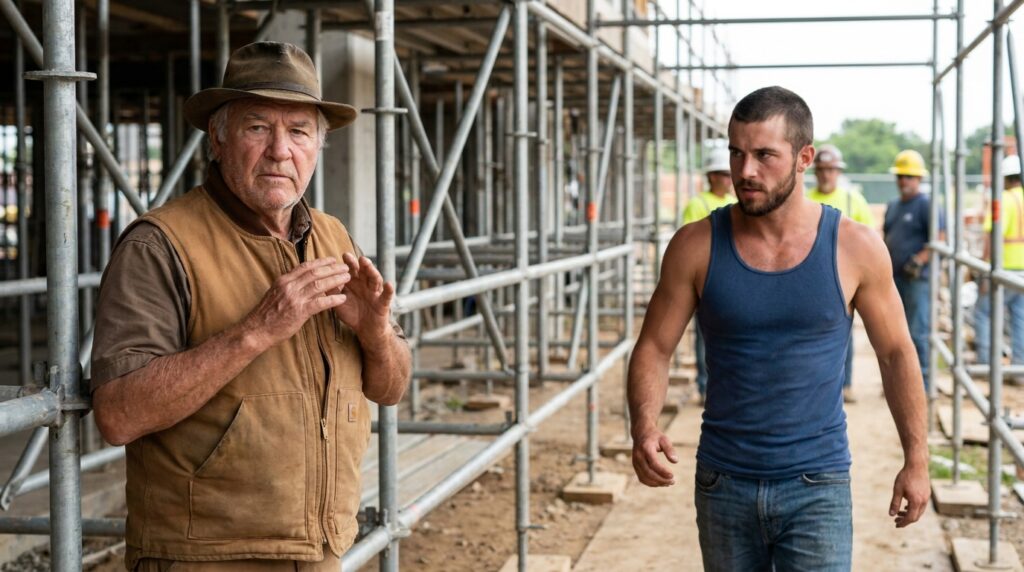
“When the iron leans three degrees before the floor joists are even set, it’s my department,” Miller said. He stepped forward, entering the light, his brown utility vest catching the glare. “You’re over-torquing them to hide the shearing. You’re trying to get the concrete poured over the footings before the county inspector looks at the stamps. Why?”
Henderson didn’t monologue. He didn’t bluster or threaten like his nephew had. He simply looked at Miller with a cold, calculating evaluation, checking the older man’s stance, measuring the distance between them. He was a professional, and he recognized the structural efficiency of the way Miller stood—how his weight was distributed, how his hands never crossed his center line.
“The build is bonded, Miller,” Henderson said softly. “The money is already in the escrow account. If we miss the concrete window tomorrow morning, the contract defaults back to the parent firm, and the local chapter loses the allocation for the entire winter cycle. My boys don’t eat if that concrete doesn’t pour.”
“Your boys are going to bury people under five hundred tons of structural failure if that concrete does pour,” Miller countered.
“Nobody’s burying anybody,” Henderson said. He reached down and unhooked the heavy iron wrench from his hip, the tool swinging with a dull, heavy momentum in his gloved fingers. “We’re going to sign that log, Miller. You and me. Right now. Because if we don’t, the company declares insolvency by midnight, and your retirement fund—the one you spent forty years building with the master trades—disappears into the bankruptcy court to pay off the liquidators.”
Miller stayed perfectly still. The information hit him not as a shock, but as a sudden, brutal alignment of pieces. The decoy was the cheap steel—the easy assumption that a corrupt subcontractor was pocketing the difference on materials. But Henderson’s mention of the bankruptcy court, of the timing of the default, pointed to a much larger machine.
“You think you’re saving the local allocation,” Miller said, his voice low, his gray eyes narrowing as he watched Henderson’s hand tighten on the iron wrench. “But you’re just the guy cleaning up the grease before the fire starts.”
“I’m the guy getting paid,” Henderson said. He raised the wrench, his shoulder dipping as he prepared to close the distance.
Miller’s internal calculation completed itself in a fraction of a second. He was sixty percent through the remaining structural lifetime of this project, and the path back to a clean build was completely blocked. Every win from this point forward would carry a cost that couldn’t be paid in sweat alone.








