
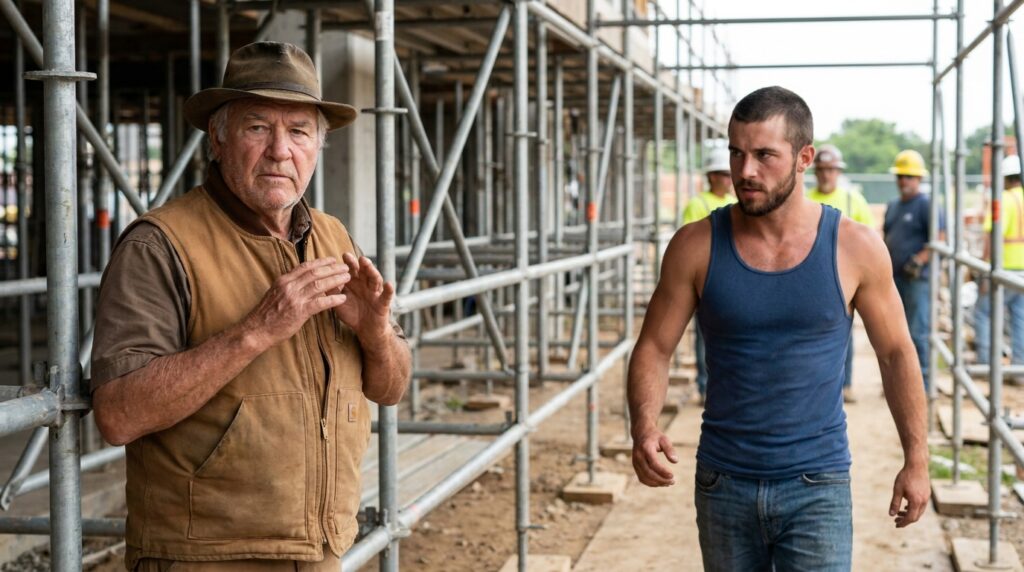
CHAPTER 4: THE INERTIA OF COLLAPSE
The heavy iron wrench swung with a low, flat whistle. It didn’t have the clean speed of a blade, but it carried the killing weight of solid forge-work. Miller didn’t try to catch it. He didn’t drop into a stance that suggested he had something to prove. He simply let the friction of his heavy leather soles do the work, pivoting back by two inches—just enough for the rusted tip of the tool to graze the stiff canvas of his utility vest.
The momentum pulled Henderson forward, his balance tilting into the empty air between them. Miller’s counter was instantaneous, driven by decades of muscle memory that bypassed his active mind entirely. He stepped inside the circle of the swing, using his stocky forearm to jam Henderson’s wrist before the subcontractor could recover his center. The impact was dull, a heavy collision of flesh and bone wrapped in work clothes.
“You’re rushing the work, Henderson,” Miller said, his gravelly voice dropping right into the space next to Henderson’s ear.
With a smooth, economical wrench of his upper body, Miller didn’t throw a punch; he simply driving the heel of his open palm into the crook of Henderson’s elbow while pulling down on the trapped wrist. The joint locked. The heavy tool slipped from Henderson’s leather glove, dropping into the dry earth with a heavy, dead thud. Miller followed through, utilizing the subcontractor’s own bulk to turn him, shoving him hard against the rusted side panel of the diesel truck.
The vehicle rocked slightly on its suspension, a low squeak from the undercarriage breaking the heavy silence of the job site. Henderson stayed against the metal, his breathing ragged, his hand clutching his elbow where the nerves were screaming. He didn’t try to swing again. He looked at Miller over his shoulder, his eyes wide with the sudden, cold realization that his physical leverage was non-existent.
“The log stays clean,” Miller said, his boots planted wide on the gravel, his hands returning to chest height in that same unhurried, professional guard. “And the pour doesn’t happen at 0600.”
“It’s already out of our hands, old man,” Henderson spat, wiping a smear of grease from his cheek with his sleeve. He pointed a trembling finger toward the truck’s open cabin. “Look at the routing manifest on the dash. Look at who signed the release order for the sub-grade. It isn’t my company. It’s the parent group’s logistics desk out of Chicago. They didn’t hire me to build this wing. They hired me to fail it.”
Miller kept his eyes locked on Henderson, but his mind reached into the cabin of the idling truck. The headlights were still cutting through the dark, reflecting off the raw plywood framing behind them, but the dashboard light illuminated a single sheet of blue carbon paper trapped under a plastic clip on the console.
He didn’t break focus. “You knew the steel was pot metal before you brought it on site.”
“I knew the price was thirty percent under market, and I knew the corporate office told me to use the supplier they specified or the contract would go to a non-union crew from the next county,” Henderson said, his voice rising in an aggressive, desperate whine. “They’re holding the pension guarantee over the local chapter’s head, Miller. If we don’t finish Layer 1 by the inspection date, they invoke the performance default. The whole fund goes to the insurance bondsmen to cover the delay penalties. It’s a closed loop.”
Miller felt the weight of the structure settle into his spine, not like a physical burden, but like a tactical trap that had been laid months before he ever walked onto the gravel. The discovery of the counterfeit bolts in the trailer was a decoy victory—a distraction that gave him the illusion of control. He had broken Henderson’s balance, neutralized his crew, and locked down the material logs, but the actual machinery of the collapse was entirely out of reach, buried deep within corporate ledgers three hundred miles away.
He stepped back from the truck, his boots crunching softly on the loose gravel. He reached into the open window of the vehicle and pulled the keys from the ignition barrel, cutting the low, rhythmic thrum of the engine. The sudden silence that dropped over the construction site was absolute, broken only by the distant, ironic whistle of the evening wind through the upper rows of unfinished scaffolding.
On the key ring, hanging next to the truck’s ignition fob, was a heavy brass master key stamped with the logo of the regional union administration office—the one that controlled the locking mechanisms for the main equipment vaults and the central records trailer down the road. It shouldn’t have been in Henderson’s possession.
“Where did you get this key, Henderson?” Miller asked, holding the brass implement up into the failing light.
Henderson didn’t answer. He just looked down at the dirt, his jaw clamped shut in the calculated silence of a man who knew he had already given away too much of the foundation.
“Get out of the truck,” Miller commanded softly. “We’re going to the office.”
Before Henderson could move, a sharp, deafening sound shattered the quiet from the eastern corner of the site. It wasn’t the sound of an engine or a voice. It was the dry, terrifying pop of high-tensile steel giving way under pre-stressed pressure—the initial shear of a foundational connection failure deep within the utility wing’s utility column. The structure was shifting early, the weight of the upper floor joists already winning the fight against the counterfeit metal.
The ground beneath their boots didn’t shake, but the silence that followed the snap was different now. It was the heavy, breathless suspension of a trap that had just begun to spring.








