
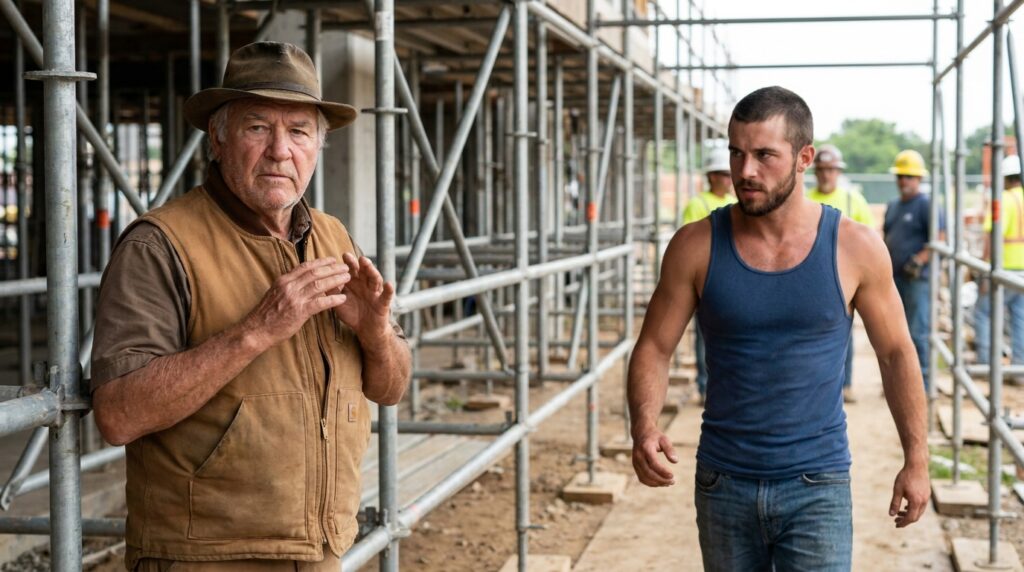
CHAPTER 2: THE FRICTION OF SILENCE
“You’re going to want to breathe through your nose, Garrity. Deep and slow. The dirt in your lungs is the least of your problems right now.”
Miller’s voice was as steady as the foundation bolts he’d been inspecting. He didn’t look down at the man pinned beneath his boot. Instead, his gaze remained locked on Vance, who had frozen ten feet away. The bearded laborer’s hands were half-out of his pockets, caught in the paralyzed indecision of a man who had just seen a mountain move. The air between them tasted of iron and the dry, alkaline sting of kicked-up concrete dust.
“Let him up,” Vance rasped. His voice lacked the venom it had carried ten minutes ago. Now, it just sounded thin, like wire being stretched to the breaking point.
“In a moment,” Miller said. He shifted his weight slightly. The heavy leather of his work boot creaked against the grit on Garrity’s wrist. Below him, the younger man made a sound—a low, rhythmic wheeze that spoke of shattered pride and bruised ribs. Miller didn’t enjoy the weight, but he respected the necessity of it. In the high-iron trade, like in the service, once the chain of command is snapped, you don’t mend it with a handshake. You weld it back together with gravity.
Miller reached into his canvas vest and pulled out a ring of heavy brass keys. They weren’t his. He’d lifted them from Garrity’s belt during the pivot, a sleight of hand so practiced it felt like a ghost limb moving. He tossed them toward Vance. The keys arched through the twilight, a flash of dull gold before Vance caught them with a clumsy slap of his palms.
“The supply trailer,” Miller commanded. “The one with the yellow rigging. Open it.”
“That’s my uncle’s private stock,” Vance stammered, looking from the keys to the fallen Garrity. “He said nobody goes in there. Especially not an overseer.”
“Your uncle isn’t standing in the dirt right now. You are.” Miller increased the pressure on Garrity’s wrist, just enough to elicit a sharp hiss. “Move. Or I start wondering what else is out of plumb on this site.”
Vance hesitated, then turned and scrambled toward the darkness where the industrial trailers sat like rusted monoliths against the skeleton of the building. Miller watched him go, then finally stepped back, releasing Garrity. The younger man rolled away instantly, clutching his arm and coughing, his blue tank top now a mottled gray from the construction silt. He didn’t try to get up. He just sat there, staring at Miller with the wide-eyed, frantic look of a prey animal that had survived the first bite.
Miller ignored the stare. He walked toward the trailer, his gait heavy and methodical. The physical exertion hadn’t touched his heart rate. Decades of ruck-marches and cold-starts had turned his body into a machine that processed adrenaline as nothing more than fuel for focus. He reached the trailer just as Vance pulled the heavy iron handle. The door groaned on dry hinges, a sound like a metal-on-metal scream that echoed through the unfinished floors above them.
Vance stepped back as Miller approached the threshold. The interior of the trailer smelled of packing oil and something sharper—a chemical scent Miller recognized from a dozen motor pools across three continents. Cold, cheap preservative.
He didn’t need a flashlight. Even in the gloom, the wooden crates stacked to the ceiling told the story. These weren’t the standard shipping containers from the Midwest foundry they were supposed to be using. These were unbranded plywood boxes, held together by staples instead of screws. Miller pulled a small pry bar from his vest pocket—the tool he used to check for gaps in the masonry—and jammed it under the lid of the nearest crate.
The wood splintered with a dry, hollow snap. Inside, nestled in grease-stained brown paper, were rows of structural bolts. Miller picked one up. It had the heft of steel, and the head was stamped with the marks of a Grade-8 fastener—the three radial lines that signified high-tensile strength. But when Miller ran his thumb over the threads, he didn’t feel the bite of precision-machined iron. He felt a smoothness, a slight graininess that suggested cast metal rather than forged.
He took his brass level from his hip and tapped the bolt. The sound wasn’t the high-pitched ping of tempered steel. It was a dull, leaden thud.
“Rusted truth,” Miller whispered to the empty air.
“What is it?” Vance asked from the door, his voice trembling. He was watching Garrity, who was now standing shakily by the pallets, wiping blood from a scraped chin.
“It’s a funeral,” Miller said, dropping the bolt back into the crate. He turned to look at the two of them. In the fading light, his face looked like it had been carved from the very limestone they were building upon—ancient, immovable, and entirely devoid of mercy.
“You boys were worried about me signing the safety log,” Miller continued, stepping out of the trailer. He loomed over them, the rusted surfaces of the job site framing him like a king in a wasteland. “You should have been worried about why your uncle wanted me to sign it so badly. You aren’t just cutting corners. You’re building a cage.”
Garrity finally found his voice, though it was cracked. “We just do what we’re told, Miller. We get paid to move the iron, not question where it comes from.”
“Then you’re overpaid,” Miller snapped. He pointed toward the exit gate, where the suburban streetlights were beginning to flicker on. “Walk away. Both of you. If I see you on my site before the sun comes up, I won’t be using a defensive guard. I’ll be using the tools.”
Vance didn’t wait for a second invitation. He grabbed Garrity by the shoulder, hauling him toward the gravel drive. They moved with a frantic, stumbling speed, leaving behind the silence of a site that was suddenly much more dangerous than a simple construction project.
Miller didn’t watch them leave. He turned back to the rising skeleton of the building. He looked at the I-beams, the joints, and the thousands of hidden bolts already buried under the initial pours. He reached out and touched the cold, rough iron of the nearest vertical support. He could feel the friction of the settling weight, a microscopic grinding that told him the three-degree variance wasn’t a mistake. It was a planned failure.
He was the Sovereign Protector of this ground, and for the first time in forty years, he realized he wasn’t defending a build. He was standing in the middle of a crime scene.








