
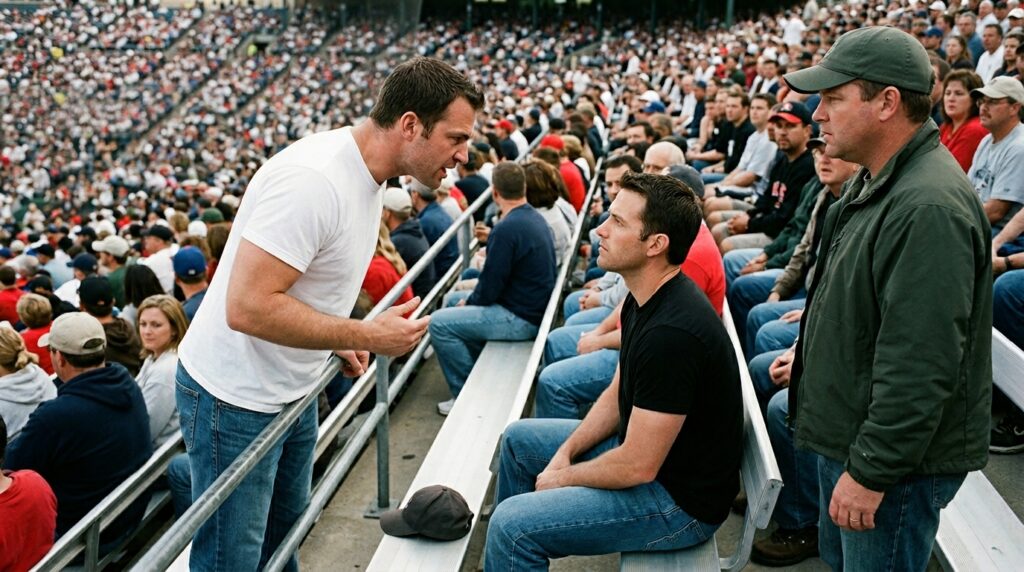
CHAPTER 4: THE MIDNIGHT ACCOUNT
The shadow in the doorway expanded, blocking out the desaturated gray light of the yard. Miller didn’t turn off his penlight; he lowered the beam so it pooled around his own boots, casting the upper half of his torso into absolute darkness. His right hand went into his pocket, his fingers wrapping around the smooth, cold teeth of the brass padlock key he had taken from Deputy Gidley. It wasn’t a weapon, but packed into his fist, it gave his knuckles the weight of an iron bolt.
“You always did stay up past the shift change, Frank.”
Jesse Vance stepped into the shed. He wasn’t wearing his military cap now, and the khaki fabric of his uniform shirt was unbuttoned at the throat, revealing the grey chest hair beneath. He looked older under the low rafters, his features worn flat by decades of small-town compromise. He didn’t have his service weapon drawn, but his hand rested comfortably on the top of his leather holster, his thumb tapping a steady, syncopated rhythm against the brass snap.
“The logbook is missing two manifests from the lower ridge, Jesse,” Miller said. His voice was too quiet, a low vibration that barely carried over the rustle of the wind against the tin roof. He stood completely still behind the oil drum, his weight balanced on the balls of his feet. “But the bank draft in the back leaf seems to cover the discrepancy.”
Vance stopped five feet away. He didn’t look at the logbook. His eyes stayed fixed on Miller’s shoulder, tracking the lack of movement with the practiced caution of a man who knew exactly what Miller had done to the boy on the stadium stairs.
“That fund has been sitting on the county books since the old mill closed down, Frank,” Vance said. The leather of his boots ground a fallen washer into the concrete floor, a dry, metallic crunch. “It was always meant for infrastructure. The timber-jack needs to clear that basin to run the new high-voltage lines through to the county seat. Your five acres just happen to sit right on the choke point.”
“The re-zoning notice Silas talked about didn’t come from the capital,” Miller said, his gaze drilling into Vance’s chest. “It came from the precinct. The bank draft is signed by Chief Halloway.”
A heavy, suffocating silence settled over the machine shed. The smell of old lubricants and rust felt thick enough to choke on. Vance’s thumb stopped tapping against his holster snap. For three seconds, his jaw tightened, the skin over his cheekbones turning the color of dried clay. He didn’t offer a villainous speech; he didn’t try to justify the ledger. He simply shifted his stance, his weight settling into his heels.
“The Chief doesn’t like loose ends, Frank,” Vance murmured. “He gave you three months to clear out on your own. The fence-line dispute was just supposed to be a nudge. Something to get you to sign the state buy-out before the real crews arrived with the dozers. But you had to go and show everyone what you could do to a man’s knee with two fingers.”
“He wanted the fight,” Miller said, the realization clicking into place with the cold finality of an iron latch. “The boy at the stadium wasn’t trying to scare me off. Halloway sent him to pull a reaction out of me in a crowded bleacher. He needed the public assault charge to invalidate my civilian deed under the county’s public safety clause.”
“It’s an old trick, but the paperwork is clean,” Vance said. He took a single step back toward the door, his hand dropping from his holster to wrap around the iron handle of the sliding door. “Gidley’s already processing the filing at the courthouse. By sunrise, your land isn’t private property anymore. It’s an active municipal reclamation zone. If you’re still sitting on this ridge when the sun hits the cedar stakes, it’s a felony trespass.”
Miller didn’t move toward him. He watched Vance’s fingers grip the iron latch. He could have closed the distance before Vance could draw, could have broken the older man’s collarbone against the edge of the oil drum, but the pragmatic math was already against him. The adversary wasn’t a group of angry loggers or a corrupt deputy; it was the machinery of the township itself, moving with the slow, irreversible weight of a steam roller.
“You took the money to watch my perimeter, Jesse,” Miller said, his voice flat, completely devoid of anger. It was an objective assessment of a structural failure. “We cleared that ditch line together.”
“I have a mortgage on the fork, Frank, and my lungs are full of pine dust,” Vance said, his voice slipping into a tired, raspy whisper. He didn’t look Miller in the eye as he began to slide the heavy tin door closed, narrowing the gap of moonlight to a thin, silver ribbon. “In this valley, you either buy into the foundation or you get scraped off the top. I told you to take the back road.”
The door slammed shut with a sharp, echoing clang that shook the rusted rafters overhead. The padlock bracket on the outside rattled once as Vance dropped the pin into place, locking Miller inside his own machine shed.
Miller stood in the absolute darkness, the small beam of his penlight dying against the oil-soaked floorboards. He could hear Vance’s heavy boots retreating across the gravel yard, followed by the distant, throaty rumble of his truck engine cranking over near the gate.
He didn’t waste energy throwing his shoulder against the iron-reinforced door. He turned the penlight back toward the leather logbook, his fingers tearing away the carbon copy of the bank draft. Beneath the purple ink of Chief Halloway’s signature, the official municipal seal was stamped deep into the paper—not just an authorization for payment, but an explicit court order for the summary removal of any unverified structures on the lot.
The fight at the stadium hadn’t been the end of his past life coming back to haunt him. It was the ignition sequence for a completely different kind of operational theater. He reached into his pocket, his hand brushing past the brass key to touch the smooth, cold iron of the survey spike he had pulled from the mud earlier. The valley wanted his land, and they had used his own training to build the trap.
He looked up at the high, narrow window where the rusted iron bars were bolted into the rotted wooden frame. He had twenty-four hours before the timber-jacks reached the well-house, and his anonymity was already gone.








