
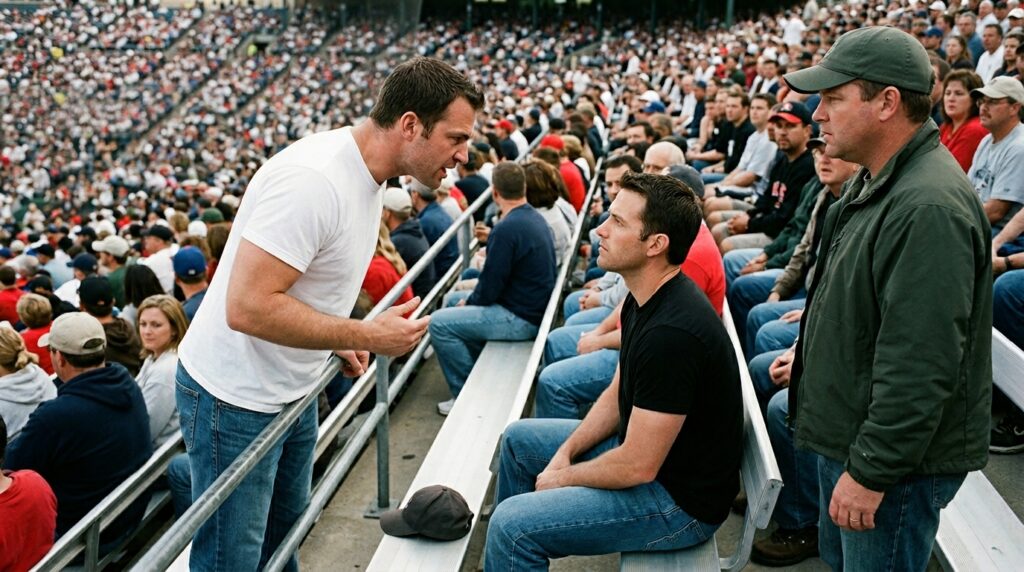
CHAPTER 2: THE BASEMENT AND THE BRASS
“—and a man with your specific lack of local history usually knows exactly how much force it takes to crack a temperamental boy’s hip, Miller.”
The words bounced off the damp, unpainted cinder block walls of the stadium’s sub-level maintenance office. It wasn’t a formal precinct interview room, but the county sheriff’s department had laid claim to it anyway. The air smelled of old lime, wet sawdust, and the chemical bite of floor sealant. A single unshaded bulb hung from a rusted conduit overhead, casting long, jittery shadows across a metal desk pitted with orange corrosion along the seams.
Deputy Gidley didn’t look like a man who spent time behind a desk. He had the thick, calloused palms of someone who handled cattle gates, and his tan uniform shirt was stained with a dark crescent of sweat under the armpits. He didn’t have his sidearm drawn, but his heavy leather utility belt creaked every time he shifted his weight against the edge of the table.
Miller sat on a low wooden stool, his hands folded loosely between his knees. The zip-ties they had used at the gate were gone—Vance had made a quiet phone call before the stadium security could bring out the iron—but the skin around Miller’s wrists still showed the pale, compressed lines of the plastic.
“The boy came down the steps looking for a fall,” Miller said. His tone remained flat, leveled to match the low hum of the exhaust fan vibrating in the high window. “He found one.”
“That boy is Jesse Vance’s brother-in-law, Frank. And his older brother happens to run the haulage crews for the northern valley timber allotment.” Gidley leaned forward, tapping the edge of a heavy aluminum citation clipboard against the rusted metal desk. The rhythmic clack-clack was loud in the small space. “People around here notice when an outsider starts re-marking the corners of the old mill lot. Then they notice when that same outsider drops a local boy on the concrete in front of half the town.”
Miller didn’t answer. His eyes were locked on the clipboard.
As Gidley tilted the aluminum frame, the light caught a small object tucked beneath the heavy wire spring at the top, half-hidden by a stack of carbon-copy trespass warnings. It was a notched brass key, the teeth worn smooth from frequent use, its bow stamped with a distinct three-digit number: 404. It wasn’t standard department issue. It was the specific pattern used for the heavy-duty utility padlocks on the industrial gates along the perimeter of the timber line.
“You’re not from the valley,” Gidley continued, his voice dropping into a transactional rhythm. “Vance says you did some time contract-routing for the logistical firms out of the state capital. Says you like the quiet. But quiet is something you have to pay for in this district, Frank. You don’t just inherit it with a deed.”
“The deed is clear,” Miller said. He felt the cold iron of his past life sliding into place behind his eyes. He calculated the distance between his stool and Gidley’s throat—four feet. Two seconds to close, one to leverage the clipboard into the deputy’s windpipe if the door handle turned from the outside. “The surveyor’s spikes are cast iron, set four feet deep into the creek bed. Your boy Jesse’s family knew that when they sold the timber rights thirty years ago.”
Gidley stopped tapping. He reached down, his fingers brushing against the notched brass key as he flipped a page on the clipboard. “Jesse’s family doesn’t own the logging manifest anymore. Things change. People find out their neighbors aren’t as steady as they look.”
The subtext hit Miller like a handful of gravel to the face. The manifest. The challenger at the stadium had used the exact same term before his cheek met the concrete.
Miller leaned his torso back just an inch, his shoulders scraping against the cold, rough concrete wall behind him. The rust on the window grate above him was shedding, fine red flakes drifting down into the hair on his forearms. “Vance has been standard with me,” Miller said, testing the water.
Gidley let out a short, dry bark that might have been a laugh if his eyes weren’t so dead. He didn’t confirm the statement, but he didn’t deny it either. Instead, he unhooked his thumb from his utility belt and tossed the clipboard down onto the table. The brass key slid out from under the paper, spinning twice before stopping near Miller’s left hand.
“Jesse Vance wears a uniform because the county pays for the cloth, Frank. But the county doesn’t pay for the diesel in his truck, and it sure as hell didn’t pay for that new barn he’s raising down on the fork.” Gidley stood up, the leather of his boots groaning under his weight. “We’re going to call this an administrative detention for the next twenty minutes. Just long enough for the stadium crowd to clear out so nobody tries to flip your truck in the lot. After that, you go back to your five acres.”
The deputy walked to the heavy iron door, his hand resting on the lever handle. He paused, looking back over his shoulder, his face half-lost in the shadow of the unshaded bulb.
“If I were you, Miller, I’d take the back road past the mill. The main lane has a lot of loose stone this time of year. Bad for the alignment.”
The latch clicked. The door groaned on its dry hinges, then slammed shut, the sound echoing down the concrete corridor outside until the only thing left was the low, electric rattle of the bulb.
Miller didn’t move for sixty seconds. He listened to the retreat of Gidley’s heavy boots against the floorboards upstairs, then reached out and picked up the brass key. The metal was cold, smelling faintly of machine oil and wet pockets. He slipped it into his pocket, his mind tracing the cause-and-effect loop with a cold, geometric precision.
The challenger hadn’t been a random drunk. The deputy wasn’t looking for an assault charge. They were looking for an reaction, a visible crack in the reclusive shell he had built around his perimeter. And Vance—the man who had sat beside him for three months while they cleared the brush along the property lines—had left his post at the gate the moment the security vests showed up.
Miller stood up, the low wooden stool scraping against the grit on the floor. His hands were steady, but the internal clock was ticking faster now. The locks on his barn were off, the challenger had said. He needed to get to the truck, and he needed to find out exactly what Vance had been putting into the logging logbooks while he was busy looking at the dirt.








