
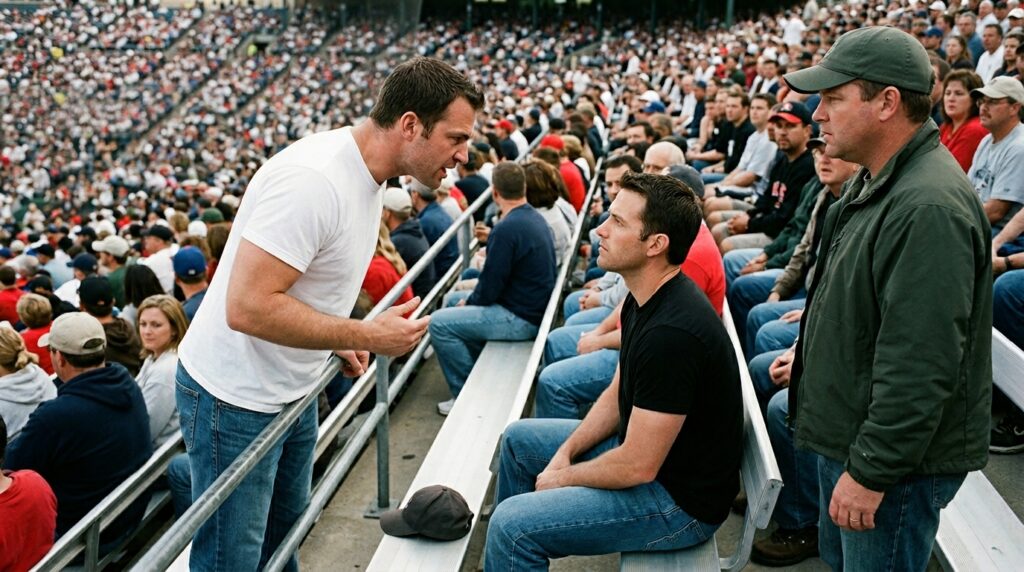
CHAPTER 3: THE ENCROACHING LINE
The truck’s low-beams cut through the hanging dust of the back road, washing over the rusted corrugated iron of the old mill before turning into Miller’s gravel driveway. The transmission grumbled as he shifted into first, the chassis shaking from a worn-out leaf spring that clicked like a broken tooth every time the tires caught a rut. He didn’t turn off the engine immediately. He sat behind the wheel, letting the diesel rattle vibrate through his boots, his eyes scanning the dark perimeter of his property.
The headlights glinted off something raw.
Ten feet to the left of his gravel track, right where the drainage ditch cut through the wire grass, a pale splinter of wood pierced the mud. Miller killed the lights, stepped out into the damp night air, and let his boots sink into the soft earth. The air smelled of rotten bark, creek silt, and the heavy, sweet scent of crushed pine needles from the logging trucks down the ridge.
He walked over to the wooden marker. It was a clean, unweathered square of split cedar, completely free of the gray lichen that coated every other post in the county. Tied around its crown was a loop of neon-orange surveyor’s tape, the plastic snapping softly in the cold wind off the flats. This wasn’t a temporary marker. It was driven deep, three feet inside his established property line, right over the buried cast-iron surveyor’s spike he had verified two months ago.
“You’re standing on the wrong side of the creek, Miller.”
The voice came from the shadow of the equipment shed thirty yards away. It didn’t belong to Vance. It was deeper, thicker, carrying the slow, deliberate drawl of a man who spent his days directing heavy machinery.
A figure stepped into the pale moonlight. He was taller than the challenger from the stadium, his face lined with the deep, permanent creases of sun and engine grease. He wore a grease-stained canvas coat that hung open, revealing a heavy leather tool belt. In his right hand, he held a long iron pry-bar, its tip caked with wet clay.
“You must be the older brother,” Miller said. His right hand remained flat against his thigh, inches from his pocket where the brass key from Gidley’s clipboard rested. He didn’t shift his stance; his boots were already set, his weight centered over his heels. “The one with the manifest.”
“The name’s Silas,” the man said, stopping ten feet away, just behind the cedar stake. He drove the iron pry-bar into the mud, leaning his weight against it like a walking stick. “And that paper doesn’t belong to me. It belongs to the county records office. The state re-zoned the basin drainage three weeks ago, Frank. This ditch isn’t your boundary anymore. The line runs straight through your well-house now.”
“Re-zoned by who?” Miller asked, his eyes tracking the way Silas kept his left hand tucked into the pocket of his canvas coat.
“The people who pave the roads you drive on,” Silas replied. He glanced toward Miller’s farmhouse, where a single yellow bulb burned over the porch. “Jesse Vance told us you wouldn’t take well to the adjustments. He said you were a particular man about your stakes. But Jesse’s a practical boy. He knows when a property is too expensive to keep.”
“Jesse’s a uniform,” Miller said, his voice dropping into the flat, hollow tone he used when evaluating a structural threat. “Uniforms don’t re-zone counties.”
“No,” Silas said, a slow, ugly grin spreading across his face. “But they sign the eviction notices when the well runs dry. You got twenty-four hours before the logging crew brings the timber-jack through that lower thicket, Frank. If your fence is still standing then, the blades won’t stop for the wire.”
Silas pulled the iron pry-bar out of the mud with a wet, sucking sound. He didn’t swing it, didn’t make a move toward Miller. He just turned his back—a calculated display of local immunity—and walked toward an unmarked black utility truck parked down the shoulder of the main road. The red tail-lights flared once, then vanished into the screen of dust.
Miller stood in the dark, the wind whistling through the orange surveyor’s tape at his feet. The decoy was falling apart, but the shape behind it was becoming clear. This wasn’t an ordinary dispute over timber rights or local pride. They were systematically moving the borders while he was being held in basement storage by Gidley.
He didn’t go into the house. He walked past the porch, his boots crunching over the rusted iron scrap near the well-house, and headed straight toward the machine shed where Vance kept his auxiliary tractor parts. The padlock on the shed door was intact, but when Miller reached out and touched the brass cylinder, it was warm to the touch. Someone had been inside within the hour.
He pulled out the notched brass key he’d taken from the deputy’s clipboard and slid it into the lock. It clicked open with a greasy, fluid slide.
Inside, the air was thick with the smell of gear oil and old burlap. Miller didn’t turn on the overhead lights. He used a small penlight, casting a narrow beam across the grease-streaked workbenches until it settled on Vance’s standard-issue leather logbook sitting on top of an empty oil drum.
He flipped the cover open. The pages were covered in Vance’s tight, slanted handwriting—dates, truck numbers, cubic feet of timber hauled from the northern flats. But pinned to the back leaf was a carbon copy of a bank draft from the valley commercial trust, dated two days ago. It was made out to Jesse Vance for an amount that exceeded three years of a deputy’s county salary. The remitter line didn’t name Silas or the logging company.
It was stamped with the official seal of the County Executive Land Management Fund.
Miller’s fingers tightened on the paper until the carbon smeared. The local logging faction wasn’t buying Vance off to steal timber. The county itself was funding the deployment, using the timber crews as a physical wedge to crack Miller’s title. Every piece of information he had gathered from the stadium fight to the deputy’s interrogation was a calculated layer designed to look like a small-town grudge, masking an institutional seizure. And the man who signed the fund allocation at the bottom of the draft was someone Miller hadn’t even faced yet.
A shadow crossed the narrow window of the shed, cutting off the moonlight. The gravel outside groaned under the weight of a slow, approaching step.








