
CHAPTER 5: THE COLD ARCHITECTURE
“Stand down, Sergeant.”
The order came from forty paces back, slicing cleanly through the thick afternoon heat and the high-pitched whine of the security trucks’ idling engines. It didn’t have the raspy velocity of the patrol leader’s commands; it carried the quiet, unchecked gravity of someone who didn’t need to check the stripes on his sleeve to know if the room was listening.
The lead patrol sergeant didn’t hesitate. His spine snapped into a rigid, vertical line, his fingers dropping instantly away from the metal edge of my aluminum clipboard. The other three security officers followed his movement like a single mechanism, their boots pivoting on the aggregate as they cleared the narrow lane between Piling Track Seven and the hangar doors.
A tall man with a severe, clean-shaven jaw and deep-set eyes walked through the gap. He didn’t wear the field utility camouflage or the white-capped helmet of the patrol units. His olive-drab command uniform was pressed flat, the two silver stars pinned to his collar catching the direct glare of the sun with a cold, metallic intensity. He held a pair of black leather gloves loosely in his left hand, tapping them against his thigh with a slow, even rhythm that matched the ticking of a radiator.
The civilian in the dark suit immediately stepped out from behind the sergeant’s shoulder, his posture shifting into a quick, defensive lean. “General, this individual is actively disrupting the preparatory route for the demonstration,” he said, his hand pointing toward the grease-pencil lines I’d drawn across the concrete. “He’s unauthorized on this pad, and he’s claiming the structural logs are compromised.”
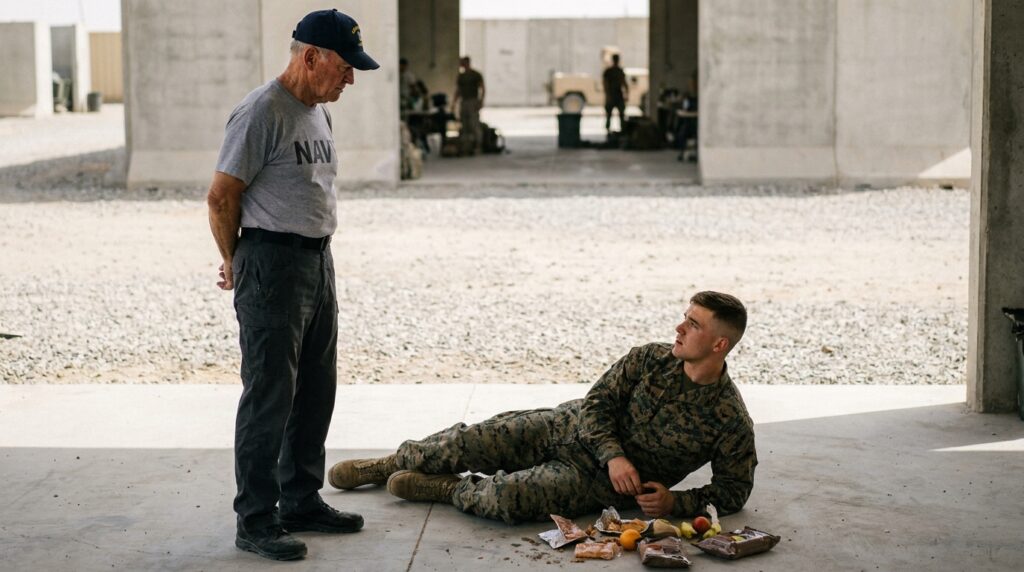
General Vance didn’t look at the civilian. He stopped five feet from me, his eyes tracking from the worn gold lettering on my navy blue cap down to the faded gray T-shirt, and finally down to the knuckles of my right hand, which still remained loosely tucked into my pocket. He didn’t ask for a pass. He didn’t look at the patrol sergeant who was still holding the clipboard.
“It’s been twenty-two years, Chief,” Vance said. His voice was low, carrying a faint rasp that sounded like it had been dragged over coarse sand. “The last time I saw you, we were pulling an engine block out of an iron-hull tender in Subic Bay.”
“Twenty-three, General,” I said, my voice maintaining its flat, unhurried resonance. I didn’t salute. A retired fleet master chief doesn’t break posture on an active tarmac for stars he helped polish when the current command was still running supply errands. “And the tender was a concrete-hulled fuel barge. The iron ones didn’t leak that bad.”
A microscopic shift occurred around Vance’s mouth—not a smile, but a brief acknowledgment of the line. He turned his head slightly, his eyes falling on the deep, grease-blackened split that ran through Piling Track Seven. “The patrol desk said an older civilian just dropped my senior close-quarters instructor on the eastern pad with a single structural pivot.”
“He was leaning on his toes,” I said, my thumb tracking the canvas strip inside my pocket. “His root was shallow. If you don’t teach them how to drop their center of gravity before they lock the collar, they’re just heavy targets.”
The civilian stepped closer, his voice rising an octave under the pressure of the standoff. “General, with all due respect to the Chief’s history, the logistics trucks are scheduled to move three hundred tons of support armor onto this pad in twelve minutes. We have a timeline signed off by the secretariat.”
“Your timeline is running on a broken shoe,” I said, pointing the toe of my tactical shoe toward the base of the track housing. “Listen to the line.”
Before the civilian could speak, a heavy, dull thump reverberated through the concrete beneath our feet—a deep, low-frequency shudder from the structural housing box beneath the track. It wasn’t the sound of a modern engine; it was the specific, terrifying groan of structural iron shearing under an unmonitored load. A thin, bitter smell of scorched rubber and ground lime drifted up from the fracture line as the gap widened by another eighth of an inch.
Vance’s face went completely still. He stepped over the split, his leather gloves snapping tight against his palm as he reached out and took the aluminum clipboard from the sergeant’s hand. He turned it over, his eyes fixing on the purple cross-blade anchor stamp on the reverse side of the log.
“This is the original build sheet from eighty-eight,” Vance murmured, his finger tracing the obsolete serial number. He looked up, his deep-set eyes locking onto the civilian with a cold, administrative finality. “The maximum load-bearing limit for this sector was calculated for standard support vehicles, not the tracked armor your office brought in from the port.”
“The new units are within the global tolerances—” the civilian began, his fingers twitching against his folio.
“The global tolerances don’t apply to a pad that sits on top of a late-Cold War drainage vault, Mr. Miller,” Vance cut him off, his voice dropping into a register that made the patrol sergeant step back another six inches. “The Chief designed this deck layout when you were still writing high school essays. If he says the line is going to shear, the line is closed.”
The civilian looked at Vance, then at me, the reality of his political timeline collapsing right into the cracked cement. He didn’t offer another counter-move. He simply pulled his phone from his jacket pocket and began walking back toward the black sedan, his shoes shuffling through the loose aggregate with a panicked, uneven cadence.
Vance turned back to me, extending the clipboard. “The secretariat isn’t going to cancel the morning show, Chief. They’ll just move the armor over the secondary tracks by Hangar Five.”
I took the metal frame back, my thumb locking over the blue ink entries. “Hangar Five uses the same sub-surface tie-downs, General,” I said, looking him dead in the eye. “And the blueprints for that pad aren’t in the local office. They’re locked in the central repository under an operational code your logistics people don’t even have on their screens.”
Vance stood silent for three long seconds, the wind catching the edge of his command collar as a new, larger shadow began to fall from the high rafters of Hangar Four. The small victory over the civilian was a false flag; the real failure hadn’t even reached the yard yet.








