
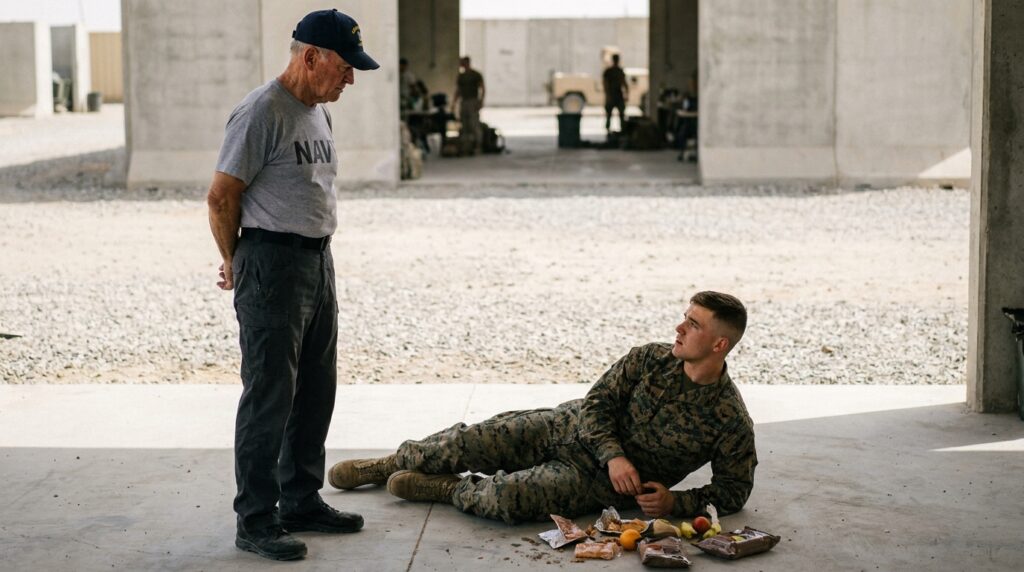
CHAPTER 1: THE SHARP EDGE OF UNYIELDING CONCRETE
The sharp sound of cracking plastic and wet grease hitting the sun-bleached concrete cut through the low hum of the training yard’s diesel generators before anyone could check the perimeter line.
My knuckles didn’t shake as the tray left my fingers. I kept my weight settled low, deep in the heels of my dark tactical pants, tracking the gray shadow of the fallen rations as they pooled against the white painted boundary lines of the tarmac. The hot afternoon sun beat down on the back of my neck, trapped beneath the stiff cotton sweatband of my navy blue cap. To the twenty-odd recruits standing in a loose semicircle ten paces back, I was just a collection of slow angles and silver hair—a frail intruder who had drifted too close to the active training deck.
“You’re cluttering up a real training deck, old man,” the voice came from directly ahead, sharp, transactional, and swollen with the unblemished authority of crisp digital camouflage.
The Challenging Serviceman took another step forward, his polished black leather boots crunching against a dry piece of gravel. He was barely out of his twenty-four-month enlistment, his chest broad under the stiff fabric of his utility uniform, his eyes locked onto the gold lettering of my cap with a smug, calculated dismissal. He wanted an audience. He wanted to show his squad how clean his eviction technique was before the afternoon readiness inspection.
I didn’t answer him. I didn’t offer a name, a rank, or a justification. In the fleet, you learn to look at a man’s eyes to see where his balance lives, and this boy’s weight was leaning too far onto his toes, driven by the easy pressure of his peers’ low snickers. My left hand moved an inch inside my pocket, my calloused thumb brushing the rough canvas wrapper of the jammed silver pocket watch. The iron smell of the yard’s industrial floor wax mixed with the dry dust kicked up by a distant transport truck.
“Pick up your trash and get behind the line,” he repeated. His right shoulder dropped slightly—a classic, unpolished telegraph of intent. He was crowding the distance now, trying to use his height to force my spine back against the chain-link boundary. He thought the weathered veins on my hands meant the bone beneath had turned to chalk.
Behind him, the low murmur of the platoon died down into a brittle, expectant stillness. No one moved to help. No one stepped between the active-duty squad leader and the old man in the gray T-shirt. They just watched the space between us shrink to less than an arm’s length.
The young soldier’s right hand came up, fingers hooking into a rigid claw, aiming directly for the center seam of my collar to drag me off the tarmac. He didn’t see my right foot drop back an inch into the concrete, anchoring my center of gravity into the stone itself. He didn’t notice that my breath had completely flattened out.
The moment his fingers brushed the cotton of my shirt, his forward momentum became my property. I didn’t strike. I didn’t swing. I simply caught the inside of his wrist with two fingers, shifted my hips three inches to the left, and let his own rushing weight slide past my ribcage into the empty air. The physics of the redirect were small, dark, and absolute. There was a brief, sharp friction of boot rubber against concrete, the heavy thud of a solid frame losing its root, and then the loud, metallic crack of his gear hitting the deck flat on his back.
The spilled food splattered across his sleeve as he settled into the stone. The yard went completely cold.
I didn’t step back. I stood directly over him, the shadow of my navy cap cutting across his wide, unblinking eyes as he gasped for the air his lungs had forgotten.








