
CHAPTER 2: THE BRITTLE CIRCLE
“Get up.”
The words didn’t carry the heat of anger; they had the cold, flat density of an iron door slamming shut in an empty corridor. My voice sounded thin against the expansive concrete of the training yard, but it carried. It clipped the edges of the surrounding platoon, cutting off the last vestige of the nervous, low-tier snickers that had drifted from the back ranks only moments before.
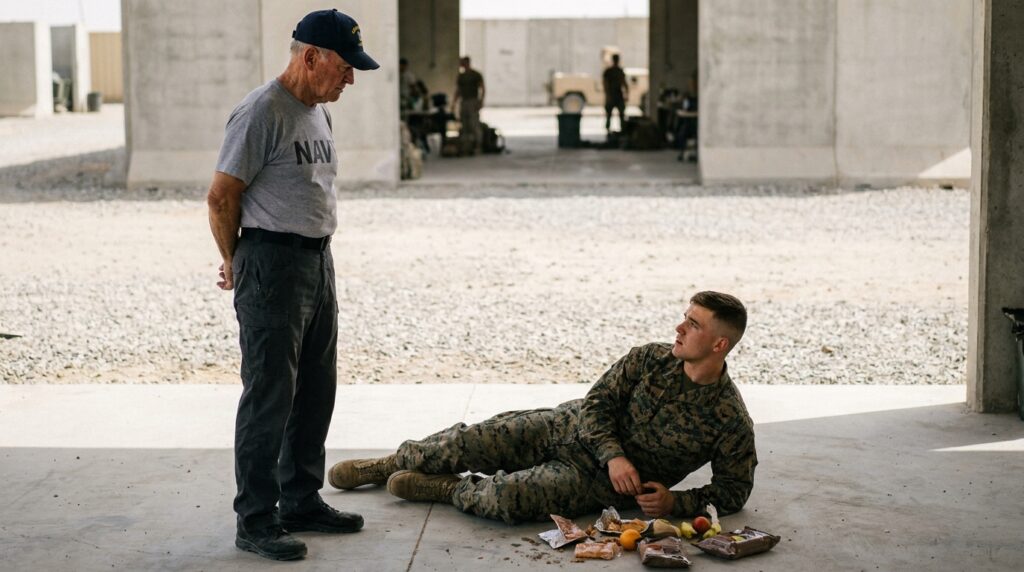
The Challenging Serviceman didn’t move immediately. He lay flat on his spine, a human shape framed by the scattered debris of broken plastic and the dark, wet smear of split rations soaking into the sun-bleached deck. His eyes were wide, fixed on the brim of my navy cap with a look that belonged to a man who had stepped out of an aircraft into empty air without checking his pack. The digital camouflage across his chest rose and fell in short, erratic jerks as his lungs fought against the solid impact of the tarmac.
Two seconds ago, he had been the center of this yard’s gravity. Now, his weight was entirely spent, his status leaking into the stone beneath his shoulder blades.
To his left, a junior corporal with two fresh grease-pencils tucked into his sleeve pocket made a small, instinctive movement—a half-step forward, fingers twitching toward the black nylon holster at his hip. It was an institutional reflex, the young guarding the young when the hierarchy suffered a sudden, inexplicable puncture.
I didn’t turn my head toward him. I simply shifted my gaze three degrees to the left, catching the corporal’s boots in my lower peripheral vision. “Stay behind the yellow line, son,” I said, my voice dropping into the lower register that thirty years of deck-level command gives a man. “Your squad leader is still on his clock.”
The corporal froze. The loose circle of recruits seemed to tighten and turn rigid at the same time, their boots scraping against the grit in a brief, collective hesitation before they settled into an absolute, breathless stillness. The hot afternoon sun hit the chain-link fences behind them, casting a grid of sharp, diamond-shaped shadows across the concrete, trapping us all inside a cage of our own making.
On the deck, the challenger finally found his hands. His knuckles, scraped raw where they had skimmed the aggregate during his descent, dug into the concrete. He rolled his weight onto his side, his breath coming in a wet, ragged hiss as he forced his knees under his chest. He didn’t look up at me. His eyes were pinned to the spilled gravy and the broken white plastic by his left boot—the exact spot where his youthful overreach had been measured and found wanting.
“You wanted to prove a point,” I said, stepping closer until the toe of my dark tactical shoe was inches from his forearm. The proximity was a chess move, a deliberate compression of his personal space designed to test if there was any fight left in his spine. “Now stand up and face me.”
He didn’t rise. His shoulders remained hunched, the muscles in his neck tightening until the cords stood out like old hemp rope under his tan skin. The arrogance that had carried him across the yard—the clean, unblemished confidence of a boy who believed the modern world belonged exclusively to the fast and the heavy—had vanished. In its place was something cold and brittle. He could feel the eyes of his entire detail pressing into the small of his back. Every second he stayed on his knees was a year stripped off his reputation on this base.
I watched his right fingers twitch against the concrete. For a fraction of a second, I calculated the risk of a low leg-sweep, a desperate, dirt-tier recovery from a boy who didn’t know how to lose gracefully in front of his men. My right hand remained in my pocket, my fingers tightening around the canvas-wrapped silver pocket watch, using its dead, unmoving weight to gauge the precise rhythm of the silence.
But the movement didn’t come. The challenger’s shoulder dropped, the tension draining out of his frame in a long, submissive exhale that rattled through his teeth.
“I understand,” he muttered. The words were sparse, transactional, stripped of the cadence he used when he was barking orders at the recruits. He kept his chin tucked low into his collar, his voice barely lifting above the low drone of the distant diesel generators. “I’ll… I’ll back off.”
“Speak into the deck, you stay on the deck,” I said, my voice dropping an octave, steady and sharp as a razor. “Say it so the rear rank can hear you.”
A dark flush crept up from his collar, turning the skin behind his ears a deep, furious crimson. He swallowed once, his chest heaving as he forced his head up just enough to look at the lower hem of my gray T-shirt, though he still couldn’t bring his eyes to meet mine under the shadow of the cap.
“I understand, sir,” he said, the honorary title slipping out through sheer, unadulterated institutional conditioning. His voice cracked slightly against the dry heat of the yard. “I’ll back off.”
The silence that followed was different now. It wasn’t the shocked pause of a crowd watching a sudden accident; it was the heavy, suffocating weight of an established reality. The recruits behind him didn’t look at each other. They didn’t smile. They stood like concrete pilings driven into the tarmac, their small-unit cohesion shattered by the realization that the man they thought was a ghost was the only solid thing in the yard.
I looked past him then, my eyes tracking across the grey, desaturated expanse of the training facility toward the low-slung administrative barracks three hundred yards out. A black government sedan had pulled up beside the secondary security gate, its exhaust shimmering in the heat distortion rising from the blacktop. Someone was watching from the rear passenger window—a pale silhouette behind tinted glass that didn’t belong to the local training cadre.
I reached into my back pocket, my fingers wrapping around the stiff corners of the aluminum clipboard I had carried past the main gate. The blue ink of the transit log was visible under the clear plastic guard, listing three specific structural codes for the foundation pilings supporting the heavy crane rigs at the western edge of the tarmac. The notations were marked with red grease-pencil—the kind used only by engineering inspectors with deep-tier clearance.
The challenger was still on his knees, his hands trembling slightly as he began to collect the larger pieces of broken plastic from the concrete, trying to rebuild his dignity through small, menial movements.
“Leave the tray,” I said, turning my back on him without checking his recovery. It was a calculated risk, but a man who has surrendered twice in the same minute doesn’t have the stomach for an off-angle strike. “You’ve got an inspection in twenty minutes, squad leader. I’d suggest you find a fresh set of utilities.”
I walked toward the gate, the soles of my shoes clicking a steady, even meter against the concrete. Behind me, the platoon didn’t break formation. They stayed exactly where they were, waiting for a command that their leader was currently too broken to give.








