
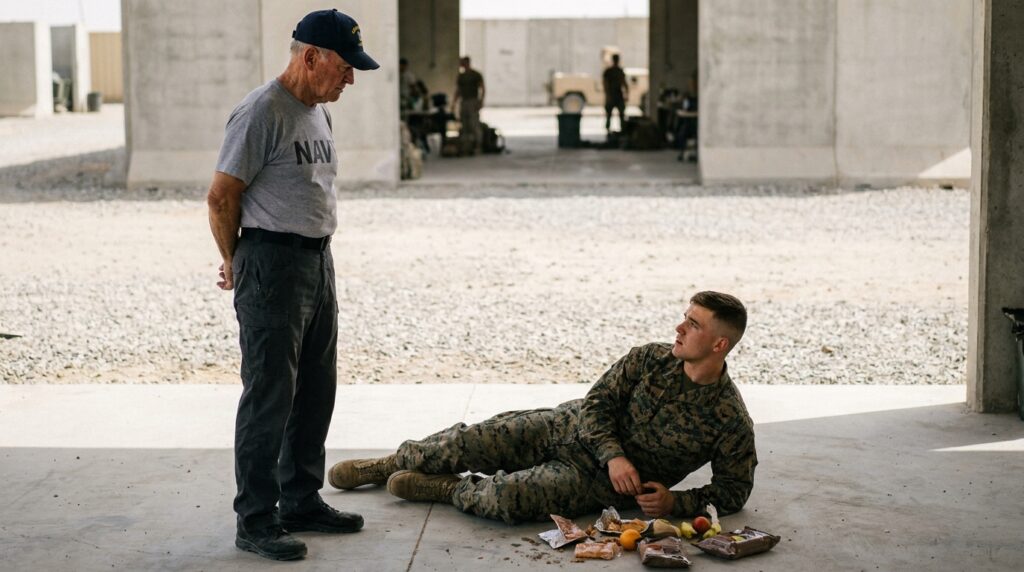
CHAPTER 3: THE FRICTION LINE
The heels of my tactical shoes struck the transition line where the main tarmac met the heavily reinforced concrete beds of the western crane tracks. The vibration traveled straight up through my shins, hard and unforgiving, a reminder that underneath the thin film of motor pool dust lay five million tons of structural stone designed to withstand industrial-grade stress. Behind me, the training yard remained frozen in its silent, fractured geometry; ahead, the shadow of the black government sedan lengthened against the corrugated steel facade of Maintenance Hangar Four.
I didn’t slow my pace. I adjusted the aluminum clipboard under my left arm, the cold metal edge biting through the fabric of my gray shirt, while my right hand slid from my pocket. My calloused fingers left the canvas-wrapped watch and reached instead for a mechanical grease-pencil tucked behind my belt.
Every yard on this installation had an architecture. If you knew how to read the expansion joints and the wear patterns on the structural iron, you knew exactly who had laid the operational baseline and where the shortcuts had been buried. The young squad leader back on the deck had been a symptom; the real structural rot was always systemic, recorded in the data logs that civilian contractors tried to slide past the gate guards before the morning shifts.
I stopped at the edge of Piling Track Seven. The concrete here was discolored, a dark, greasy bloom radiating outward from a hairline fracture that ran parallel to the high-tension tie-downs. I knelt down, the joints in my knees clicking with a dry, metallic precision that matched the environment. The stark daylight caught the edge of a non-standard brass casing wedged deep inside the expansion joint—not a training round, but a live 5.56 primer, crushed flat by something massive and unmonitored.
“You’re thirty minutes ahead of the logistics detail,” a voice said from the shadow of the sedan’s open rear door. It was a dry, thin sound, lacking the military cadence of the base personnel but carrying the specific weight of someone who spent their life writing the budget codes that bought the camouflage.
I didn’t look up immediately. I pressed the tip of the black grease-pencil against the fracture, tracing the stress line across the concrete until it met the steel tracking shoe. “The log said the structural anchor at Track Seven was clear,” I said, my voice flat, keeping its steady, low-frequency rhythm. “The log was lying. This track has shifted an inch and a half to the west under live load.”
A man stepped out of the black vehicle, his polished oxfords clicking against the aggregate with a clean, sterile rhythm that didn’t belong on a live deck. He wore a dark civilian suit that looked too heavy for the mid-afternoon heat, his eyes hidden behind narrow glasses that reflected the silver glare of the hangar roofs. He held a leather folio closed against his chest like a shield.
“The transit log was signed off by the engineering command at the sector office,” the civilian said, his eyes scanning the yard behind me, tracking the distant, unmoving circle of the recruits who were still trying to parse what had happened to their squad leader. “It’s considered a closed matter for the upcoming readiness review. You shouldn’t be out here marking the pavement, Chief.”
“The sector office doesn’t live on this deck,” I said, rising slowly to my feet, letting my spine straighten section by section until I was looking down at him from beneath the low brim of my cap. I held the clipboard out, the red markings on the white paper clear under the harsh sun. “They didn’t see the crane rig tilt three degrees during the midnight shift. If they run the heavy armor over this line during tomorrow’s demonstration, the entire western anchor is going to shear off at the base.”
The man in the suit didn’t reach for the clipboard. He kept his hands locked on his folio, his jaw tightening until a small muscle twitched beneath his ear—the same tiny physical tell I’d seen on a hundred junior officers right before their logistics lines folded under pressure. He knew about the fracture. He knew exactly how many tons of unauthorized cargo had been run over this track to warp the steel shoe.
“The demonstration is scheduled for zero-eight-hundred,” he said, his tone dropping into a sharp, transactional hiss that barely cleared the distance between us. “The invitations went out from the general’s office last week. There are people arriving from Washington who don’t care about an inch of concrete deviation. They care about seeing the new close-quarters defense units operate in real-time.”
“They’re going to see them drop twenty feet into a drainage vault if you put three Bradleys on this line,” I said.
I took a deliberate step into his personal space, the shadow of my navy cap falling across the lapels of his heavy suit. It wasn’t an aggressive movement—it was a positioning play, a quiet compression of the lane that forced him to either step back against the sedan’s hot metal frame or look directly into my eyes. He chose the frame, his shoulders bracing against the black painted door with a faint, metallic click.
The civilian looked down at my hands, his eyes lingering on the old, thick scars that crossed my knuckles—the permanent record of thirty years spent holding the lines together when the steel gave way. He wasn’t a soldier, but he had enough analytical intellect to calculate the risk of an old man who didn’t show any fear of the office he represented.
“You’re making this very difficult for the local command,” he murmured, his voice tightening as he reached inside his jacket, his fingers searching for something that wasn’t a weapon, but carried the same weight on a military base—a phone with a direct line to the provost marshal. “We brought you in to look at the vintage hardware in the memorial hall, Chief. Not to re-engineer the active transit lines.”
“The transit lines are my business because the foundation prints have my initials at the bottom of the column,” I said, letting the aluminum clipboard drop against my thigh with a dull slap. “And if your office tries to run that armor before I verify the secondary anchors under Hangar Four, the provost marshal isn’t going to be the one cleaning up the yard.”
A sudden, sharp whistle blew from the secondary gate behind us, a high, piercing sound that broke through the low hum of the generators. Two white-capped security vehicles turned the corner of the fence line, their tires throwing up small sprays of gravel as they accelerated down the main access road toward the track, their red and blue lights cutting through the white glare of the afternoon sun.
The man in the suit smiled then, a small, thin line that didn’t reach his eyes. “Looks like someone reported an unauthorized civilian interfering with base personnel on the eastern pad,” he said, stepping out of my shadow. “You should have stayed in the history room, old man.”
I didn’t turn to face the approaching vehicles. I kept my eyes locked on the fracture at his feet, my left thumb already tracing the edge of the canvas wrapper in my pocket, counting the beats before the tires hit the line.








