
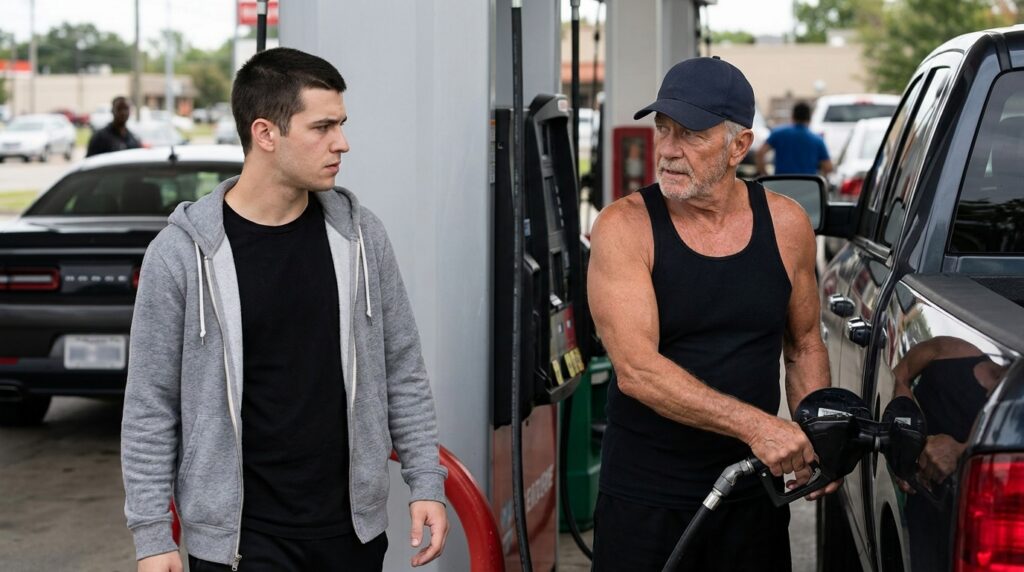
CHAPTER 5: THE CORE OF THE COLD RIDGE
The brass valves in the valve house didn’t yield to wrenches. They required the direct, bone-shaking impact of a five-pound sledgehammer swung against the frozen iron packing nuts until the rust broke loose in sharp, orange flakes that stung the eyes.
Ben wiped his brow with the stiff leather of the work gloves the old man had thrown him. His palms were already blistered beneath the hide, the raw friction of the hickory handle sending a rhythmic jolt straight up his bruised right side every time the hammer connected with the metal. The air inside the subterranean concrete vault was five degrees colder than the yard, smelling faintly of ancient river silt and dead moss.
“Hit it again, son,” the old man muttered from the dark below the pipe tier. He was holding a rusted flashlight between his teeth, his grease-blackened fingers bracing the primary coupling to keep the main line from buckling under the shock. “The threads are loaded with lead-caulk. She won’t drop until the shoulder clears the casing.”
Ben swung. The iron head struck the valve stem with a flat, echoing clank that filled the narrow vault until his ears rang with a high, steady whistle. With a wet, sucking groan, the three-hundred-pound bronze fitting finally sheared off its mount, dropping two inches into the rotten straw padding they had laid across the concrete floor.
“Get the crowbar under the lip,” his father whispered from the access ladder. He was shifting his weight from foot to foot, his head constantly turning toward the square opening above where the midnight fog was drifting across the ridge line. “We’ve been in this hole twenty minutes too long. The coal trains from the northern gap usually slow down the valley patrol, but the tracks have been quiet tonight.”
“The trains aren’t running because the bridge at the junction has a cracked pier,” the old man said, spitting a dark stream of tobacco juice into the empty pipe casing. He didn’t look up from his work as he hauled his shoulder against the bronze mass. “The state closed the line at noon. If a car comes up the ridge road now, it’s looking for us, not the coal.”
Ben dropped the sledge and shoved the nose of the pry-bar beneath the heavy flange. The metal was cold enough to stick to the leather of his gloves. Working together, his weight balanced against the old man’s brute, calloused leverage, they hoisted the valve up toward the ladder where his father could hook it with the truck’s hand-winch.
The cable clicked—a slow, rhythmic tic-tic-tic of greased iron teeth catching the pawl—as the valve rose into the fog.
Ben climbed out of the vault first, his knees scraping the damp concrete lip of the manhole. He stood up in the high grass of the ridge, his gray hoodie instantly soaking through as the cold mountain mist hit his neck. The pickup truck sat thirty yards away in the shadow of a dying willow tree, its tailgate down, the green-patinaed water mains already hidden beneath the tattered canvas.
Then he saw the light.
It wasn’t a flashlight. It was a single, broad sweep of high-beam yellow cutting through the skeletal white oak trees at the bottom of the ridge road, half a mile below their position. The beam rose and fell with the slow, heavy cadence of a vehicle climbing the washed-out grade—not a commercial car, but something with a stiff, heavy-duty suspension that didn’t bounce when the wheels hit the ruts.
“Arthur,” the old man said, his boots clearing the manhole with a heavy thud. He didn’t look at the light; he looked down at the grease-smeared tailgate where the brass key still lay. “Kill the lantern in the shack. Now.”
Ben’s father scrambled toward the foreman’s shack, his silhouette brief and frantic against the windowpane before the yellow glow died, leaving the clearing in absolute, slate-gray dark.
The headlights below disappeared behind the bend of the old limestone cut, but the sound of the engine followed—a low, rhythmic diesel thrum that matched the idle of their own truck, but sharper, tighter, like a vehicle that had been serviced on a county maintenance schedule.
The old man walked over to Ben, his hand closing around the iron tire iron he had tucked into the stake pocket of the truck bed. His face was completely shadowed by the willow branches, but his breath came out in short, steady plumes that smelled of wintergreen and tobacco.
“That’s the third-shift patrol from the lower district,” the old man said softly, his voice dropping into that transactional gray zone where every word felt like a calculated risk. “He’s twenty minutes early for his loop. Either the bank receiver put a call into the substation after the afternoon inventory check, or somebody down at the four-lane gas station remembered the track width on my rear axle.”
He looked at Ben, his gaze cold and steady under the gray brows.
“Get in the bed of the truck, son,” the old man ordered, shifting his grip on the tire iron until the rusted metal clicked against his belt buckle. “Pull the canvas over your head and hold the valve down so it doesn’t rattle against the copper when we hit the gravel. If he stops us before the junction, you let me do the talking. Your father hasn’t got the stomach for what comes next if the paperwork don’t match.”
Ben hesitated, his fingers tightening around the raw fabric of his hoodie’s pocket. The pink receipt from the foundry was still turning into pulp in the yard below, but the red initials stamped at the bottom seemed to burn straight through his memory. The entire ridge was collapsing, and he was currently sitting directly in the hinge of the break.








