
CHAPTER 4: THE MIDNIGHT WEIGH
The iron scale plate beneath Ben’s boots groaned, a low, structural protest that sounded like the entire valley giving up its anchor. He didn’t drop his head. The cold air felt sharp against his wet cheeks, but the heat inside his ribs had turned steady, a hard, localized ache that kept him clear.
“The creek bed is full of runoff,” Ben said, his voice flat, taking on the dry texture of the unpainted masonry around them. “And there isn’t enough lime in the pit to hide three sets of tracks.”
The old man didn’t move the tire iron. His knuckles remained fixed against the rusted steel tool, dark grease packed under his nails from forty years of clearing jams. He looked at Ben’s father, then back down at the pink slip of paper turning translucent in the black puddle by the tire.
“Your boy’s got a stubborn hinge on his jaw, Arthur,” the old man said. He didn’t raise his volume, but the density of his words cut straight through the low whistle of the wind in the roofless joists. “Just like you did before the third foreclosure notice came through the slot.”
Ben’s father stepped off the wooden loading dock, his boots leaving dull, white half-moons in the limestone dust on the iron plate. He didn’t approach Ben. Instead, he reached into the cab of the pickup, his fingers hunting through the glovebox until they clicked around a worn leather-bound ledger. The spine was split, held together by gray duct tape that had frayed into sticky black threads.
“Look at the ledger, Ben,” his father said, extending the book with a hand that shook just enough to make the metal rings on the binder click. “Just look at the names.”
Ben didn’t take the book. He didn’t need to. In the dim amber wash of the kerosene lantern, the stamped ink on the open page was wide enough to read without clearing the lime dust. The entries didn’t stop with his father or the old man standing by the bumper. The columns stretched back eighteen months, neat rows of figures tracking weights, tonnages, and dollar values. Every line represented a section of the county’s lifeblood—the high-pressure valves from the municipal reservoir, the heavy copper grounding cables from the defunct sub-station, the bronze bearings from the local irrigation locks.
The signatures running down the margin belonged to the town’s remaining infrastructure trustees. The men who sat on the school board, the inspectors who signed the safety certificates for the dry-docks, the clerks who handled the local property deeds. The decay wasn’t a sudden rot from the outside; it was an organized, meticulous liquidation carried out by the very people who had built the foundations forty years prior.
“We aren’t stealing, son,” his father whispered, his voice disappearing into the vast, hollow space of the machine shop. “We’re just converting the corpse before the regional bank takes the land. If we don’t pull the metal tonight, the state receivers lock the gates on Monday, and every house on the south ridge goes up for public auction to settle the utility bonds.”
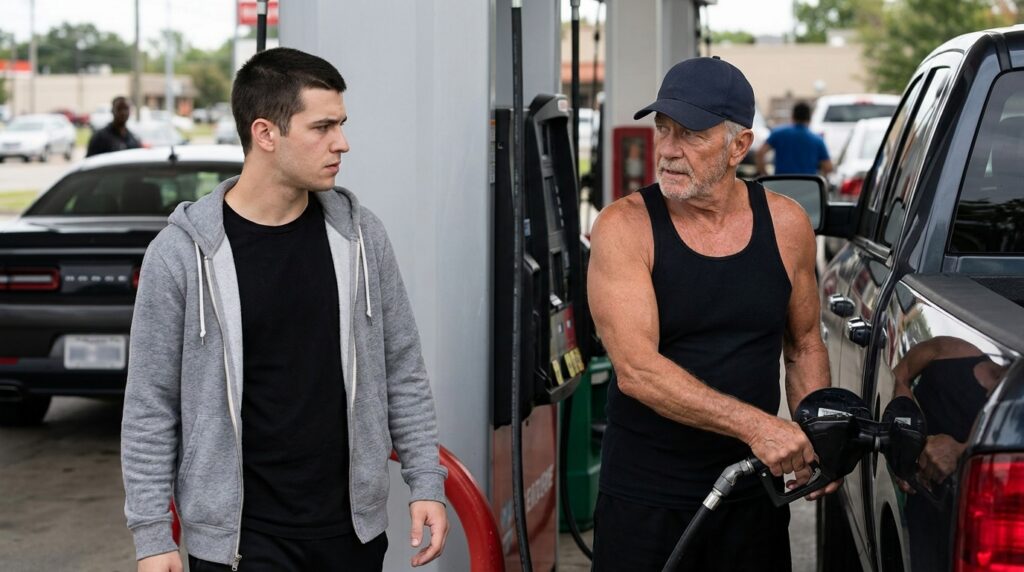
Ben looked at the old man. The muscular shoulders under the black tank top remained solid, an immovable boundary of old iron and survival logic. The confrontation at the gas pump hadn’t been an old man defending his pride against a restless youth; it had been an unyielding system protecting its final operational line. The old man wasn’t the enemy of his growth—he was the mirror of what this county did to men who stayed too long in the dust.
The weight of the brass key in Ben’s pocket felt different now. It wasn’t a prize or a weapon. It was a lien.
“You should have told me,” Ben said, his throat tight as he looked at the green-patinaed pipes in the truck bed.
“You were too busy looking for someone to hit, Ben,” his father said softly, closing the ledger with a dull, heavy thud that puffed a tiny cloud of white powder from the tape. “You wanted a fight because you thought the world was hiding something from you. It wasn’t hiding. It was just emptying out.”
The old man lowered the tire iron, letting the blunt end settle against the gravel with a dry crunch. He reached into his pocket, pulled out a pair of heavy leather work gloves, stiffened with dried sweat and scale, and tossed them onto the tailgate right next to the brass key.
“The wind’s turning toward the north,” the old man said, turning his back to check the hemp ropes on the tattered tarp. “The river barge leaves the south dock at four. We need three more lengths from the valve house before we scale the load. Pick up the gloves, son. Or start walking back to the highway.”
Ben stood on the iron plate, the silence between the three of them growing vast and absolute, filled only by the rhythmic ticking of the cooling diesel engine and the steady, cold friction of the valley air.








