
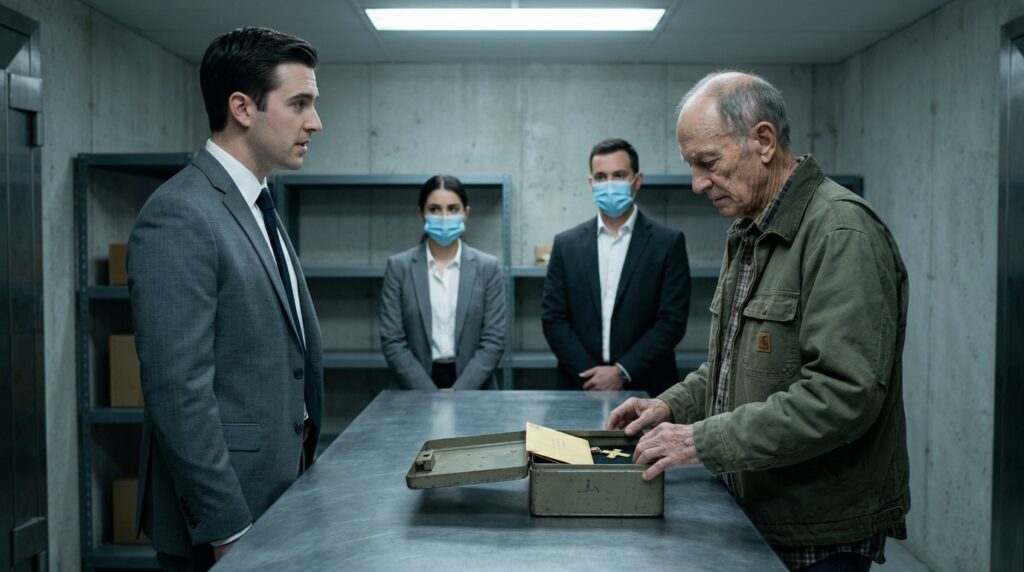
CHAPTER 7: THE REVERBERATING END
The shadow with the crowbar moved first, its boots crunching heavily into the gravel directly beneath the window frame. Thomas didn’t look up to track the silhouette. He didn’t need to. In the foundry, if you watch the slag instead of feeling the heat on your skin, you’re already burned.
He didn’t reach for the keys on the hook. That was the choice they expected—the predictable scurry of a cornered animal. Instead, Thomas rolled his weight backward, his spine scraping the rough pine veneer of the lower cabinet until his boots found purchase against the steel frame of the propane stove. He kicked out with his right heel, hard, driving the base of the old appliance directly into the copper gas line behind it.
The pipe didn’t snap—he didn’t want a spark—but the old brass valve hissed, a sharp, cold plume of pressurized gas venting straight through the floorboards toward the porch.
“Miller!” Thomas shouted, his voice a gravelly roar that rattled the broken glass remaining in the frame. “You tell this suit what happens when a match hits the floorboards of an uninsulated single-wide! You tell him if he wants to burn the ledger, we can do it while we’re all standing on the pile!”
The footsteps on the porch stopped instantly. A muffled oath came from the broad man with the iron bar. Through the gap beneath the Formica counter, Thomas saw the presenter take two steps back, his pristine leather shoes slipping on the wet wood of the steps.
“Mr. Vance, let’s not be foolish,” the presenter called out, though his cadence had shifted up, the professional ice cracking under the immediate, kinetic threat of an explosion. “There is no profit in mutual destruction.”
“I’ve spent fifty years living in the destruction you people left behind,” Thomas said. He didn’t look at the window; he kept his eyes on the small wooden drawer from his tool chest, which he had dragged into the narrow space between the counter and the stove. His hands were steady as he reached inside, sliding his thumb over the frayed blue ribbon of the gold cross medal, then wrapping his fingers completely around the tarnished iron key with the square head.
He wasn’t going to run to the car. He didn’t have to leave the yard to win the Monday morning deadline.
Outside, Greg’s voice rose from the dark of the ditch, cracking with a wet, ragged cough. “He’s not bluffing, kid! The old man’s worked the furnaces since before your father had a desk! He knows exactly how much iron it takes to crush a room!”
“Gregory, quiet,” the presenter snapped, but the authority was gone from his tone. The subtext had fully dissolved. They were no longer representatives of a slow, indifferent legal probate; they were predators who had realized the prey had dug into a bunker lined with black powder.
Thomas used the distraction to slide toward the narrow hallway that led to the utility closet at the back of the trailer. He didn’t break line of sight with the front window until he was clear of the kitchen. The floorboards here were soft, the carpet fraying at the edges where thirty years of tracking grease had rotted the fiber. He reached the heavy iron door of the old cast-iron floor safe—the one his grandfather had sunk into the chassis of the trailer when the county first re-zoned the valley.
The lock was stiff, its tumblers dry and clogged with lint. Thomas inserted the square-headed iron key into the slot. It didn’t turn at first. He braced his shoulder against the particle-board wall, his rough palm pressing into the cold iron handle until the mechanism gave a deep, metallic thud that resonated through the steel frame of the entire structure.
Inside the safe wasn’t a weapon. It was an old, land-grant deed box, sealed with the official ribbon of the state circuit court from 1974.
He pulled the ledger from his jacket, along with the white stationary from State Asylum No. 3. He didn’t try to hide them again. He placed them directly inside the open deed box, right next to the original registry page that bore Gregory Miller’s young, compromised signature. Then, he didn’t turn the key to lock it. He left the safe wide open, the yellow beam of his flashlight illuminating the documents clearly for anyone standing in the hallway.
He walked back to the kitchen, his posture no longer stooped. He stood up straight, his head and shoulders visible through the broken window frame, looking out into the misty twilight.
The presenter was standing at the bottom of the steps, his hands raised slightly away from his dark wool overcoat, his face pale under the neon glare from the highway. Behind him, the broader man had lowered the crowbar, his shoulders slumped in the posture of a laborer who had realized the foreman was no longer looking.
“It’s already filed,” Thomas said, lying with the absolute, unblinking precision of a man who had spent forty years validating structural tolerances. “The court clerk didn’t bribe just one person in seventy-six. My mother kept duplicate copies of the asylum admissions log in the parish registry. The notary verified the signature match three hours before I ever went to your vault room.”
The presenter stared at him, trying to read the micro-expressions on Thomas’s scarred face. But there was nothing to read. The old man’s face was like the iron plates at the bottom of the forge—calcified, dark, and marked by fires that had gone out decades ago.
“You’re bluffing,” the presenter whispered.
“Try me on Monday morning, son,” Thomas said softly. “But until then, you’re trespassing on a parcel that’s under an active probate injunction. Gregory knows the sheriff’s name. He knows how long it takes for the county cruiser to get from the crossroads when an old worker calls in a break-in.”
Gregory didn’t move from the ditch. He just looked down at his boots, his hands buried deep in his grease-stained uniform pockets, his shoulders shaking with another silent, defeated cough. He knew the paper was real. He knew that once the light got into the iron, there wasn’t enough grease in the valley to slide the door shut again.
The presenter looked at Thomas for five long seconds. Then, without another word, he turned on his heel, his leather shoes crunching sharply as he walked back toward the dark sedan waiting at the crossroads. The broad man followed him, the iron crowbar trailing in the dirt behind him like a broken wing.
Thomas stayed at the window until the red tail-lights disappeared into the valley fog for the final time. The wind was still cold, the smell of pressurized propane faint but clearing as the draft carried it away through the shattered pane.
He reached into his pocket, his fingers finding the photograph of the young woman on the porch. The textures were faded, the edges fraying, but the internal architecture of his life was finally solid. The house of hatred had been torn down, and in its place, the quiet, golden echo of a sacrifice had taken root in the iron.
He turned back to the kitchen table, picked up his cold coffee, and took a long, slow sip.








