
CHAPTER 6: THE SHADOW INTERSECTION
The twin cones of light from the highway didn’t just illuminate the road; they sliced through the hanging fog, throwing long, skeletal shadows of the junked machinery across the trailer’s aluminum siding. Thomas moved in the dark, his boots knowing every uneven hummock of frozen earth, every buried tire rim. He slipped through the screen door frame just as the sedan’s high beams washed over the front gate, turning the shards of his broken window into a constellation of cold, glittering points.
Inside, the wind was still whistling through the glass. Thomas didn’t turn on the kitchen light. He navigated by the pale gray glare filtering through the broken window, approaching the Formica table where the green lockbox lay open like an empty ribcage.
His fingers found the tarnished iron key with the square head, then the white asylum document, and finally the old ledger sheets he had recovered from his tool trunk. He stuffed them all down into the lining of his olive work jacket, zipping it up to his throat. The fabric was stiff, smelling of grease and the cedar chest where it had spent the summer. It felt like armor, but it was thin against the freezing draft.
“Greg’s wrong,” he whispered into the dark.
He pulled the pocketknife from his trousers, running his thumb over the split handle. Greg had said they wanted a burn. He had said the company wanted the records of the trust fund destroyed before Monday morning to protect the county land acquisitions. But the ledger pages Thomas had pulled from the tool chest didn’t just show money moving; they showed a series of signatures from the local notary public in 1976—signatures that authorized the transfer of the foundry assets while his mother was locked inside State Asylum No. 3.
And one of those witness signatures belonged to a younger shop steward named Gregory Miller.
The realization didn’t come with anger; it came with a dull, sickening weight, like a blow to the solar plexus. The shared burden of the valley’s decay wasn’t just a matter of corporate greed. It was a network of small betrayals, executed by tired men in laborers’ clothes who had been offered a way out while others were buried in the gray infrastructure of the state. Greg wasn’t standing in the ditch to give a friendly warning. He was standing there to see if the brick had done its work.
The sound of car doors clicking shut outside cut through his thoughts. Two distinct thuds. Not slammed, but closed with the quiet, heavy precision of expensive metal.
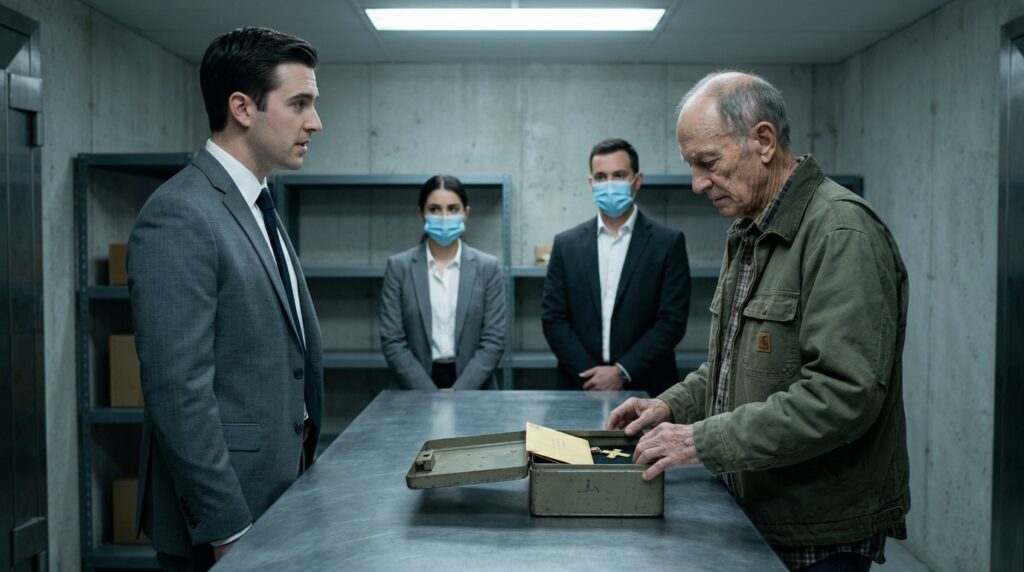
Thomas knelt behind the kitchen counter, his vision adjusted to the desaturated gloom. Through the broken window pane, he watched two figures advance up the gravel path. One was the young presenter from the vault, his sharp grey suit now covered by a dark wool overcoat that absorbed the light. The other was taller, broader, his face obscured by a low-brimmed hat. They walked slowly, their feet crunching methodically on the stones.
“Mr. Vance,” the presenter’s voice called out, perfectly modulated, carrying easily over the sigh of the wind. It lacked the cold bureaucracy of the vault room; it was conversational now, almost warm. “We know you’re inside. We left our vehicle at the crossroads to avoid causing an unnecessary disturbance in the neighborhood.”
Thomas didn’t move. He pressed his back against the lower cabinets, the bone handle of his knife digging into his palm.
“Gregory tells us you’ve opened the lower compartment,” the presenter continued, his footsteps stopping at the edge of the porch. The floorboards groaned—a familiar, dry protest that Thomas heard every morning. “The state probate office is a complicated machine, Mr. Vance. Mistakes are made in the archiving of old corporate liabilities. We are prepared to offer a private settlement that addresses the oversight regarding your mother’s care. Substantially more than the land itself is worth.”
The subtext was clear as a bell. The decoy was the land title; the real threat was the exposure of a fifty-year-old institutional conspiracy that could bankrupt the holding company if the state registry was forced to audit the 1976 acquisitions. They thought he was a pragmatist. They thought forty years at the foundry had left him tired enough to take a check and buy a warmer house somewhere else.
“I have the ledger,” Thomas called out, his gravelly rasp cutting through the broken windowpane. He didn’t rise. He kept his head below the level of the Formica counter. “I see the witness lines from October seventy-six, son. I see Greg’s name.”
A brief silence descended on the porch, thicker than the fog.
When the presenter spoke again, the professional warmth had completely vanished, replaced by the flat, indifferent tone of a machine that had encountered an obstruction. “Gregory was a young man with a family to feed during the layoffs, Mr. Vance. Most people in this valley made choices they aren’t proud of. But a ledger without an official certification from the state archive is just an old book. If you don’t return to the vault office with us tonight to complete the formal verification, the estate will simply be tied up in litigation until neither of us is alive to see the conclusion.”
The shadow of the broader man shifted, the silhouette of an iron crowbar catching the faint neon glare from the highway down the road. They weren’t waiting until Monday. They were going to take the box, the paper, and the ledger right now, and the valley would simply record another old trailer fire caused by a faulty space heater in November.
Thomas gripped the knife tight, his eyes tracking the line of the floorboards toward the back door. The primary action wasn’t here in the kitchen anymore; the narrative had evolved into a calculation of endurance. He had to reach his car, but the keys were on the hook by the front door—exactly three feet from the broken window where the presenter stood.








