
CHAPTER 2: THE SUNSET IN THE REARVIEW
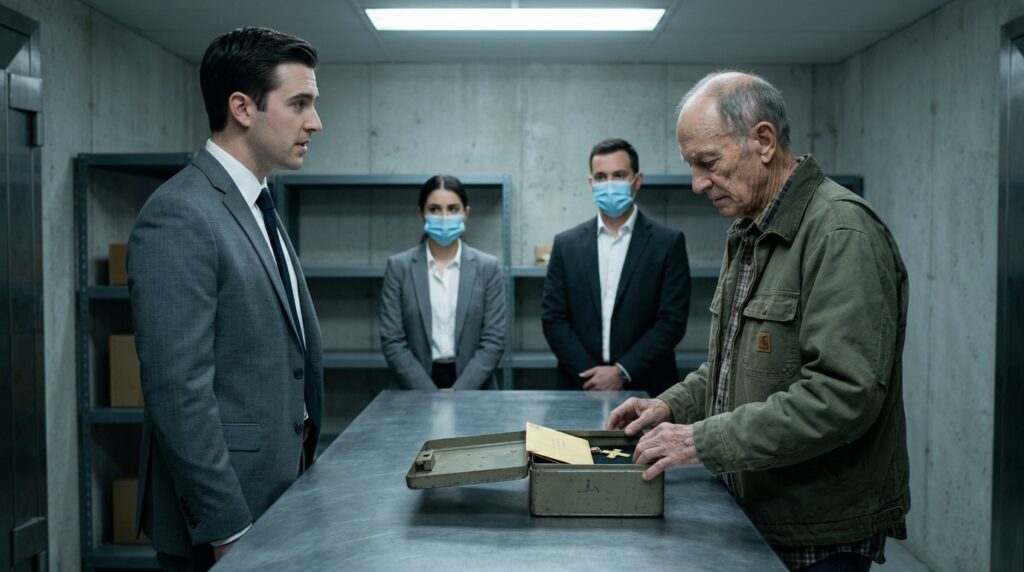
The heater in Thomas’s twenty-year-old sedan didn’t warm the cabin so much as it blew the smell of scorching dust and old oil directly into his face. He held the steering wheel with both hands, his knuckles white against the cracked black vinyl wrapper. On the passenger seat, resting on a frayed flannel blanket he kept for hauling tools, the green metal lockbox sat like an unexploded shell.
Every time the car bounced over a pothole on the interstate, the box shifted. And every time it shifted, Thomas heard it—not just the light rattle of the yellowed envelope against the tin sides, but that low, heavy thud from beneath the velvet lining. The sound of a secret with a basement.
The sky outside the mud-splattered windshield was the color of a bruised plum, the last bleeding edge of a November sunset fading into a cold, flat gray. The streetlights of the valley were just flickering awake, distant and dim through the haze of industrial exhaust. Thomas glanced at the box, then back to the road. His thumb automatically sought the split in the bone handle of the pocketknife in his jacket pocket, pressing until the edge bit into his skin.
He didn’t go straight back to the trailer. He couldn’t. Instead, he pulled into the gravel lot of the diner near the old foundry—a place where the coffee tasted like copper and nobody asked why your hands were shaking.
He left the box wrapped in the blanket, tucked beneath the seat, locking the rusted door with a heavy twist of the key. Inside the diner, the air was thick with grease and the soft, rhythmic sigh of the pie case compressor. He took a booth in the back corner, where the vinyl was patched with silver duct tape that caught the glare of the neon sign outside.
When the waitress dropped a thick ceramic mug in front of him, the steam rose in a lazy, curling spiral. He wrapped his palms around the porcelain, letting the heat seep into his stiff joints. His skin was dry, crosshatched with the fine gray lines of embedded iron dust that fifty years of soap hadn’t been able to wash away.
“You look like you saw a ghost, Tom,” she said, wiping the laminate table with a rag that smelled faintly of bleach.
“Just bureaucratic nonsense down at the county seat, Martha,” he murmured, his voice flat. He didn’t look up from the dark surface of his coffee. “Just paperwork.”
“The kind that keeps a man from breathing?” She paused, the rag hovering. She’d known him since his wife passed, since the foundry downsized him, since he became a fixture of the back booth. She knew the exact cadence of his silence.
“The kind that rewrites thirty years of dinner conversations,” Thomas said.
He didn’t touch the coffee. He waited until she moved down the counter to refill a trucker’s mug, then he reached into his breast pocket. He pulled out the yellowed envelope. He hadn’t opened it in the vault—he hadn’t given that sharp-suited boy the satisfaction of watching him break—but here, under the buzzing fluorescent tube, the red wax seal looked less like a legal boundary and more like a scab.
His fingers were clumsy as he broke the wax. It didn’t snap cleanly; it crumbled into tiny, dark red flakes that scattered across the laminate table like dried blood.
Inside the envelope were three pages of heavy linen paper, the edges soft and fibrous with age. The handwriting was elegant but hurried, the ink faded from black to a sepia brown that looked like it would dissolve if he breathed too hard on it. He smoothed the first page flat with the palm of his hand, his rough skin rasping against the texture of the past.
Thomas, the letter began. There was no greeting. No ‘my dear boy.’ Just his name, written with a sharp downward stroke that he remembered from the margins of old schoolbooks.
If you are reading this, the state has finally run out of reasons to keep my iron under lock and key. They will tell you this is an inheritance. They will tell you it is your right. I am writing this to tell you that it is a ledger of what I had to tear down so you could build something that didn’t smell like soot.
Thomas leaned back, the vinyl of the booth groaning beneath his weight. His breath came short. The subtext of his life had always been that she had left because he wasn’t enough—because the foundry wasn’t enough, because the valley was too small for her ambitions.
He forced his eyes down to the next paragraph, his heart hammering against his ribs like a trapped bird.
You will find the cross. It belonged to your grandfather before the war took his mind. But more importantly, you will find the record from the state registry dated October 12, 1976. I signed the absolute waiver of maternal relation. I stripped your name from my ledger. I told the court, and I told you, that I wanted no part of the life you were making.
Thomas dropped the paper. The words seemed to vibrate on the page. It was exactly what he had believed, but seeing it in her ink—seeing the confirmation that she had legally, purposefully severed the cord—felt like a second eviction. The diner around him seemed to recede, the clatter of silverware turning into a distant, underwater roar.
But then his eyes caught the final line of the first page.
The man who came to the house that night wasn’t an auditor, Thomas. And the debt wasn’t mine.
He picked up the page again, his hands shaking so violently the linen rattled. He turned to the second sheet, but the text there was fragmented, lines crossed out with heavy, angry strokes of the pen.
Thomas swallowed hard, a cold sweat breaking out along his hairline. He stood up abruptly, leaving a five-dollar bill on the table next to the untouched coffee. He stuffed the letter back into his jacket, his fingers brushing against the pocketknife.
He needed to get back to the car. He needed to get to the tool shed behind his trailer. The letter was a shield, but the box—the box had a double floor, and whatever was clicking underneath that velvet wasn’t a legal waiver. It was the real weight.
As he pushed through the diner’s glass door into the biting November air, the gravel crunching beneath his boots, he didn’t notice the dark sedan parked at the far edge of the lot, its headlights dark, its exhaust turning into white plumes in the cold. He only saw the green metal box waiting for him under the seat, a cold iron anchor demanding to be hauled to the surface.








