
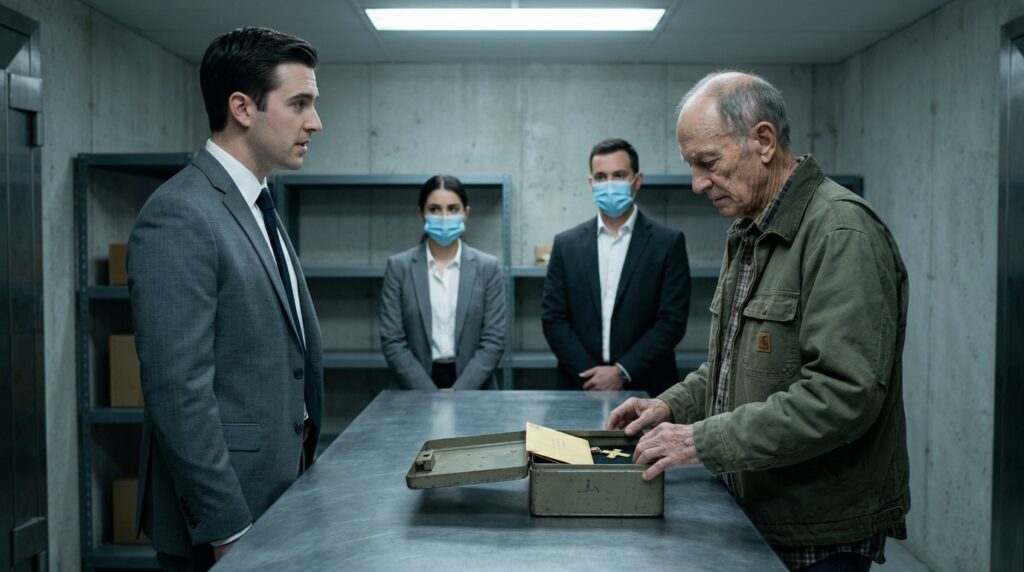
CHAPTER 3: THE FRAGMENTED LINE
The gravel yard outside the trailer was choked with the skeletal remains of old machinery, their rusted gears half-buried in dead weeds. Thomas didn’t lock the sedan’s door this time; he simply grabbed the green metal box by its flaking handle and marched toward the porch. The cold night air lunged into his lungs, but the sweat on his neck remained hot. Behind him, the country road was silent, yet the phantom weight of that dark sedan from the diner lot seemed to linger at the edge of his vision like a smudge on a lens.
He kicked the screen door open. The interior of the trailer smelled of old newsprint and the winter squash he’d left on the counter to cure. It was a space designed for one man to grow old in without bothering anyone else—small, wood-paneled, and quiet.
He slammed the box down onto the Formica kitchen table, right beside an unwashed plate and an empty tin of tobacco. His breath came in ragged, uneven spurts.
“October twelfth,” he muttered, pulling the three pages of heavy linen paper from his jacket pocket. His fingers left gray grease smudges on the margins as he unfolded them under the low-wattage bulb of the ceiling fixture.
He bypassed the first page entirely, his mind rejecting the cold reality of the legal waiver, and focused his gaze on the second sheet. Here, the elegant penmanship deteriorated into a jagged scrawl, choked by thick, aggressive lines of India ink that completely obliterated entire sentences. It looked like someone had tried to drown the words after writing them.
Thomas held the paper directly up to the bulb, trying to bleed light through the black ink blocks.
…they came to the forge before the morning shift… he managed to decipher, his eyes straining against the yellow glare. …said the audit was just the beginning. If the boy stays on the deed, the liabilities will transfer. They don’t want the land, Thomas, they want…
The rest of the line was a solid bar of black.
He moved his thumb down, the split handle of his pocketknife pressing hard against his thigh through his trousers. The subtext of his life—the solid, concrete wall of hatred he had maintained against his mother for half a century—was fracturing. This wasn’t a story of a woman running away to the city because she hated the grime of the valley. This was a ledger of terms.
…I signed the waiver because a mother who hates you is a mother who cannot be leveraged, the scrawl continued near the bottom of the page. The court clerk took the bribe to file it under the closed probate archive. If you ever find this, it means the clock has run out on their paper. Do not look for me. Look at what is left in the iron.
Thomas dropped the paper back onto the Formica. The silence of the trailer was suddenly too loud, filled with the hum of the old refrigerator and the distant whistle of a train cutting through the valley floor. “Look at what is left in the iron,” he whispered.
He turned his attention back to the green box.
The yellowed envelope and the gold cross medal with its frayed blue ribbon were gone from the main compartment, left on the table. The interior of the box was empty now, save for the purple velvet lining that looked faded and threadbare under the light.
Thomas reached inside, his calloused fingertips pressing into the corners of the tin. He pushed downward, then laterally. Nothing moved. He leaned his weight into it, his knuckles popping.
With a dull, solid click, the right corner of the lining gave way.
The false bottom didn’t slide open smoothly; it was stuck with decades of accumulated grime and structural warp. Thomas pulled his pocketknife from his jacket, flicked the worn blade open with his thumb, and wedged the steel into the seam. He pried upward, the metal of the box groaning in protest until the velvet-covered tin plate popped loose with a sharp snap.
A small cloud of gray dust and dry rot escaped into the air.
Beneath the plate lay a secondary floor, barely half an inch deep. It didn’t contain money, nor did it contain land deeds. Nestled in the shallow dark was a folded piece of official government stationary, crisp and white compared to the linen pages, and a small, tarnished iron key with a square head.
Thomas didn’t touch the key yet. He reached for the paper, his heart hammering a frantic, uneven rhythm against his ribs. The letter had given him a decoy—the agonizing truth that she had intentionally disowned him to cut a deal with unnamed auditors. It was a devastating failure of everything he thought he knew, a revelation that made her look like a coward who traded her son for a clean ledger.
But as he unfolded the crisp white stationary, the heading at the top made his breath stop completely.
DEPARTMENT OF REHABILITATION AND CORRECTIONS – STATE ASYLUM NO. 3.
DATE OF ENTRY: OCTOBER 14, 1976.
Thomas’s eyes flew down the page, skimming past the clinical jargon until they locked onto the patient name and the diagnosis section. It wasn’t an audit. It wasn’t a financial liability.
Before his brain could fully process the words on the medical discharge form, the window behind him shattered.
A brick wrapped in heavy packing paper crashed through the glass, showering the Formica table and the old letters in a spray of glittering shards. The sudden blast of cold night air cut through the room, spinning the loose flakes of red wax across the floor.
Thomas instinctively dropped to his knees, his boots crunching on the glass, his hand gripping the bone handle of his knife as he stared up at the dark, broken square of the window, where the low hum of an idling engine could be heard out in the driveway.








