
CHAPTER 8: THE LAST TURNING OF THE SOIL
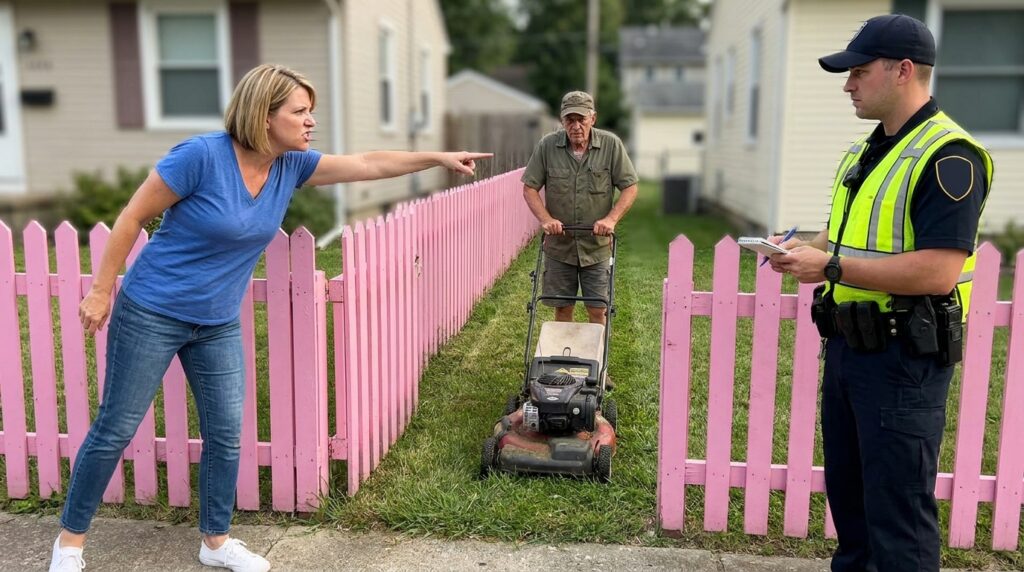
The knots in the starter nylon didn’t give. When Frank wrapped the grease-hardened cord twice around his palm, the fiber bit deep into the raw split on his knuckle, cementing the yellow road dust directly into the meat of his skin. He didn’t wait for Miller to clear the gate opening. He took a short, lateral step until his left boot heel was wedged against the iron flange, braced his hip against the green shroud of the deck, and threw his weight backward into the white glare of the noon.
The engine didn’t catch on the first pass. It gave a dry, metallic hack—a flat slam of cast iron against steel rings that sent a small puff of oily, blue exhaust straight down into the wild orchard grass. The smell of scorched regular unleaded hit the dirt first, thick and hot, mixing with the vinegary sting of the lime sludge until the air in the ditch felt like the floor of an unventilated maintenance barn. Across the lane, the blinds in the beige house settled back against the glass with a dry, plastic rattle, their shadows dropping straight down the siding as the street-side watchers went quiet.
Frank didn’t drop his arm. He adjusted the loop around his fingers, feeling the frayed edges of the cord rasping against his wet calluses, and pulled again.
The single cylinder tore open with a heavy, ungreased roar that shook the lower rail of the pink gate. The vibration traveled up through the welded handle bars, settling into the bones of Frank’s elbows with a hard, continuous thrum that turned the glare of the street into a series of gray, trembling rings. He didn’t look back at Martha Vance where she stood on the second step of her porch, her blue V-neck shirt a flat square of faded cotton trapped inside the dark rectangle of the box elder shadow. He shifted his thumbs to the throttle wire, pinning the slide until the engine reached that flat, smoky scream it only hit when the blade was clogged with heavy mud.
He pushed the front wheels forward, the iron edge of the deck dropping through the transition into the overgrown garden lane.
The blade didn’t hit soft grass. The moment the housing cleared the boundary line, the steel took a violent, shuddering bite out of the gray sludge surrounding the hydrangea roots. The sound was a wet, heavy thud-thud-shred that tore the stalks out by the fiber, throwing chunks of pasty, chemical-soaked lime directly against the freshly painted pink pickets. With every inch the machine advanced, the dark ooze beneath the third post didn’t just drain—it widened, the churning action of the blade exposing the rusted lip of a secondary, unrecorded three-inch pipe that ran parallel to the wooden foundation, bypassing the city’s concrete culvert entirely.
It was an unpermitted drain line, the iron scaling off in thick, purple flakes that fell into the rotating blades. The truth of the line sat bare in the sun now, stripped of the three yards of river gravel Martha’s father had dropped to hide the outlet. It was a direct bypass, dumping the old tank wash runoff from the closed industrial site straight into the municipal ditch under the cover of a residential fence. The pink paint wasn’t a boundary markers’ shield; it was an active cover for thirty seasons of civil overreach that had poisoned the water down on the Miller fork.
Deputy Miller didn’t move his boots away from the gate. He stood with his official leather notepad pinned against his high-vis vest, his face completely gray under the stiff brim of his patrol cap as he watched the machine expose the pipe flange. He didn’t pull his pen. His fingers stayed hooked over his utility belt, the heavy dark fabric of his uniform trousers stained with the greasy slime that the rotating blade had whipped into the air. He didn’t order Frank to stop a second time. The radio on his lapel was still chirping with the high, broken static of the district office, but the sound remained secondary to the rhythmic, destructive chug of the Toro cutting through the last yard of the easement.
Frank held the machine steady, his shoulders locked against the bucking handle as the final strip of chicory and wild onion went into the discharge chute. The steel housing scraped once across the exposed iron of the illegal pipe, a sharp, screaming spark of orange fire cutting through the yellow dust before the deck cleared the transition and hit the clean gravel of the lower lot.
He pulled the throttle wire back until the engine died with a long, whistling hiss of hot oil.
The silence that came back over the block was heavy, full of the smell of turned lime mud and the dry, iron tang of split metal. Martha Vance didn’t move her hands from her pockets. She stood perfectly still on her step, her square sunglasses fixed on the fresh, black trench Frank had left along her white sneakers’ path. The carpenter’s pencil was gone from her fingers, dropped somewhere in the dust of her walkway when she took that single, forced step into the dark.
Frank didn’t look for an apology. He reached for his rag, wiped the greasy smudge from his palm, and looked down at the clean, flat line of the ditch. The fence was still standing, its bright pink pickets splattered with the gray sludge of the subsoil, but the boundary had shifted for good. The iron was out of the grass.








