CHAPTER 2: THE ANGLE OF THE RECKONING
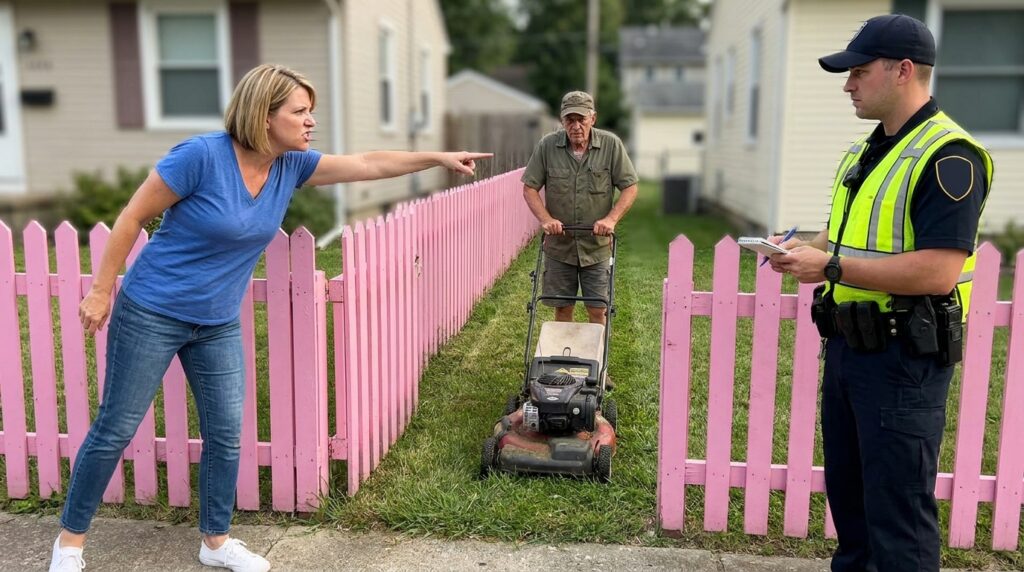
“A civil trespass requires an established line, Martha, not just an opinion written down in a soft-lead pencil,” Frank said. He didn’t take his hand off the starter grip of the Toro. The rubber handle was cracked from three summers of valley heat, the black compound leaving a greasy, charcoal-colored smudge across the meat of his palm. He could feel the grit from the ditch road settling into the collar of his olive work shirt, itching against his throat like dry horsehair. He didn’t shift his boots. If he moved three inches to the left, he’d be standing on the sun-bleached rye grass that grew through the bottom wire of her fence, and he wasn’t about to give her the satisfaction of a photograph.
Martha Vance didn’t blink behind the square, tinted lenses of her sunglasses. The reflection of the gravel road stayed perfectly flat in the dark plastic, two gray lines meeting at a point somewhere near Frank’s shins. She adjusted her grip on the leather binder, her knuckles turning the color of skim milk against the grain of the hide. She wasn’t a tall woman, but she had the heavy, set-back posture of someone who had spent twenty years behind the zoning desk at the county annex, watching people run out of money before they could finish their retaining walls.
“The line was established by the district engineer during the municipal runoff survey of ninety-eight,” she said. Her voice had the dry, unhurried click of a typewriter carriage returning. She didn’t point this time; she simply shifted the ledger three inches to the right, using the corner of the heavy cover to indicate a small, notched scar on the concrete apron of the culvert. “The town code stays clear on secondary easements, Frank. If you’re operating mechanical equipment within eighteen inches of a structural barrier without an aggregate permit, the fine accumulates by the hour. I’ve already logged the timestamp.”
“The ninety-eight survey didn’t account for the lateral shift in the creek bed after the flood,” Frank muttered. He leaned his weight back onto his heels, his work shoes sinking an eighth of an inch into the dry, powdery silt of the ditch bank. “The whole culvert moved four inches south when the county dropped the twin pipes under the county line. Your old daddy knew that. He’s the one who planted these posts four inches short so he wouldn’t have to clear the poison ivy out of the riprap.”
Martha’s jaw didn’t just tighten; it seemed to lock into the skin around her ears, the small muscles below her cheekbones flattening until her bobbed hair caught the glare from the sky. She reached into the side pocket of her blue V-neck shirt, her fingers emerging with a small, worn piece of graphite—a carpenter’s pencil, the tip shaved flat with a utility knife instead of a sharpener. She didn’t look down as she made a single, heavy stroke across the top edge of the binder’s index page. It was a rhythmic, practiced motion, the sound of the dry lead tearing slightly at the cheap pulp paper between them.
“My father left a clean deed, Frank. More than you can say for the acreage your nephew’s trying to parcel out behind the lumber yard,” she said. She took half a step forward, her white sneakers coming within an inch of the pink picket gate’s lower edge. The movement brought the smell of her—laundry detergent, stale peppermint, and the dry, paper-dusted scent of old filing boxes—right through the gap in the cedar pickets. “The county doesn’t care about the creek shift. They care about what’s filed in the vault. And right now, the vault says you’re five inches into the tax lot.”
Frank let his eyes drift from her face down to the bottom rail of the fence. The pink latex paint was thick there, globbed over the screw heads where her father had reinforced the hinges after the frost heave of 2012. But below the paint, right where the cedar runner met the main corner post, there was a dark, wet stain that didn’t match the dry mid-summer dirt. It wasn’t water. It had an iridescent, oily sheen that didn’t belong in a front-yard garden bed—a sluggish, chemical rust that seemed to be bubbling up from beneath the root system of her prized hydrangeas.
He knew that stain. He’d seen it forty years ago when the old man was still running the asphalt distributor for the state road crew, parking the tank trucks in the lane after dark when the supervisors weren’t checking the mileage logs.
“Your daddy didn’t leave a deed, Martha,” Frank said, his hand finally dropping off the starter rope. The nylon cord snapped back against the engine shroud with a sharp, metallic clink that sounded like an empty shovel hitting gravel. “He left a map with three different ink colors on it, and two of them don’t have signatures from the recorder’s office.”
Before she could answer, the low, greasy rumble of a small-block V8 came down from the ridge road, the sound dropping into the cul-de-sac before the car even cleared the tree line. It was the white-and-gray Dodge from the south district precinct, its heavy tires crunching the loose stones at the edge of the asphalt as it slowed down to a crawl. The light bar on the roof didn’t have the flashers on, but the blue lenses looked like cold ice against the yellow dust of the valley.
Martha didn’t turn her head toward the noise. She just held the binder against her ribs, her thumb pressed so hard into the leather that the seam began to stretch. “That’s Deputy Miller,” she said, and for the first time, her voice had a small, dry pocket of air in it. “He’s got the ninety-eight plot sheet in the cruiser.”
Frank didn’t look at the car either. He kept his eyes on that dark, greasy line beneath the pink post, watching a single bubble of gray fluid break against the dry clay.