CHAPTER 4: THE ACCUMULATION OF DEBT
“Show him the back of the third append sheet, Martha,” Frank said. He didn’t drop his hand back to his pocket. He extended one split, grease-stained finger toward the bottom edge of the leather binder where her thumb was still clamped hard enough to whiten the nail. “The part from twelve years back. When the county drainage supervisor had to sign off on the culvert repair after the winter overflow.”
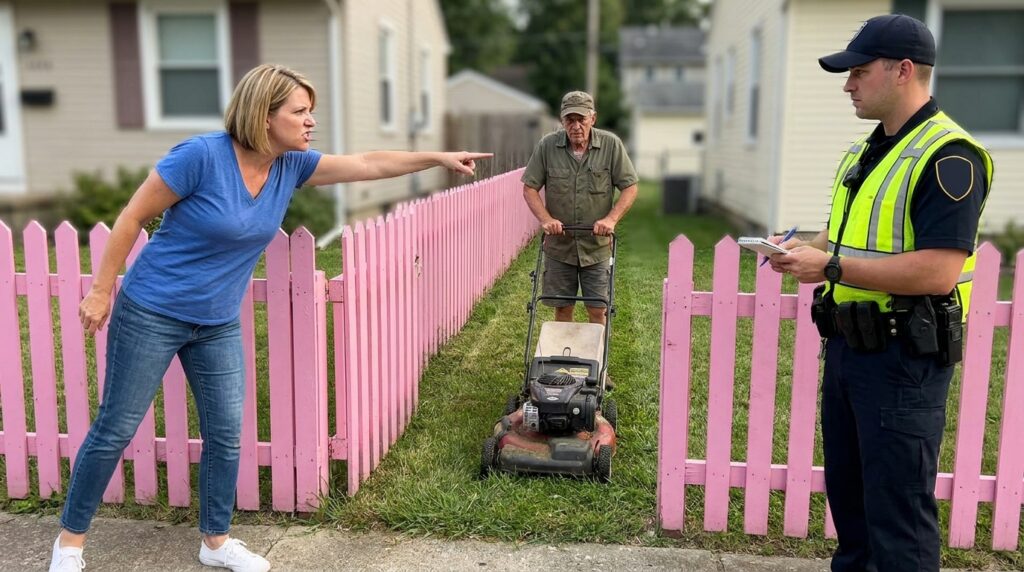
Martha didn’t move for three seconds, her shadow stretching long and rigid across the sun-bleached rye grass between her shoes and the fence rail. The blue V-neck shirt didn’t give off the soft rustle of cotton; it stayed completely still under the noon glare, pinned by the dead air that pooled in the corner of the lot. Then, with a slow, jerky rotation of her wrist, she tilted the ledger just enough for the light to slide across the top document. A pale yellow sheet, thinned by basement damp and wrinkled at the margins where the water-mark had bled, lay directly beneath the current zoning log. It was an official county citation, dated April 2014, bearing the faded purple ink stamp of the South District Enforcement Office.
Deputy Miller leaned his chest forward, his leather utility belt groaning as his holster rubbed against the heavy metal of the gate hinge. He squinted through his tinted lenses, his nose twitching once at the sour, vinegary odor that continued to bubble from the root system of the hydrangeas.
“What is that, Martha?” Miller asked. He didn’t wait for her to flip the page. He reached out with two fingers, his gray knuckles dark against the brittle, yellowed paper as he turned the document over against the grain of the binder’s rings. “This says there’s a permanent stop-work order on the maintenance lane. Signed by my uncle when he was still presiding over the district board.”
“It was an administrative oversight that was countered by the secondary filing,” Martha said. Her voice didn’t rise, but it had a thin, scraping rattle like dry gravel being turned over with a shovel. She pulled the binder back against her ribs, her white sneakers shifting two inches away from the post foot where the dark ooze had begun to crust into a greasy, purple ring. “The town had no legal jurisdiction over the private right-of-way once the culvert was backfilled. The family took over the maintenance obligations under the standard civil exemption.”
“The exemption didn’t pass, Martha,” Frank said, his boots crunching into the dry clay as he took half a step closer to the pickets. He pointed directly at the purple ink at the bottom of the page. “Look at the line beneath the signature. The county didn’t give your father the maintenance rights. They ordered him to dig out the ditch line and expose the original survey stake because the flow was backing up into the lower orchard. He never did it. He just built this pink fence six inches higher and ran the latex paint over the rot.”
Miller didn’t take his eyes off the paper. He pulled his carpenter’s pencil out of his shirt pocket, using the flat, shaved graphite edge to trace a line of text that had been obscured by a heavy streak of blue ballpoint ink. “This line here,” Miller muttered, his face darkening under the shadow of his patrol cap. “It says any mechanical alteration of the grade within five feet of the junction box is a code violation until the primary line is cleared by a state engineer. Frank, when did you last see the junction box?”
“It’s under the third post from the corner,” Frank said, his voice dropping into the low, rumbling rhythm of an old tractor engine idling in a closed barn. “The one she’s standing next to. Her old man dropped three yards of river gravel over the iron cover back in eighty-eight so the district inspectors wouldn’t check the outlet pipe.”
Martha’s arm went rigid, the leather binder shaking slightly against the blue cotton of her shirt. She didn’t look at Frank; her eyes stayed pinned to the deputy’s badge, tracking the small, silver reflection of the box elder trees that wavered in the polished metal. “The gravel was placed for erosion control, Bobby. Your uncle knew about it. He’s the one who suggested it after the spring wash.”
“My uncle didn’t sign this append sheet, Martha,” Miller said, and this time his voice lost the easy, slow-valley crawl that he used for routine traffic stops. He tucked the paper back into the binder rings with a sharp, heavy flick of his wrist that left a small tear in the thinned margin. “This is a non-certified copy. The enforcement office kept the original because the fine was never settled. According to this record, this entire fence line has been under a statutory lien since before my first year in the academy.”
The grease beneath the post gave a soft, wet pop as another bubble of gray fluid broke through the crust. The smell of it was thick now—not just old solvent, but the sharp, metallic tang of industrial sulfur that had been cooking under five feet of packed clay and river stone for thirty summers. Frank didn’t look at Martha’s face. He looked at the single push mower sitting behind his shins, its steel blade still holding the plug of dried mud he’d scraped off an hour ago. He knew the fence wasn’t just a boundary anymore; it was a lid.
“Ma’am,” Miller said, his boots shifting until he was standing squarely between her gate and the edge of the asphalt. “You need to put that book in the house and step back from the ditch lane. I’m going to have to call the district supervisor out here to look at this grade.”
Martha didn’t answer. She took one slow step backward into the deep shadow of her porch lane, her white sneakers leaving two faint, gray impressions in the dust where the chemical line had begun to dry. Her fingers remained locked around the flat carpenter’s pencil, the graphite tip dug so deep into her index finger that the skin was stained a permanent, metallic gray.