
CHAPTER 5: THE UNYIELDING LINE
The halogen floodlights hissed above Lane Four, casting a harsh, desaturated glare that turned the concrete into a landscape of bone and shadow. Diesel exhaust from the transport truck rolled across the aggregate in thick, oily waves, sweet and suffocating. The candidates stood in a clean line at the active boundary marker, their knuckles white around the receivers of weapons that had never passed a domestic inspector’s ledger. They weren’t their standard M4s. These were stamped with rough, gray phosphate finishes and foreign serial blocks that felt cold and wrong under their gloves.
Albright stood by the front bumper of the idling transport, his hand resting on the canvas tailgate. Two military policemen stood behind him, their holsters unclipped, their posture stiff against the desert wind.
“The manifest is unsigned, Miller,” Albright said. His voice was nearly lost to the low, rhythmic thrum of the diesel engine. “You’re obstructing a strategic transit order. Step out of the lane.”
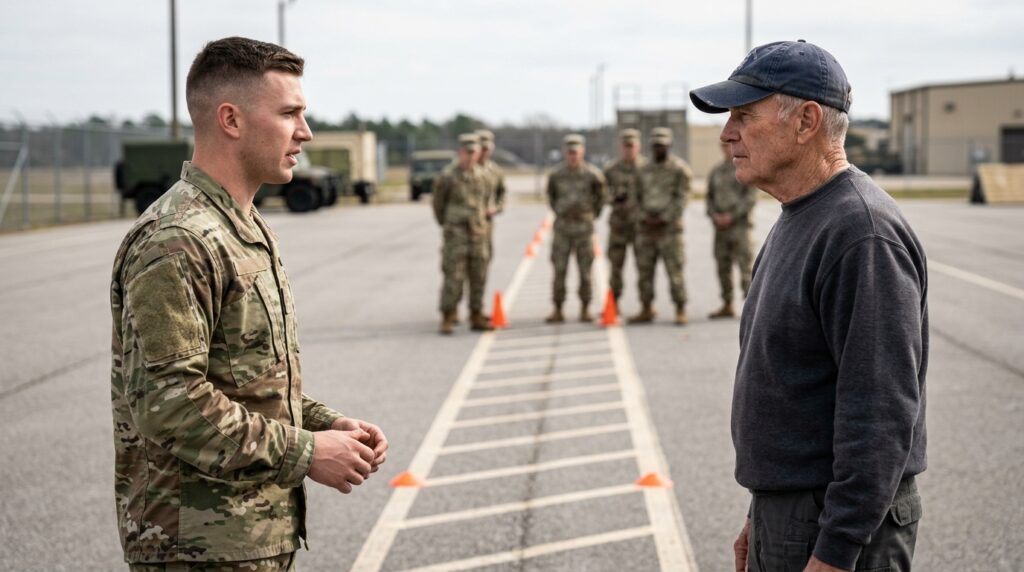
Miller didn’t step back. He stood directly in the entry mouth of the barricade, his feet set wide on the chalk line where Vance had dropped him hours before. His fingers didn’t touch his weapon’s grip; they were tucked inside his rig, holding a heavy steel armory gauge—a tool used to check bore erosion, old and pitted with dark rust along its barrel.
“The unit hasn’t cleared the verification block, Captain,” Miller said. The words came out slow, rhythmic, matching the ancient, mechanical tick of the stopwatch still hanging around Vance’s neck thirty feet back in the dark. “According to the facility charter, no operator leaves this tarmac for an active theater until the lead instructor signs off on their baseline stability. They are currently sitting at forty-one seconds on a thirty-eight-second line. They fail.”
“The line was written by a computer ten years ago,” Albright barked, stepping into the white glare. The flaking rust on the base of the light pole behind him looked like dried blood under the mercury vapor. “The theater doesn’t give a damn about three seconds, Miller. The aircraft is turning its rotors at the coast right now. Move them into the truck.”
“The line wasn’t written by a computer,” Miller said. He didn’t look at Albright; his eyes went down the line of his twelve candidates, meeting the gaze of the youngest—a kid named Evans whose greasepaint had started to run down his neck from the sheer heat of the idling engine. “It was written in the Horn of Africa. It was written in a concrete compound where twelve men took an entry three seconds too fast and left their rear security to a blank brick wall. They died because the man who signed their readiness sheet allowed an administrative schedule to dictate the speed of their boots.”
Evans shifted his grip on the foreign rifle, his eyes darting from Miller to the dark silhouette of Master Chief Vance standing just beyond the perimeter wire.
Albright nodded to the two policemen. They moved forward, their boots crunching on the gravel, their hands coming down toward Miller’s shoulders.
They didn’t reach him.
Vance stepped out of the shadow of the equipment lockers. He didn’t use force. He didn’t raise his voice. He simply placed his old, grease-filmed clipboard directly between the lead policeman’s chest and Miller’s shoulder line. The wood of the board was notched and splintered at the corners, showing thirty years of operational friction.
“The instructor is within his directive, Captain,” Vance said. The rasp in his throat had the cold, heavy finality of an iron door dropping into a groove. “I signed that ledger in 2016. I spent ten years watching the administrative desk use my name to justify shortcuts that turned young men into statistics before their first laundry rotation. The thirty-eight-second line is a failure threshold. If they go out there with these metrics, they aren’t going as operators. They’re going as a screen.”
Albright’s face went dark, the skin around his jaw tightening until the bone showed white through his tan. “This isn’t a training evolution anymore, Master Chief. The authorization came from the regional procurement director. These men have already been allocated. Their identification logs are deleted from the branch mainframe. If they stay here past midnight, they don’t exist on any ledger in the system.”
The final truth hit the lane like a physical weight—the cold, pragmatic reality of the gray zone. The system hadn’t broken down; it was operating exactly as designed. The candidates weren’t being trained to survive; they were being prepared to vanish into a conflict that didn’t have a name, using weapons that didn’t have a source, certified by an instructor whose keys were already broken in the lock.
Miller looked at Vance. The older man’s thumb was static on the stopwatch crown. The mechanical ticking had stopped.
“Then we stay on the tarmac,” Miller said. He reached down and gripped the iron rail of the barricade, his fingers catching on the rough, peeling paint. “If they don’t exist on your ledger, Captain, then you can’t log them out of my armory. We’ll run the lane again. And we’ll keep running it until their line is straight, or until the fuel in that truck runs dry.”
Albright looked at Miller, then at Vance, then at the twelve candidates who had simultaneously lowered their weapons from their shoulders, their barrels dropping into an unyielding, unified guard position across the yellow safety line. The two policemen stopped, their eyes tracking the sudden shift in the unit’s weight. The logic of the tarmac had overtaken the authority of the envelope.
“You’re ending your career right here, Miller,” Albright said, his voice dropping into a flat whisper as he stepped back toward the transport cab. “Both of you. The command will replace you by morning.”
“The morning is five hours away,” Miller said, his boots settling deeper into the alkaline dust of Lane Four. “That’s five hundred runs. Evans, take the point. Watch your rear security on the pivot. Don’t look at the clock.”
The transport truck began to back away, its gears grinding as it retreated into the darkness beyond the floodlights, leaving the tarmac to the raw hiss of the halogens and the steady, rhythmic sound of twelve men cycling their bolts in the cold air.








