
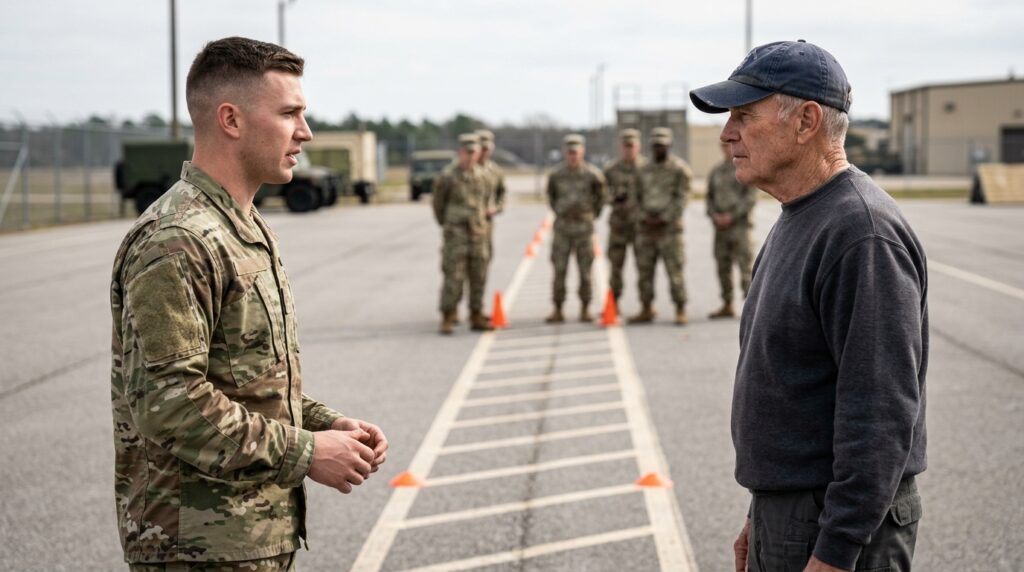
CHAPTER 3: THE GHOST IN THE TIMER
“You signed it.”
Miller’s hand remained flat against the laminate desk, the blue luminescence from the terminal catching the sweat that had beaded along his jawline. He didn’t turn around to face Vance yet. On the screen, the digitized stroke of the old master chief’s signature looked sharp, a frozen fragment of a bureaucratic compromise that had cost a squad their lives ten years ago. “Amendment 88-Alpha. Every metric I’ve been tearing my men apart to hit—the entry speed, the blind corners, the thirty-eight-second threshold—it isn’t a new efficiency standard. It’s a carbon copy of the failure at the Horn.”
Vance stepped into the room. His heavy boots made no sound on the grit-strewn linoleum, a habit born of years where noise meant a coffin. The scent of damp cotton and engine grease expanded into the air-conditioned frost of the bunker.
“The command doesn’t throw away old files, Miller. They just change the letterhead,” Vance said. He stopped three feet away, his shadow completely covering the keyboard. He reached down with a hand that looked like split wood and pressed the power button on the monitor. The blue light died instantly, leaving only the dim amber indicators of the tower hum. “You think you’re the first instructor to believe he could outrun a bad doctrine with better athletes?”
“They died because of this timeline,” Miller rasped, turning his head sharply. His eyes adjusted to the gray gloom, catching the dull silver gleam of the stopwatch hanging from Vance’s neck. “And now Command is forcing it down my throat for this current rotation. Why did you sign off on a failure?”
Vance’s jaw tightened, the old skin over his cheekbones hardening like cured leather. “Because ten years ago, the regional procurement office told me the same thing they’re telling your current commander today: the theater of operation doesn’t wait for mastery. They needed boots in the dirt by the end of the quarter. They wanted an evaluation that proved the accelerated pipeline worked on paper, so they could secure the deployment funding. I refused three times. Then they reminded me that if I didn’t sign it, they’d find a junior lieutenant who would—and those boys would go out there with zero training instead of three weeks of it.”
“So you gave them a survival rate based on a lie,” Miller said. The words were transactional, a cold calculation between two men who understood the value of resources.
“I gave them a line they could try to hold,” Vance countered, his voice dropping into a low, rumbling register that vibrated against the metal studs of the walls. “And I spent the last ten years watching this facility rot from the edges while the metrics grew prettier. But you aren’t just auditing old paperwork, Miller. If you were, you wouldn’t have been looking at the gate logs at 0330.”
Miller’s fingers reached into his pocket, his knuckles scraping against the sharp serrations of the foreign rifle tag he had pulled from Lane Four. “Harris said a depot truck bypassed the gate. They left grease on the concrete that isn’t ours. And when I checked the procurement queue before you shut the screen down, three of our standard armory inventory crates were missing their tracking numbers. They weren’t replaced by domestic carbines.”
Vance didn’t look surprised. He reached out and grabbed Miller’s rifle by the iron sling mount, lifting it slightly to feel the weight. “The administrative team isn’t just accelerating the schedule to look good for the inspectors on Friday, Miller. They’re balancing a second set of books. When the candidates go down to the depot for the live-fire phase tomorrow night, they aren’t using the training rifles.”
“What are they shooting?”
“The equipment that came off that truck,” Vance said, letting the rifle drop back against Miller’s gear with a dull metallic clink. “Foreign-caliber systems. Unmarked receivers. The kind of iron that doesn’t leave a trail back to a domestic supply chain when it’s abandoned in a ditch.”
The realization hit Miller like the forearm blow on the tarmac—dense, heavy, and stripping the breath from his lungs. The administrative pressure, the frantic rush to shave seconds off the clearing sequence, the sudden influx of unaccounted logistics—it wasn’t an evaluation at all. The candidates weren’t being prepared for a standard deployment review. They were being scrubbed from the grid before they even finished the course.
“They’re deploying them early,” Miller whispered, his eyes scanning the dark corners of the admin room as if the rusted iron frames themselves were listening. “Without the final phase. That’s why the metrics are fixed to the old Horn of Africa file—it’s the exact logistical template for an deniable operation.”
“They’re setting the clock,” Vance said, his hand moving to his stopwatch, his thumb resting over the mechanical crown. The faint, rhythmic ticking seemed to grow louder in the shadow of the bunker. “And your name is the one on the training sign-off sheet. By tomorrow night, if those boys don’t hit the thirty-eight-second mark on the live lane, the system logs it as an instructional failure. If they go into the dirt and don’t come back, it’s because Miller didn’t push them hard enough. The ledger stays perfectly balanced.”
The steel door at the end of the corridor groaned on its rusted hinges, a sharp scrape of iron against concrete echoing through the building. The sound of two sets of heavy, official boots entered the air-conditioned hall, moving deliberately toward the logistics cage.
Vance didn’t look back. His eyes remained locked on Miller’s, cold and probing. “That’s Captain Albright’s detail from District. They aren’t here to check your spreadsheets, instructor. They’re here for the signed clearance logs.”
Miller looked down at his terminal key, still slotted into the dead machine. The foreign metal tag in his pocket felt like an anvil. He had less than five seconds before the flashlights swept the glass partition.








