
CHAPTER 4: THE ORDER OF DEPLOYMENT
Miller’s thumb jammed into the terminal slot. He didn’t pull the key straight out; he twisted it hard to the left, snapping the internal copper pins with a dry, metallic pop. The amber lights on the tower blinked out, plunging the workstation into total dark just as the first sweep of a heavy incandescent flashlight brushed the wire-reinforced glass partition.
“Miller?”
The voice from the corridor was broad, thick with the weight of authority that didn’t belong to the grease-stained mechanics or the training staff. It was Captain Albright.
Vance didn’t move. He remained an immovable block of gray fleece against the filing cabinets, his breathing so shallow it didn’t even register against the low hum of the cooling fans. He merely pointed his chin toward the floor-level escape hatch beneath the desk—an old utility tunnel built when the facility still stored heavy artillery propellant.
Miller dropped. His knees scraped the concrete, the rough aggregate tearing the fabric of his trousers as he slid into the black recess of the hatch. He pulled the iron grate closed above his head, matching the click of the latch to the exact moment Albright’s heavy boot struck the door of the office.
Through the narrow slits of the iron grate, Miller looked up. The light from Albright’s flashlight cut across the room, illuminating the white hair on the back of Vance’s head.
“Master Chief,” Albright said, his voice flat, professional, and entirely missing the reverence usually afforded to the old veteran. “We’re looking for Miller. His terminal key is still registered as active on the grid, but the main gate didn’t log him out.”
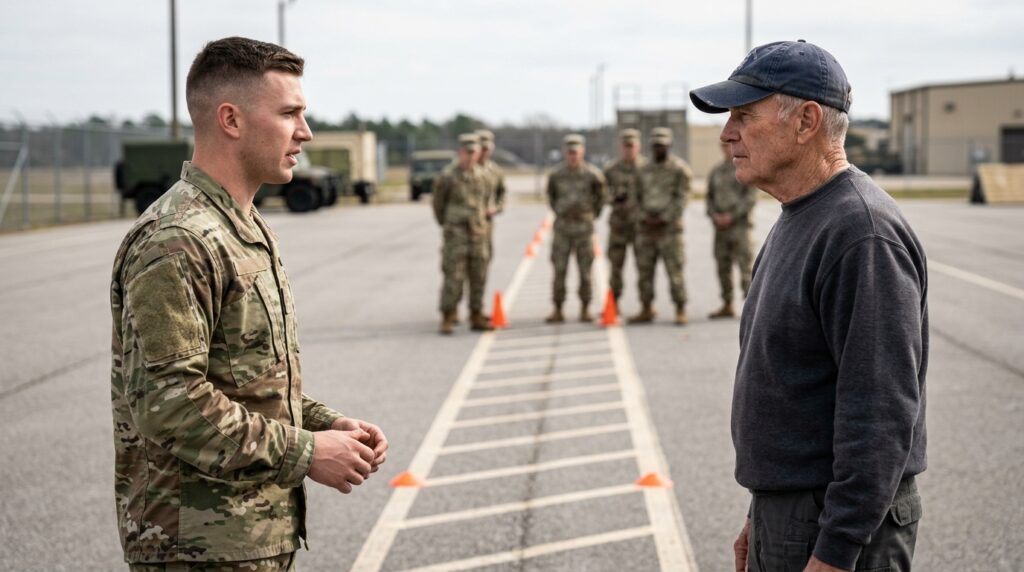
“He’s out on Lane Four,” Vance lied. His voice didn’t waver a fraction of a hertz. It had the same dry, static-crackle stability it had during an artillery barrage. “The boy broke his lane timer. He’s out there with a wrench trying to fix the digital display before the colonel’s inspection tomorrow.”
Albright stepped further into the room. The beam of his light caught the broken key shaft still protruding from the dead terminal. He walked over, his gloved fingers touching the shattered plastic. “Looks like he broke more than the timer. The regional desk just received an automated alert. System failure on Lane Four’s database.”
“The wiring here is forty years old, Captain,” Vance said, taking a slow step forward to block Albright’s view of the floor grate. “Everything in this facility is rusted down to the thread. If you want a clean network, buy us new boxes. If you want signatures, wait until the morning log is printed.”
Albright didn’t answer immediately. He reached into his coat pocket and pulled out a stiff, double-sealed manila envelope. The paper looked pristine, entirely untouched by the dust that claimed every surface on the base. He dropped it on top of the dead terminal.
“We don’t have until morning,” Albright said. “The deployment orders were signed off by District an hour ago. The live-fire phase at the depot is canceled. The candidates are boarding the transport at 2300 tonight.”
Miller felt the cold air of the utility tunnel settle into his bones. His fingers clutched the iron rungs of the ladder below him. Tonight. They were cutting twenty-four hours out of the schedule—cutting the final safety drills entirely.
“They haven’t cleared the thirty-eight-second lane,” Vance said, his tone dropping into a dangerous, static quiet. “They aren’t stable on the entry. If you push them into the line now, they’ll break before they get three doors deep.”
“They don’t need to be stable, Master Chief. They just need to be there,” Albright replied. He turned toward the door, his flashlight beam dropping to the floor, missing Miller’s fingers by an inch. “The operational window for the eastern sector opened early. Command doesn’t care about their split-times anymore. They care about numbers in the block. Tell Miller he has two hours to sign the readiness manifest in the order pack. If his signature isn’t on it when the truck leaves, the failure of the unit belongs entirely to his ledger.”
The boots retreated down the hall, their heavy thuds fading until the steel exterior door groaned shut.
Vance reached down and pulled the iron grate open. The old man’s face looked gaunt in the dim light of the corridor, the deep lines around his mouth resembling cracks in dried river mud. He offered Miller a hand, his grip like a rusted vice as he hoisted the younger instructor back into the room.
Miller didn’t waste time. He tore the seal on the manila envelope. Inside lay a thick stack of green-bordered deployment logs. The text at the top read: TASK FORCE RED HORIZON – PRIMARY EXPEDITIONARY MANIFEST.
His eyes didn’t look at the tactical coordinates. They went straight to the logistics pages. Attached to the back was a typed inventory sheet for the weapons loaded onto the depot truck at 0330—the unnumbered crates. They were listed under a generic foreign classification code, but the weight metrics matched exactly what Vance had warned him about.
Then he saw the roster. Twelve names. All twelve of his current candidates.
But it was the column next to their names that made Miller’s hand shake. The tactical tracking codes assigned to them weren’t the standard active-duty identifiers. They were listed under a budget code reserved for non-recoverable logistical units.
“They aren’t coming back,” Miller said, his voice a low whisper that didn’t sound like his own. “This isn’t a deployment. It’s a clearance. They’re using my training scores to show that these men were fully qualified when they went missing in the gray zone.”
Vance walked over to the window, looking out through the grease-filmed glass at the dark shape of the transport truck idling at the edge of the tarmac. The headlights cut through the swirling dust, twin yellow eyes in the desert night.
“They want you to sign the lie, Miller,” Vance said without turning around. “Just like I signed it ten years ago. If you sign, the boys go into the truck believing they’re ready. If you don’t, Albright’s MPs take you out of the lane, sign it themselves, and the boys go anyway—only they go without you.”
Miller looked at his broken key on the desk. He looked at the heavy manifest in his hands. The system had them completely bracketed; there was no external rescue coming, no administrative appeal that would travel faster than the wheels of that transport truck.
He reached into his pocket, pulled out the jagged foreign rifle tag, and dropped it onto the papers, the metal clinking against the pristine sheets.
“We aren’t signing the manifest,” Miller said, his voice hardening into a pragmatic, unyielding line. “We’re going back to the tarmac. If they want those boys at 2300, they’re going to have to take them from Lane Four while the brass is still hot.”








