
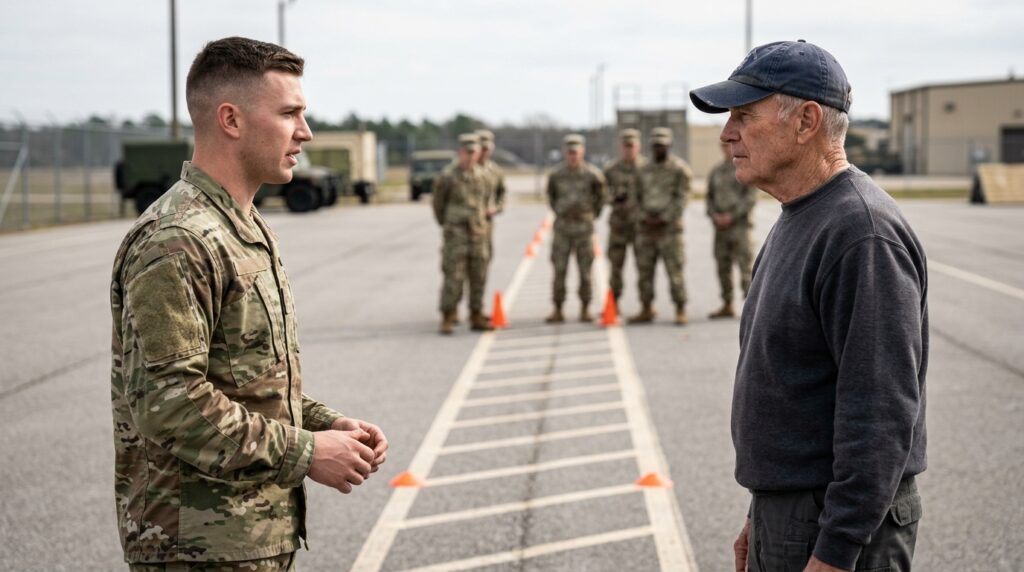
CHAPTER 2: THE AUDIT OF THE LEDGER
“The armory cage doesn’t open itself at four in the morning, Miller.”
The voice didn’t come from Vance. It belonged to Staff Sergeant Harris, who was leaning against the rusted iron frame of the equipment locker at the edge of the tarmac, a clipboard tucked under his arm like a shield. His boots were scuffed down to the gray steel toes, the leather cracked by the unrelenting glare of the salt flats. He didn’t look at Miller; his eyes were fixed on the foreign rifle tag Miller was currently turning over between his calloused thumb and forefinger.
Miller didn’t answer immediately. He tucked the metal tag into his pocket, the sharp edge scraping against his palm. The smell of oxidized iron and old cosmoline grease clung to his skin, a stubborn residue that felt entirely out of place in a facility supposedly stocked exclusively with standard-issue domestic carbines.
“The log has my digital signature on it,” Miller said, his tone flat, stripped of the bravado he had used against Vance. He began gathering his spent brass from the gravel, each shell casing dropping into his canvas pouch with a heavy, rhythmic clank. “It says I cleared out six weapon crates for the advanced evaluation. Except I was upstairs filling out spreadsheet columns for the logistics review until dawn.”
Harris pulled a short, rusted pocketknife from his pocket and began cleaning the dirt from beneath his fingernails. The metallic rasp of blade against skin was the only sound for several seconds. “Then someone else used your token. Or the system generated the authorization from the top down and dropped your name on the bottom line to keep the ledger clean. It’s happening more often since they put the new network in.”
Miller stood up, his spine stiffening under his damp camouflage blouse. The word metrics had become a parasite in this command, eating away at the hours once spent checking headspaces and cleaning firing pins until everything was reduced to a green checkmark on a monitor three hundred miles away. “Who had the detail last night?”
“Nobody from the training staff,” Harris muttered, pointing the tip of his blade toward the low-slung administrative concrete bunker across the compound. The building was an ugly, windowless block, its corrugated metal roof bleeding orange rust lines down the stucco walls from decades of morning condensation. “The supply truck from the depot came in at 0330. They bypassed the main gate log entirely. Said they had a direct clearance code from the regional procurement office.”
Miller didn’t wait for Harris to finish. The friction in his chest wasn’t just frustration anymore; it was a cold, pragmatic alarm. He walked across the sun-baked tarmac, his boots striking the concrete with deliberate force. Every corner of this facility was showing its age—the iron gates flaking orange scale, the asphalt pitting into black teeth under the heat—yet the administrative demands were moving with a slick, frictionless velocity that made no physical sense.
He shoved the heavy steel door of the admin bunker open. inside, the air-conditioning was a stale, chilling hum that smelled of dust filters and ozone. At the far end of the narrow corridor, behind a wire-reinforced glass partition, sat the logistics terminal.
Miller entered his administrative key. The monitor flickered to life, casting a cold blue glow across his face. He bypassed the colorful charts detailing target retention and deployment readiness scores—the very metrics he had been killing his candidates to maintain—and dove straight into the raw procurement archives. He wanted the origin of the thirty-eight-second clearing standard Vance had just systematically dismantled.
His fingers flew across the sticky, grease-filmed keyboard. The document was deeply buried under three layers of generic training circulars, listed only as Tactical Doctrine Amendment 88-Alpha.
When the file opened, Miller’s breath hitched.
The document wasn’t a new innovation from a modern think-tank. It was an old after-action report from 2016, originally stamped CLASSIFIED – RETRIEVAL ONLY. The tactical framework, the rapid-entry parameters, and the exact split-times he was forcing his men to hit were all there, down to the millisecond. But it wasn’t a success story.
It was an evaluation report from a disastrous deployment in the Horn of Africa—a tactical sequence that had resulted in an entire squad being overrun in a concrete compound because their entry speed left their flanks completely blind to structural ambushes.
Miller leaned closer to the glass screen. His eyes traced down to the digital signature block at the bottom of the old ledger. There were two authorizations. One belonged to a deceased general whose name was currently on the base library.
The second signature was a hand-written scan, faded but completely legible: Master Chief V. Vance, Lead Evaluator.
The room grew suffocatingly cold. The very man who had just thrown him into the dirt for running too fast had signed the order that made that speed a law a decade ago. But beneath Vance’s signature, someone had manually scratched out a single line of text with a heavy black digital marker. Miller squinted, trying to read the pixels through the heavy compression of the old file.
The redacted text didn’t contain logistical data. Through the digital ink, he could just make out the word: EXPENDABLE.
A sharp click behind him broke the silence of the office. The light from the corridor outside was blocked by a broad, heavy silhouette.
“You’re looking at the wrong ledger, Miller,” Vance said from the doorway. The old man didn’t move into the blue light of the screen. He remained in the shadows, his hands tucked into the pockets of his heavy gray sweatshirt, the hand-wound stopwatch around his neck giving off a faint, mechanical tick that filled the quiet room like a slow fuse.








