
CHAPTER 7: THE KINTSUGI COVENANT
The rattle of the iron gate sounded like a dry bone snapping in the cold expanse of the hangar. Outside, the low, gray hum of a military police cruiser’s diesel engine vibrated against the corrugated walls, a steady, persistent pulse that seemed to measure out the remaining seconds left in the room.
Colonel Vance didn’t reach for the yellow folder in Miller’s hands. He simply stood by the rusted rack of truck axles, his fingers lightly brushing against a grease-smeared stencil marked US ARMY salvage. His shoulder lines were slightly dropped, the rigid posture of command entirely gone, leaving only an aging man who looked as though he had been carrying a collapsing wall on his back for half a century.
“The numbers aren’t lies, Miller,” the colonel said, his voice dropping into an unhurried whisper that seemed to drift like dust through the yellow light. “They’re just the price of a quiet town. My father paid it with his honor, and I’ve spent twenty-six years signing the vouchers to ensure the checks never stopped clearing for the men who left their limbs in that valley.”
Miller looked down at the fragile, yellowed pages. In the dull amber glow of the rafters, the handwritten entries—the crossed-out gear, the reassigned funds—looked like the messy, unglamorous stitching of an old wound. This wasn’t a grand conspiracy born of greed; it was a desperate, permanent patch designed to mend a broken circle of veterans whom the system had otherwise prepared to discard. The young soldier felt his own thumbs pressing against the fragile edges of the manila folder, the texture rough and gray against his skin.
“They’re going to search this depot, sir,” Miller said, his eyes tracking the long, parallel lines of concrete dust toward the main entrance. “If the provost marshal sees these manifests, the ledger won’t survive the afternoon.”
The colonel let out a short, dry breath that sounded like old paper turning. “The provost marshal answers to the brigade commander, and the brigade commander was a captain under my father. The records will stay clean if the man who found them understands the nature of the unit.” He stepped closer, his boots making no sound on the oil-stained concrete. “I didn’t send you here to punish you, specialist. I sent you here because Thomas Vance told me you were the first person in three years who looked at that line and saw something worth protecting.”
Miller looked from the colonel’s face to the tiny set of old lieutenant bars lying on the rusted crate. The silver solder on the back pins was clumsy, an ugly, grey lump that held the yellow brass together after it had snapped under pressure. It was exactly like the old veteran’s vice-like grip on his wrist, or the cook’s quiet, methodical scraping of the grease-stained pans. It was the unglamorous, hidden work that kept a fractured world from splintering completely.
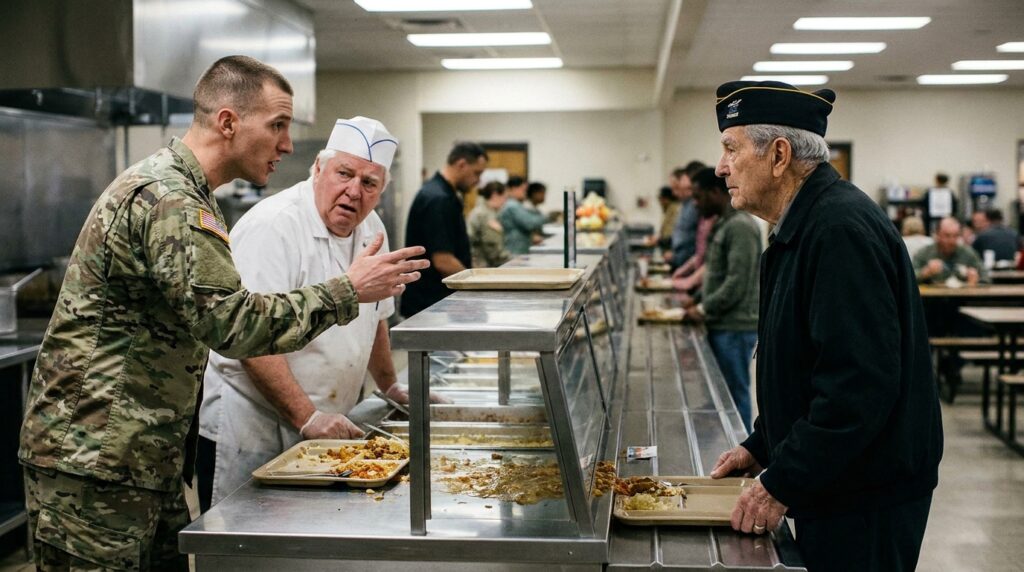
He thought of his phone, still sitting cold and dark in his pocket with its three-day-old notification from the bank. He thought of his own unexamined rage, the volatile entitlement that had made him push past a seventy-year-old worker just because the world wasn’t moving at the speed of a tactical deployment. The rage was gone now, replaced by a quiet, heavy understanding of the burden these older men had been carrying while the rest of the country slept.
Slowly, without breaking eye contact with the officer, Miller closed the yellow folder. He didn’t drop it into the gray cardboard box. Instead, he lifted the lid of an unserviceable grease bucket nearby, its interior coated with thick, black lithium lubricant that smelled intensely of petroleum and old iron, and slid the yellowed manifests deep beneath the dark sludge until the paper was completely buried.
“There’s nothing in this sector but salvage, sir,” Miller said, his voice flat, adopting the neutral, unyielding cadence of an official report. He wiped his oil-stained fingers on a piece of clean burlap from a nearby pallet, the rough fibers scraping against his skin like a dry wire brush. “The inventory is verified. The ledger balances.”
The colonel looked at the grease bucket for a long moment, then slowly reached down and picked up his utility cap from the rusted crate. His hand was no longer shaking. He tucked the old lieutenant bars back into his breast pocket, smoothing down the camouflage fabric until the outline vanished completely.
“Report back to your platoon for the afternoon detail, specialist,” the colonel said, turning toward the heavy bolt of the hangar doors. “And tell your squad leader you’re assigned to the community relations detail at the municipal center this weekend. They need someone who knows how to handle the heavy trays.”
The iron bolt gave a long, scraping shriek as the colonel threw it back, allowing the harsh, unvarnished daylight of the base to rush across the concrete floor. Miller stood in the fading yellow light of the wire cage, his shadow stretching out long and straight behind him as the external hum of the engines died away into the routine noise of the morning.








