
CHAPTER 5: THE LEDGER FAULT
The morning assembly at the motor pool smelled of unwashed canvas and cold diesel exhaust, a thick, gray film that seemed to coat the tongue before a man could even speak. Miller stood at the tail end of third platoon’s line, his fingers locked behind his back, his boots gripping the cracked asphalt where the oil leaks had dried into slick, black scabs. The sun hadn’t cleared the tree line yet, leaving the base in a desaturated blue shadow that made the parked five-ton trucks look like sleeping iron beasts.
“Specialist Miller.”
The voice didn’t come from his squad leader. It came from the company clerk, a pale staff sergeant named Harris who carried a clipboard like a shield against his chest. He didn’t look at Miller; his eyes were fixed on the white processing slip attached to the aluminum tray.
“Report to the battalion commander’s office. Full utility uniform. Clear your sector now.”
The platoon didn’t turn their heads—the discipline was too old for that—but Miller felt the subtle shifting of the shoulders around him, the quiet withdrawal of men who knew when a name had been marked for deletion. He didn’t answer. He simply stepped out of the formation, his boot heels hitting the gravel with the same dull, rhythmic scraping that had followed him through the park the night before.
The battalion headquarters building was a long, low block of cinder sheets and green paint that had blistered under twenty summers of sun. Inside, the floor was covered in a dull brown linoleum that smelled heavily of commercial wax and stale tobacco. As Miller reached the colonel’s door, the silence from the inner office was heavy, broken only by the dry, electric hum of a desktop fan turning its blades against the stale air.
Colonel Vance sat behind a metal desk that was perfectly clear except for a green plastic blotter and a single, unzipped leather folder. He looked exactly like the portrait in the civilian cafeteria—his shoulders were wide, his short gray hair cut to the skin at the temples, his uniform carrying the sharp, crisp creases of a man who spent his life inside an institution. But as Miller stepped onto the small rubber mat before the desk and brought his hand to his brow, he noticed the colonel’s fingers were trembling slightly where they rested on the green plastic.
“Sir,” Miller said, his voice flat, his eyes fixed on the white wall six inches above the colonel’s head.
The colonel didn’t look up immediately. He reached into the leather folder and pulled out a vintage set of brass lieutenant bars. They were old, the yellow metal scratched and pitted by time, but on the back of the small pins, a clumsy lump of silver solder showed where someone had repaired the fastenings by hand decades ago.
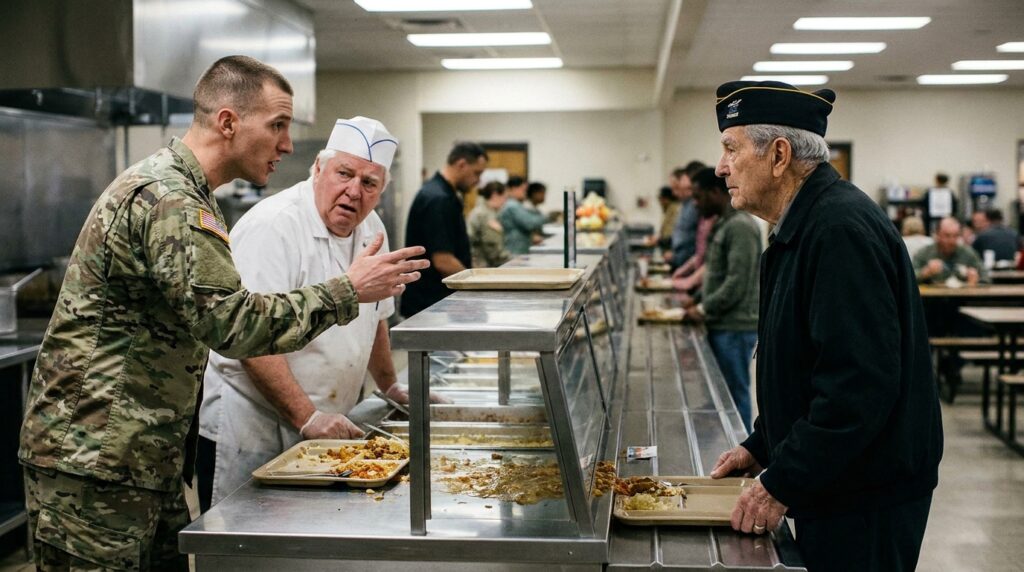
“The manager of the community center called the provost marshal last night, Miller,” the colonel said. His voice was a dry, controlled rasp that sounded less like authority and more like a machine running out of oil. “He said an active-duty specialist was causing a public disturbance in the serving line. Shoving a civil servant. Spilling food.”
“Yes, sir,” Miller said, his jaw tightening as the memory of the cold floor and the peppermint breath rushed back into his throat.
The colonel placed the brass bars down on the desk with a tiny, metallic clink that sounded incredibly loud in the small room. “The provost marshal wanted to issue an Article 15. A reduction in rank. Forfeiture of half your pay.” He paused, his thumb tracing the soldered silver on the pins. “But Sergeant First Class Vance called my personal quarters at midnight. He said you were just helping an old man with a heavy tray.”
Miller’s eyes dropped from the wall, locking onto the colonel’s face. The skin beneath the older man’s eyes was yellowed with exhaustion, the fine lines around his mouth twitching with a hidden pressure that had nothing to do with a civilian altercation.
“He told me you found his wallet, Miller,” the colonel whispered, his voice dropping so low that the desktop fan almost drowned it out. “He told me you returned the papers.”
The silence that followed was different from the silence of the cafeteria. It was the silence of two men standing on opposite sides of a fault line, both of them holding the same piece of rusted truth. Miller looked at the old lieutenant bars on the desk and realized they were the same ones listed under the names on the wet ledger scrap—the ones that had been paid for by forty years of an old man’s silence.
“I returned the property, sir,” Miller said quietly, his gaze returning to the blank wall. “Everything was intact.”
The colonel closed his hand over the brass bars, his knuckles turning white against the green blotter. “There’s an administrative detail at the logistics warehouse this afternoon,” he said, his voice tightening back into the formal cadence of command. “A file verification. You’re assigned to it until further notice. You will report directly to me with the results. Dismissed.”
As Miller saluted and turned toward the door, he noticed a gray cardboard filing box sitting by the colonel’s boots, its lid secured with three layers of faded green rigging tape. Scribbled across the side in blue ink was a single date from forty years ago, the numbers scratched deep into the cardboard like an old scar.








