
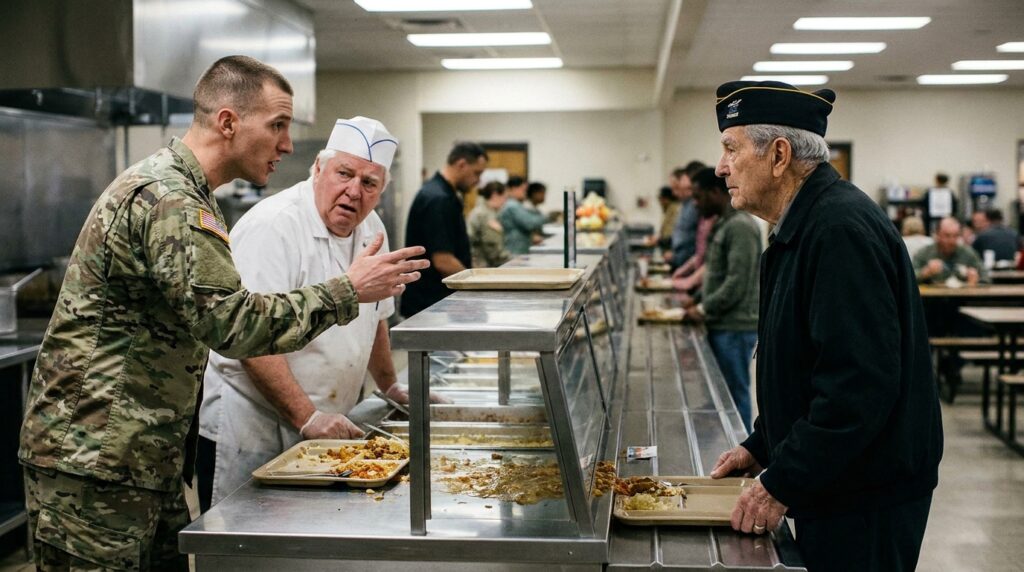
CHAPTER 4: THE GENERATIONAL BRIDGE
The cafeteria smelled different when the steam tables were dead. Without the wet, heavy fog of boiling water and overcooked starch, the space expanded into a hollow cavern of desaturated tile and cold stainless steel. The overhead fluorescent tubes had been switched off, leaving only the amber security lights by the emergency exits to cast long, skeletal shadows across the stacked chairs.
Miller pushed the heavy glass door open, the rubber seal giving a soft, breathy sigh against the frame. He had walked three miles from the park, the small scrap of ledger paper tucked into his palm like a splinter he couldn’t dig out. His camouflage coat felt stiff, holding the chill of the evening air within its nylon weave.
Near the back counter, a single yellow bulb illuminated the wash area. The stocky cook stood beside the massive galvanized sink, his white chef hat gone, revealing a bald scalp mapped with thin, purple veins. He was using a long wire brush to scrape the blackened residue from the bottom of an industrial baking pan. The sound was a rhythmic, harsh rasp—shrrk, shrrk, shrrk—that seemed to anchor the entire room to the reality of physical labor.
Miller stopped at the edge of the line, his fingers resting on the cold steel tray guide where he had initiated the chaos hours earlier. The shattered bowl of peaches was gone, the floor bleached so thoroughly that a pale, clean circle remained amidst the yellowed wax.
The cook didn’t stop brushing. “We closed at seven, son,” he said, his voice flat, not looking up from the zinc sink. “The manager went home. It’s just me.”
“I came back to say I’m sorry,” Miller said. The words felt heavy, unpracticed, like a foreign language he was trying to speak through a broken jaw. He unbuttoned his coat, exposing the blank green undershirt beneath. “For the tray. For the rest of it.”
The wire brush stopped. The old man leaned his weight against the rim of the sink, his thick forearms wet with gray, soapy foam. He turned his head slowly, his eyes tracking Miller from his polished boots up to the dark hair that was still damp from the restroom basin.
“You didn’t come back for the tray,” the cook said softly, wiping his knuckles on a rough dish towel that had worn down to the structural threads. “You met Tom in the park.”
Miller reached into his pocket and placed the small scrap of ledger paper on the counter between them. The amber light caught the cursive ink, making the crossed-out names look like old cuts on a tree. “He left this on the bench. My colonel… the man who signs my passes, the man who tells us what honor looks like… his name is at the bottom.”
The cook stepped out from behind the sink, his orthopedic shoes clicking softly on the clean linoleum. He didn’t look at the paper; he looked at Miller’s face, tracing the sharp lines of tension that still twitched near the young soldier’s eyes. “Tom was his platoon sergeant. Forty years ago. The colonel was just a boy then, three weeks out of the Academy, trying to read a map in a dark ditch while the mortars were coming in from the ridge.”
“Vance told me he walked,” Miller whispered, his voice catching on the iron tang of the air. “The papers in the washroom said cowardice.”
“The papers say what the general’s office needed them to say to keep that boy from a prison cell,” the cook said, his voice dropping into a low, gravelly register that sounded exactly like the veteran’s. He reached out, his swollen, arthritic thumb touching the edge of the steel counter. “Tom had a family back here. A wife who was sick, a house with a mortgage that was already sliding. The general made a call. One man goes to the stockade and loses his name; the other gets a star on his shoulder and a career that can support an old sergeant’s family from the shadows for forty years. That’s why Tom works the line here. That’s why I work it with him. The money that pays for this food doesn’t come from the county, specialist.”
Miller felt the room tilt slightly, the rigid certainty of his military world fracturing along lines he couldn’t see. The institutional order he had clung to so desperately—the hierarchy that he thought gave him the right to push past old men—was built on a foundation of quiet, unrecorded trades made in the dark.
“Why didn’t he tell anyone?” Miller asked, his hands tightening into fists. “Why carry the stain?”
“Because a contract is a contract, son,” the cook said, his face softening as he looked at the younger man’s uniform. “And sometimes, protecting the uniform means you have to let people think you dirtied it. Tom didn’t drop you today to show off. He dropped you because you were starting to look like the boy he saved forty years ago—someone who thought the rank made him a god.”
The old man reached down, took the ledger scrap from the counter, and dropped it into the wet foam of the sink. The blue ink began to bleed instantly, turning the gray water into a pale, swirling cloud before vanishing down the drain.
“Go back to your station, specialist,” the cook said, turning back to his baking pans. “Your colonel is waiting for his report. And Tom’s got a long shift tomorrow.”
Miller stood in the silence for a moment longer, the cold iron of the cafeteria no longer feeling like an insult, but a weight he was finally learning how to carry. He turned, his boots silent on the clean floor, and walked out into the present-day night.








