
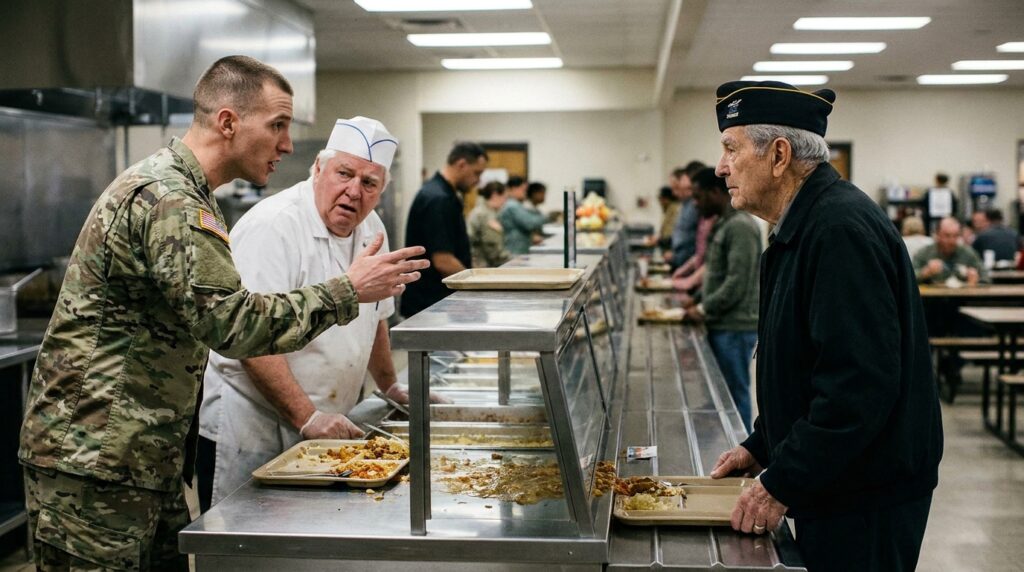
CHAPTER 2: THE RECOGNITION TANK
The grease from the floor didn’t want to leave the skin. Miller dug his thumbs into the hollows beneath his jaw, forcing the institutional cold water from the basin up over his temples until his ears rang with the chill. The mirror above the porcelain sink was clouded with old silvering, mapping gray spiderwebs across his reflection. In the dim, flickering light of the cafeteria restroom, his camouflage uniform looked less like an armor and more like a rented suit that didn’t quite fit the breadth of his shoulders. His heart was still hammering a erratic, frantic rhythm against his ribs, a leftover tremor from the effortless leverage that had put him on his back.
He wrung out a paper towel, the rough, unbleached fiber tearing under the pressure of his fingers. The smell of cheap bleach and damp porcelain filled his throat, thick and suffocating. It was the same smell as the transit bays in Kuwait, the same gray neutrality of places designed to process men who were temporarily between crises. He had been back for three months, yet every room in this town felt like a holding cell where the air was too thin to breathe.
His hand shook slightly as he reached for his cap on the edge of the basin. As he lifted the damp fabric, his boot tapped against something solid beneath the curve of the porcelain pedestal.
It was a wallet, thick and dark with the grease of long handling, its edges frayed down to the gray structural threads. A strip of old olive-drab parachute cord was looped through the eyelet, severed cleanly at the end as if it had snapped away from a belt during a sudden movement. On the worn leather face, a hand-drawn infantry insignia—the crossed rifles of the 11th Regiment—was scratched into the hide, the lines faded into shallow, gray scars.
Miller picked it up, the leather cold and slightly damp against his palm. His thumb traced the scratched rifles. He knew that insignia; it was the old style, the one his own battalion commander kept framed behind glass in the headquarters building three hundred miles away.
He didn’t open it immediately. He stood by the small window where the afternoon sun cut through the frosted pane, casting a pale, desaturated yellow block across his knuckles. The silence from the cafeteria outside was heavy, broken only by the rhythmic clink of silverware being sorted into plastic bins. He felt like a thief, but the weight of the vice-like grip on his wrist was still a fresh ache in his bones. He needed to know what kind of old man kept that kind of iron in his fingers.
When he pulled the leather billfold open, there were no credit cards, no driver’s license, no bright plastic markers of modern life. There was only a folded square of standard-issue military paper, the blue ink of the official stamp faded to a ghostly, water-damaged purple.
Miller unfolded it with the caution of a man handling unexploded ordnance. His eyes skipped the standard bureaucratic headers, landing directly on the bold line near the center: General Court-Martial Order No. 412.
The name was there—Thomas J. Vance. Sergeant First Class. But it was the language below that made the air freeze in Miller’s chest. Dishonorable discharge. Forfeiture of all pay and allowances. Failure to engage. The words were flat, clinical, and total. According to the document, the old man who had just stood over him with the absolute authority of a pristine lineage was legally a ghost, stripped of his honors forty years ago for leaving his post during a midnight sweep in the central highlands.
“You shouldn’t be looking at that, specialist.”
The voice came from the doorway, dry as old pine.
Miller didn’t jump. His training took over, his shoulders locking into a rigid presentation as he turned, his thumb automatically folding the paper back into the leather billfold. The elderly veteran stood in the frame of the door, his dark jacket unzipped now, revealing a faded flannel shirt that looked too large for his frame. Without the cap, his white hair was thin, plastered down by sweat in parallel lines against his skull. He looked smaller now, the formidable shadow he had cast in the serving line dissolving under the harsh, buzzing fluorescent tubes of the restroom.
“It fell under the sink,” Miller said, his voice tightening as he held the wallet out. He didn’t offer an apology this time; the document in his hand had shifted the ground beneath them. “Sir.”
Vance stepped into the room, his boots making no sound on the wet linoleum. He didn’t reach for the wallet immediately. Instead, he leaned his weight against the second sink, his eyes resting on the faded blue ink showing through the thin paper.
“A man who stays in the service as long as you have should know how to mind his sector,” Vance said softly. There was no anger in his face, only a vast, desaturated exhaustion that seemed to come from the marrow of his bones. “That paper doesn’t belong to the unit anymore. It belongs to the state.”
“This says you walked,” Miller said, the words slipping out before his discipline could catch them. He felt a strange, defensive heat rising in his throat—a rejection of the idea that the only man who had shown real authority in this town was a fraud. “My colonel… he wears the same patch. He talks about the 11th like they were gods.”
Vance let out a short, dry sound that might have been a laugh if his mouth hadn’t remained so flat. He reached out, his thick, tobacco-stained fingers closing over the leather, pulling it gently from Miller’s grip.
“Your colonel was a lieutenant when that paper was signed,” Vance said, his voice dropping into a whisper that seemed to absorb the ambient hum of the lights. He tucked the wallet into his internal jacket pocket, his hand lingering over his heart for a second before dropping away. “And some men are better at keeping their uniforms clean than others.”
Before Miller could process the statement, the restroom door creaked open again. The stocky cafeteria worker stood there, holding a mop bucket that smelled heavily of ammonia. He looked between the two men, his eyes lingering on Miller’s uniform with a look that wasn’t fear, but a deep, unreadable pity.
“Tom,” the cook said quietly, his hand resting on the wooden handle of the mop. “The manager’s calling the base. They’re asking about the boy.”
Vance didn’t look back at the cook. He kept his eyes locked on Miller, his gaze heavy with a secret that felt older than the uniform itself. “Tell them he was just leaving,” Vance said. “He’s got a long way to walk.”








