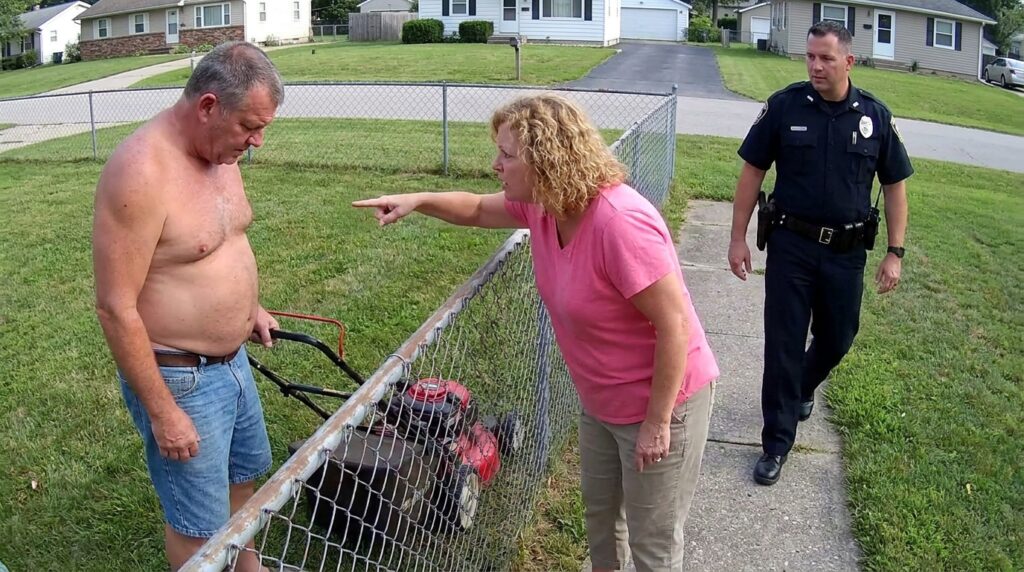
CHAPTER 6: THE DISMANTLED REIGN
The aluminum clipboard snapped shut with a hollow, metallic crack that seemed to echo through the stagnant noon air of the cul-de-sac. Officer Miller didn’t return the board to his side pocket; he held it vertically against his hip, a rigid plate of gray metal that caught the white glare of the sun. The red-and-blue strobe lights continued their silent, rhythmic sweep across the property line, turning the dry blades of grass into brief, artificial flashes of color.
Brenda stood perfectly still, her hand frozen on the collar of her pink shirt. The sunglasses hid her eyes, but the sudden slackness in her jaw revealed the collapse of her internal math. The smartphone in her hand trembled slightly, its screen catching a greasy thumbprint over the dark display. The old garage behind her—the structure she had spent three years defending with city codes, fake notices, and midnight measurements—seemed to lean even further over the cracked concrete path, its crumbling mortar joints shedding a fine gray powder onto the dirt.
“Sign the acknowledgment line, Ms. Giddings,” Miller said. His voice was no longer that of a mediator resolving a civil disturbance; it had the cold, rhythmic precision of a stamp press at the assembly plant. He extended a black ink pen, its plastic barrel wet from the heat of his hand. “The state authority issued the condemnation easement registry in October. Your signatures on the preliminary certified letters are already logged with the district clerk.”
Brenda didn’t take the pen. Her extended finger, the one she had jabbed through the chain-link fence for twenty minutes to assert dominance over Arthur’s lawn mower, slowly curled back into her fist. “The letters didn’t specify the garage line. They said the right-of-way expansion was limited to the drainage ditch at the curb. This is an administrative overreach.”
“The right-of-way extends twenty-four feet from the center line of the existing asphalt,” Miller said, his boots grinding against the spalling concrete as he shifted his weight. He didn’t point toward her yard; he pointed toward the small, notched steel masonry spike embedded in the dirt. “That pin isn’t an arbitrary boundary. It’s the original 1974 municipal datum point. Everything within eight feet of it belongs to the state transit corridor. That includes your side wall, your roof drainage, and your gravel drive.”
Arthur slowly let go of the black rubber grips on the push mower handles. His hands were numb from the engine’s long vibration, the skin on his palms grayed with a mixture of carbon grease and dry dust. He stood up straight, his bare chest glistening under the heat haze. For three years, he had adjusted his internal tolerances to endure her micro-campaigns—the late-night city code reports, the handwritten citations pinned to his oak tree, the constant, voyeuristic glare from her front window. He had assumed she was simply a petty tyrant hungry for a sliver of land.
Now, looking at the red, stamped seal of the Department of Eminent Domain on the form beneath Miller’s thumb, the full scope of the trap became transparent. Brenda wasn’t trying to steal two feet of his grass out of greed; she had been trying to force the legal property line west, using his quiet nature as leverage, hoping to establish a historical usage boundary that would push the state’s excavation crews away from her illegal foundation.
“The fence can come down whenever the state brings the equipment through, Officer,” Arthur said, his voice low, steady, carrying the flat unyielding tone of an old machinist who had spent his life dealing with fixed dimensions. “I won’t be blocking the crews.”
Brenda turned her head toward him, her lips pulling back into a tight, desperate sneer that couldn’t mask the panic rising in her throat. “You think you’ve won something here, Arthur? If they clear this easement, they’re widening the state route into a four-lane connector. Your house sits on the exact same 1974 right-of-way plat. When the grading machines start rolling, they aren’t stopping at the chain-link. They’re taking your front porch too.”
The silence that followed her words didn’t belong to the neighborhood; it was the heavy, dead quiet of a factory floor after the main breakers were pulled. Two houses down, the elderly neighbor slowly stepped back inside her screen door, the plastic sunshade clicking against the frame as she closed it. The street was empty, the bright pink shirt and the polished blue uniform looking like small, temporary markers against the vast, cracked asphalt of the cul-de-sac.
Arthur looked down at his boots, then at the single push mower parked tight against the wire. He reached into his denim pocket, his thumb finding the coarse surface of his sharpening stone, running over its edge with a slow, calculated stroke. He didn’t look at Brenda’s leaning wall, nor did he look at the rotating amber lights of the distant county truck that had paused at the corner, waiting for the legal dispute to clear.
“I know where the line is, Brenda,” Arthur said, his gaze shifting back to the iron pin in the concrete curb. “I’ve always known where it is. Difference is, I didn’t try to build a lie on top of it.”
Officer Miller didn’t wait for a response. He clipped the signed form to the back of the ledger, turned his back on Brenda’s sedan, and walked back toward his cruiser, his heavy boots making a regular, rhythmic crunch on the gravel. Brenda stood alone on her side yard, her sunglasses reflecting nothing but the parched, unwatered expanse of the street, her fake authority stripped away down to the bare, non-compliant stone.
Arthur turned his mower around, his calloused hands taking the grip as he guided the heavy machine back toward the dark, cool safety of his garage, leaving the boundary lines exactly where they had been written fifty years before.