CHAPTER 4: THE MIDDAY CROSSING
The starter rope ripped backward against Arthur’s palm with a wet, heavy crack, the vibration transferring straight down the steel tubing of the handle into the small of his back. The Briggs & Stratton engine didn’t just catch; it detonated into a flat, deafening roar that swallowed the dry rattle of the cicadas whole. The sun was dead center in the pale Midwestern sky, baking the gray dirt along the chain-link boundary until the heat rose in visible, oily waves from the galvanized mesh. Arthur gripped the black rubber sleeves of the handle, his shirtless chest coated in a fine, gritty layer of pulverized limestone and dried sweat. He pushed the deck forward.
He didn’t get five feet before the pink shirt cut through the glare.
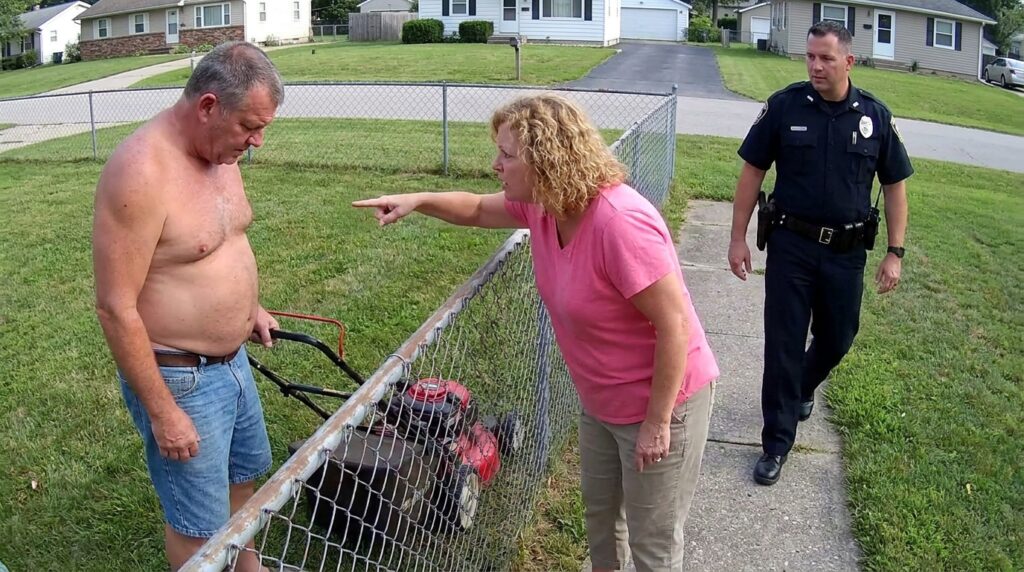
Brenda didn’t walk down her porch steps; she plunged down them, her khaki trousers stiff with dried mud at the cuffs, her leather sandals slapping against the cracked concrete of her walkway with the rhythmic velocity of a machine tool. Her oversized designer sunglasses reflected two distorted, miniature versions of Arthur’s house as she slammed her body flat against her side of the chain-link fence. Her right arm came through the mesh, her index finger extended like a rusted spike, pointing directly at the front left wheel of the push mower.
“Shut it down! Shut it down right now, Arthur!” Her voice tore through the mechanical roar, dry and jagged, stripped of its usual bureaucratic pretense. She was leaning so hard against the wire that the links groaned, the metal diamonds biting into the flesh of her forearm. “You are tracking across the line! I have the police on the line! They’re coming out code-three, you stubborn old bastard!”
Arthur didn’t pull back. He kept his feet planted in the parched crabgrass, his boots resting on the exact edge of the concrete curb where the ancient masonry pin was driven. He didn’t drop the throttle lever to idle. He kept the engine running at full speed, the heat from the cooling fins blasting against his shins, the blue exhaust smoke hanging in the stagnant air between them.
“The wheel is three inches inside the post, Brenda,” Arthur said. He didn’t raise his voice; he simply adjusted his stance, leaning his weight into the machine to keep the vibration from tearing it from his calloused palms. “I’m cutting what’s mine.”
“It isn’t yours!” she screamed, her hand jerking violently through the fence, her nails catching on a loose strand of wire. She shoved a glossy, white-framed smartphone against the mesh, its screen displaying a blinking emergency dispatch map. “They know about the harassment. They know you’ve been monitoring my garage. Look at the curb, Arthur! Look at what you did to the survey paint!”
Through the gray dust rising from the dry turf, the high-pitched, warbling yelp of a municipal siren cut through the block from the north intersection. Within seconds, a dark blue cruiser swung into the cul-de-sac, its tires throwing up a loose spray of gravel as it braked hard against the curb behind Brenda’s gray sedan. The red-and-blue strobe lights didn’t just flash; they cut through the blistering midday sun, throwing sharp, artificial shadows across the parched front yards.
The driver’s door opened with a heavy, pressurized click, and Officer Miller stepped into the dispute lane. He didn’t pull his holster clip down, but his upright, rigid posture immediately locked the space between the two properties. His dark hair was clipped short, his uniform shirt stiff with starch, his face a neutral mask of state authority. He didn’t look at Brenda; he looked at the machine pinned against the fence line.
“Both of you stay right where you are,” Miller said, his voice flat, carrying the practiced weight of a man who had spent fifteen years separating neighbors over six inches of dirt. He stopped three feet from the fence, his attention split, his eyes tracking the physical orientation of the mower deck. “Sir, kill the engine.”
Arthur reached down with his left hand, his thumb catching the kill switch on the block. The motor choked, sputtered once, and died, the sudden silence of the street feeling heavy, thick with the smell of unburned gasoline and scorched grass.
“Officer, look at him,” Brenda hissed, her voice dropping into a frantic, shaking whisper as she leaned around the fence post, her khaki sleeve touching the officer’s arm. “He’s been out here since noon. He’s deliberately destroying the boundary markers. He’s tracking his equipment over my structural footings, and he’s got a camera pointed directly at my bedroom window from that pillar.”
Miller didn’t move toward her. He took a slow step toward the mower, his black leather boots crunching against the dry clay. He knelt down, his uniform trousers tightening against his knees, his eyes narrowing as he peered beneath the rusted steel deck.
Arthur stood perfectly still, his hands remaining on the rubber grip. But as his fingers tightened on the metal tubing, his thumb brushed against a cold, sharp metal ridge he hadn’t noticed before—a deeply grooved serial code stamped into the inner barrel of the handle itself, matching the exact format of the municipal numbers he had seen on the county surveyor’s truck that morning. It wasn’t an aftermarket addition. The mower itself was an old municipal asset, stamped by the city engineering department three decades ago, and the line it was tracking wasn’t a private property boundary at all.
Miller reached down, his gloved hand moving toward the notched steel masonry pin beneath the grass, his face going completely rigid as his fingers touched the scraped concrete.