CHAPTER 2: THE ANGLE OF REPOSE
The heavy iron deck of the push mower rattled against Arthur’s shins, vibrating through the thin soles of his work boots as he guided the machine along the tire-tracked edge of the curb. The air was thick with the scent of pulverized crabgrass and the bitter, metallic tang of hot engine oil. He kept his eyes down, watching the left wheel tracking exactly three inches inside the rusted silver chain-link mesh. Then, the dry screech of a locking brake assembly tore through the mechanical hum.
Brenda’s faded gray sedan didn’t just park; it drifted onto the gravel shoulder, its front bumper coming to rest three inches from the steel wheels of Arthur’s mower. The driver’s door swung wide, the rusted hinges groaning under the sudden weight as Brenda stepped out onto the asphalt. Her khaki pants were stiff, coated in a fine layer of dry lime dust from her garden beds, and her oversized designer sunglasses caught the glare of the midday sun like two black mirrors. Behind her, the white chassis of an official county survey truck slowed to a crawl at the edge of the cul-de-sac, its amber light bar rotating silently in the heat haze.
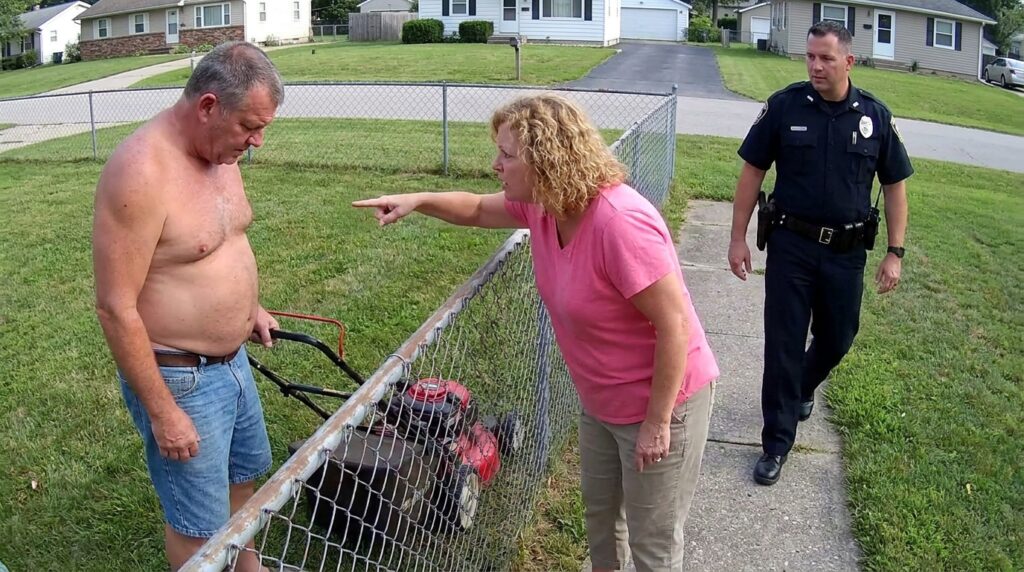
“Turn it off, Arthur,” Brenda said. Her voice didn’t carry the high pitch of fear; it had the flat, practiced drone of a county bureaucrat enforcing a lien. She didn’t drop her hand to her side. She kept her arm locked, pointing a manicured finger toward the yellowed grass beneath her bumper. “You don’t move that deck another foot down this curb. This shoulder isn’t public access, and that truck doesn’t have an easement to back into my drive.”
Arthur pulled the throttle lever back until the Briggs & Stratton sputtered and died, the sudden silence of the street settling over them like heavy dust. He didn’t let go of the rubber grip. His knuckles, grayed with graphite grease from the garage workbench, remained locked.
“The county sent a notice three weeks back, Brenda,” Arthur said, his voice low, matching the steady cadence of the idling survey truck fifty feet away. “They’re checking the culvert drainage. The markers go on the line.”
“The markers are fraudulent,” she snapped, stepping closer until her shoulder pitched forward against the corner of the chain-link posts. She reached into her pocket, pulling out a laminated folder bound with a black heavy-duty rubber band. She didn’t open it. She held it against her chest like an armor plate. “The original 1982 subdivision plat doesn’t account for the retaining wall shift. If that truck sets its outriggers on this gravel, it’s a civil trespass. I’ve already logged the plates with code enforcement.”
From the cab of the county truck, a young technician in an orange high-visibility vest leaned out the window, his clipboard resting against the side mirror. He looked at Arthur, then at Brenda’s sedan blocking the narrow right-of-way, his engine idling with a wet, heavy diesel chug. The driver wasn’t putting the vehicle in park; he was keeping his foot on the brake, the red tail-lights glowing through the exhaust smoke.
Arthur took a slow step forward, his boot heel grinding into a patch of spalling concrete where the curb met the fence anchor. His thumb rubbed the small sharpening stone in his pocket, calculating the distance. Brenda wasn’t looking at the surveyor. Her eyes were fixed on the base of Arthur’s fence line, her jaw locked into a tight, defensive grin. She was standing exactly over the fresh orange utility paint he’d noticed minutes before—but her left boot was intentionally covering something else.
He looked down. A small, notched steel masonry spike was driven flush into the asphalt right where the concrete curb had cracked away from the dirt. It wasn’t a standard county marker. It was old, the head of the spike pitted with deep, orange scale rust, and it sat precisely eight inches inside Arthur’s side of the chain-link line.
“You should move the car, Brenda,” Arthur said, his eyes narrowing as he traced the line of the spike toward the foundation of her detached garage twenty feet back.
“I’m not moving a single tire,” she said, her voice dropping into a sharp, transactional whisper that didn’t reach the surveyor’s truck. She stepped down harder, her heel grinding over the rusted spike, hiding it from view. “And if that boy in the vest tries to drop a pin in this dirt, he’ll be talking to the municipal attorney before his shift ends. Go back to your garage, Arthur. You’re out of your depth on this one.”
Arthur didn’t answer. He watched the county truck begin to back up, its reverse beeper starting its monotonous, high-pitched chime as the driver gave up on the blocked shoulder. But as Arthur looked up at Brenda’s garage, he noticed the bottom row of concrete blocks didn’t align with the newer gravel path she had laid down. The wall bulged outward, its mortar joints gray and crumbling, leaning toward his property like a slow-moving wedge of stone.