CHAPTER 3: THE PERIMETER GLOW
The blue light from the monitor didn’t warm the garage; it just pulled the gray out of the concrete floor panels. Arthur sat with his forearms flat on the oil-stained plywood of his workbench, his eyes tracking a single cluster of pixelated shadows on the upper left quadrant of the terminal screen. The localized camera feed from his front porch was fixed at an eleven-foot elevation, casting its digital eye down across the sharp, diagonal slant of the silver chain-link fence. It was twelve minutes past two in the morning. Outside, the steady drone of cicadas was occasionally cut by the dry hiss of wind through the dry oak leaves, but inside the monitor’s frame, the world was reduced to sixteen shades of charcoal and a persistent, high-frequency raster hum.
He zoomed in on the property line. The fence mesh looked like a gray spiderweb under the infrared illumination, its galvanized steel posts casting thin, dark lances across the unwatered patch of grass that Brenda claimed as her absolute territory. For twenty minutes, nothing had moved but a stray plastic bag caught on a low wire. Then, a vertical slip of light appeared on Brenda’s side of the yard.
The heavy solid-core side door of her garage swung open exactly six inches.
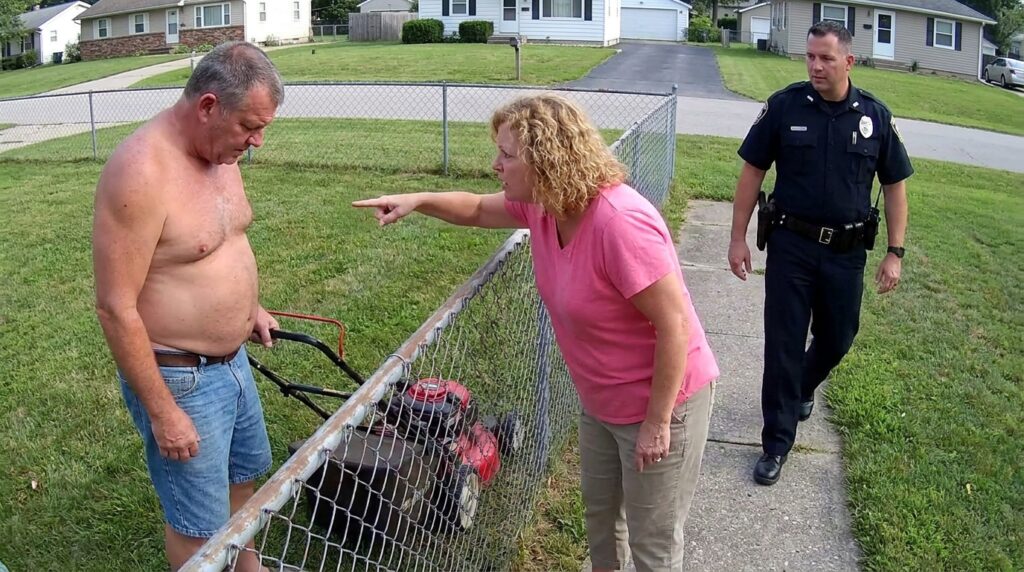
Arthur leaned forward, his calloused thumb mechanically rubbing the edge of the pocket sharpening stone he’d placed beside his keyboard. He didn’t blink. Through the narrow gap in the doorway, a shape materialized. It was Brenda, but she wasn’t wearing the loud, authoritative pink polyester shirt from the afternoon standoff. She was wrapped in a heavy, oversized canvas coat that obscured her outline, her curly blonde hair pinned tight under a dark knit cap. In her right hand, she wasn’t carrying her smartphone or a laminated county zoning folder. She was dragging a long, heavy iron pry-bar, its chisel tip making a dull, metallic scrape against her gravel path.
She stepped onto the grass, moving with a deliberate, rhythmic hesitation that reminded Arthur of a machinist checking a lathe alignment before dropping the cutter head. She didn’t look up toward his house. She knew where his old floodlights were aimed, but she didn’t seem to realize he had moved the wide-angle doorbell fixture three feet higher on the cedar pillar the previous Tuesday.
Brenda knelt at the base of the chain-link anchor post—the exact spot where the notched steel masonry spike remained driven into the cracked concrete curb.
Arthur watched her set the tip of the iron bar against the dirt. Through the pixelated gray rendering of the camera feed, he saw her lean her full weight onto the lever. The ground didn’t give way easily; the parched Midwestern clay was packed hard as firebrick, but she wasn’t digging. She was probing. She struck the buried concrete footing of the fence post once, twice, a faint, rhythmic thunk vibrating through the structural frame of Arthur’s workshop walls before the sound even reached his ears through the digital audio line.
“What are you measuring, Brenda?” Arthur muttered to the empty room, his hand tightening on the plastic casing of his monitor.
On screen, Brenda paused, her head tilting toward the dark silhouette of his house. She stayed frozen for nearly thirty seconds, her posture rigid, a living extension of the iron tool she gripped. When she satisfied herself that the dark windows remained blind, she reached into her coat pocket and pulled out a small, metallic cylinder. Under the infrared glare, the object didn’t shine; it absorbed the light, casting a distinct, flat reflection that Arthur recognized instantly from his thirty years at the assembly plant.
It was an antique brass surveyor’s plumb bob, its steel tip notched with three parallel grooves.
She dropped the weighted cord directly over the old masonry spike. But she wasn’t checking the fence line’s vertical true. She was using the line to mark a distance back toward her own garage wall. She pulled a yellow fiber tape measure from her waistband, stretched it across the eight-inch gap between the iron spike and the bottom row of her crumbling foundation blocks, and held it there.
Arthur tapped his fingers against the workbench, his mind running the calculations. An eight-inch gap. If her foundation sat exactly eight inches behind that rusty marker, then her entire roof drainage system, her concrete footings, and the heavy structural timber of her side wall didn’t just align with the boundary—they crossed it beneath the dirt. Her garage was sitting on his easement, supported by a hidden wedge of unreinforced masonry that had been sliding toward his lawn since the county last graded the drainage culvert in 1982.
Suddenly, the screen flickered. A violent horizontal distortion line tore through the gray pixels of the camera feed, the time stamp at the bottom corner leaping forward by three seconds. The infrared light bar on the porch unit died for a microsecond, then snapped back into alignment.
When the image cleared, Brenda was gone. The side door of her garage was shut tight, the iron bar was missing from the gravel path, and the chain-link fence sat empty under the pale moonlight. But at the bottom edge of the frame, right where the notched steel spike was embedded, the orange utility paint had been cleanly scraped away, replaced by a fresh, deep white gouge that ran straight through the concrete like a fresh surveyor’s line.
Arthur didn’t pull his eyes away from the glass. He reached down and rewound the digital archive to the exact moment of the distortion. When he froze the frame at two-fourteen, he saw that the static hadn’t been caused by a loose connection or a drop in line voltage. A dark, secondary shadow had crossed the edge of the lens from the opposite side of the street—a tall, unmoving silhouette standing right beside the neighborhood’s main electrical transformer box, holding an electronic device that glowed with a faint green interface.