CHAPTER 1: THE ACCUMULATION OF SURFACE RUST
The yellow paper didn’t tear; it pulled right through the head of the rusted roofing nail Brenda had driven into the bark of his pin oak. Arthur Vance didn’t look across the driveway toward her porch. He didn’t have to. The sun was at three o’clock, baking the grease on his fingers into a dark, protective lacquer as he rolled a pair of worn steel calipers between his palm and thumb. In his line of work, tolerances were everything—half a thousandth of an inch meant a hydraulic seal held or it sprayed fluid until the pump ran dry.
He folded the notice. The graphite pencil text was written with a heavy, tremor-heavy hand: Property value degradation via unmanaged arboreal encroachment. Code 41-B enforcement pending.
He stepped inside the dark garage, where the smell of oil stone and old iron hung thick in the rafters. The heat here was dry, rattling the aluminum skin of his storage sheds with every passing semi-truck on the state route half a mile out. Arthur sat on his stool, his stocky frame sinking into the cracked vinyl seat. He picked up a piece of structural survey map from 1982, its corners eaten by silverfish, its fold lines grey with dust.
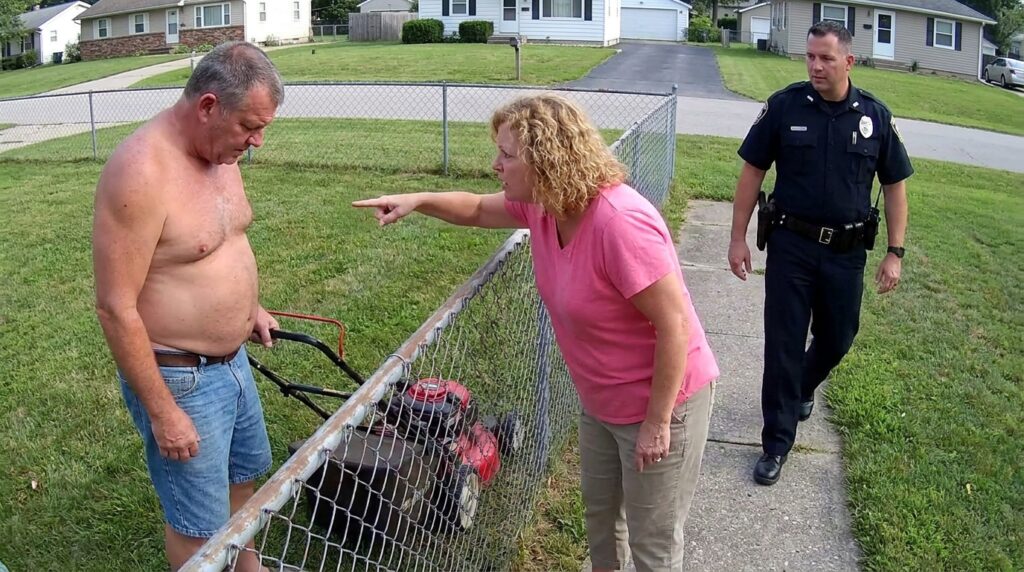
Outside, the dry rhythmic scrape of a plastic rake against parched grass began. Brenda was working her perimeter. She moved with a stiff, forward-pitched weight, her pink shirt a loud, unnatural scar against the pale, unwatered lawns of the block. Through the low window of the garage door, Arthur watched her index finger rise, pointing at a single dead branch hanging over the chain-link mesh.
He didn’t move. He reached into his pocket, his calloused thumb finding the small, coarse sharpening stone he’d carried since his first year at the plant. He ground his nail against the edge until the bone-white dust settled into the grease on his knuckles. The street was too quiet. It was the kind of midwestern silence where every screen door slam sounded like a starter pistol, and every neighbor watched through the slant of a vinyl blind. They were all waiting for him to break, to yell back, to match her volume. But Arthur knew how metal behaved under pressure. If you heated it too fast, it cracked. If you let it sit in the damp, it grew its own orange hide. You just had to know which part of the iron was still solid.
He checked his watch. The high-angle lens on his porch was already humming, recording the gray-scale pavement and the long, thin shadow of the fence. He reached down, gripped the pull-cord of the old Briggs & Stratton engine on his mower, and gave it one steady, calculated pull. The exhaust coughed a black plume of unburned fuel into the heavy afternoon air, and through the vibration in the rubber handle, Arthur felt the line lock into place.
But as the engine settled into its flat, mechanical roar, he noticed something at the base of the oak—a small, fresh patch of orange utility paint where no gas line had ever been marked.