CHAPTER 5: THE WEIGHT OF THE LINE
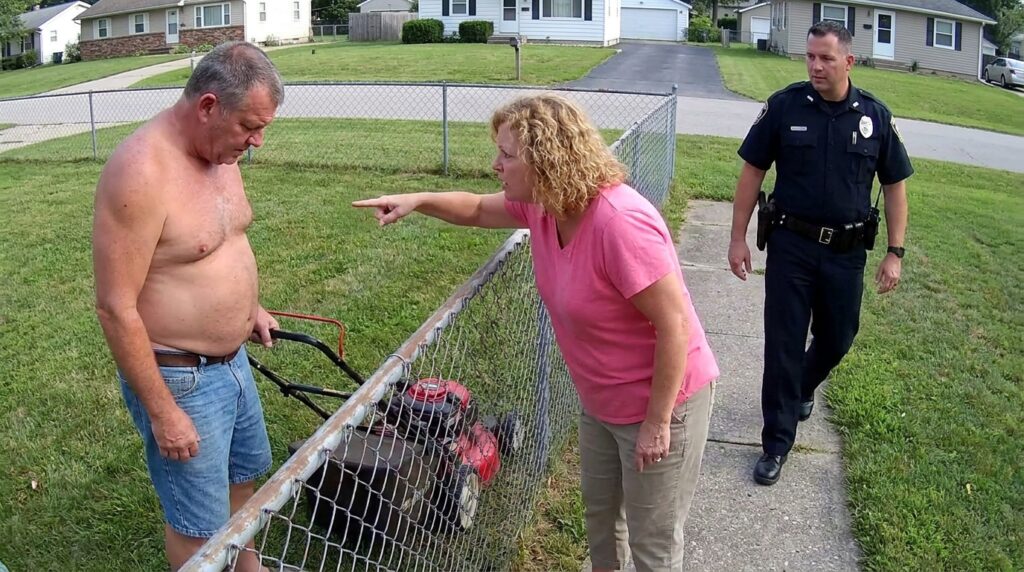
“Step back from the deck, Brenda,” Officer Miller said. He didn’t look up from his crouch, but his gloved fingers remained firmly pressed against the scraped concrete patch flanking the old chain-link anchor post. The red and blue strobes from his cruiser rolled across his sweat-sheened forehead, casting regular, rhythmic flashes of purple light over the dust-coated grass.
Brenda didn’t move her foot. Her sandal heel remained ground into the clay, right over the edge of the notched masonry pin she had tried to measure with her plumb bob the night before. “He ruined the grading, Officer. Look at the wheel tracks. He’s deliberately undercutting the lateral support for my garage foundation. If that wall shifts any further, it’s a total structural failure due to unmitigated water diversion.”
Arthur didn’t let go of the mower handles. The engine block was already clicking as it cooled in the parched air, releasing a sharp, sulfurous stink of over-torqued iron. He pulled his smartphone from his denim pocket with his left hand, his thumb resting against the smudged glass screen. He didn’t offer a defense; he waited for the law to find its own level.
“I asked you to step back,” Miller repeated. This time, he stood up, his knee joints making a dry, popping sound that was instantly swallowed by the constant hum of the cruiser’s electrical inverter. He adjusted his duty belt with a short, heavy tug, his gaze shifting directly to Brenda’s face. The polarized lenses of his sunglasses hid his eyes, but his mouth was pulled into a hard, professional line that left no room for neighborhood negotiation. “You’re crowding the workspace, and you’re standing over the primary monument marker.”
Brenda took a half-step backward, her shoulder pitching downward as she pulled her arms tight against her khaki-covered waist. Her phone was still clutched in her fist, its screen dark now, catching the harsh reflection of Arthur’s porch roof. “The monument is misplaced. The subdivision was re-platted after the 1982 freeze. I have the files right here.”
Arthur tapped his screen twice, bringing up the localized camera archive from two-fourteen that morning. He turned the device toward Miller, the bright white interface showing the pixelated gray rendering of Brenda’s canvas coat and the distinctive silhouette of the iron pry-bar cutting into the hard-packed clay.
“The post hasn’t moved, Officer,” Arthur said, his voice flat, retaining the heavy, rhythmic cadence of an old plant operator who knew exactly how much load a frame could take before the welds split. “But someone spent twenty minutes last night trying to see how deep the concrete footing went under my side of the fence.”
Miller took the phone from Arthur’s grease-stained hand. His leather glove made a faint, sticky stick-slip sound against the casing as he tilted the screen to block the blinding midday glare. For forty seconds, the street went entirely quiet. Two houses down, an aluminum screen door creaked open, an elderly neighbor leaning out past her porch railing to watch the flashing lights, her face half-hidden behind a plastic sunshade.
Brenda’s jaw worked silently. Her hand went to the collar of her pink shirt, her fingers twitching against the synthetic fabric as she watched Miller trace the frame-by-frame progression of the digital video. “That’s an unverified recording from an unregistered residential surveillance fixture. It doesn’t hold any evidentiary weight in a property line dispute.”
“It shows an active attempt to alter a physical marker,” Miller said, his voice dropping into a register that made Brenda’s chin jerk upward. He handed the phone back to Arthur, then pulled a heavy aluminum clipboard from the side pocket of his cruiser door. As he turned it over to clamp a blank incident report sheet, Arthur’s eyes locked onto a small, blue-and-white metal tag riveted to the back of the aluminum board. It bore the exact same five-digit municipal asset code as the stamp on his own push mower handle.
Arthur’s thumb tightened against his sharpening stone. The police officer wasn’t using a standard county-issued ledger. The equipment belonged to the regional highway extension authority.
“The survey pin shows your garage foundation is eight inches inside the active utility easement, Ms. Giddings,” Miller said, his pen drawing a clean, unyielding black line across the official grid paper. He didn’t look up at her. “The video shows you were aware of the encroachment before you made the dispatch call this afternoon.”
“The easement was abandoned by the county commissioners twenty years ago!” Brenda’s voice cracked, the high, frantic edge finally breaking through her calm veneer as she pointed her finger past Miller’s shoulder toward the street. “They can’t claim an encroachment on a structure that has its own tax assessment line!”
“The easement wasn’t abandoned,” Miller said, finally lifting his head to look past her toward the crumbling bottom row of her concrete blocks. “It was transferred to the state transit corridor. And right now, your garage is the only thing blocking the drainage clearing for the widening project.”
Arthur took a slow step back, the weight of the old iron mower handles suddenly feeling different under his palms. He looked down the length of the street, noticing for the first time that every house on the western edge of the cul-de-sac had a small, matching orange paint slash near their curbs—except for Brenda’s. The conflict wasn’t a petty neighbor war over six inches of crabgrass. Brenda wasn’t trying to steal two feet of his lawn to expand her garden; she was desperately trying to shift the legal line of the entire block to save her garage from a state demolition order.
But before Arthur could state the connection aloud, Miller turned the clipboard around, revealing a red, stamped municipal seal at the bottom of the report form that didn’t say Code Enforcement. It said Department of Eminent Domain.