CHAPTER 6: THE SNAP OF THE STRAP
The snap of the heavy leather strap releasing on the officer’s utility case was a dull, transactional sound, but it stayed entirely clean above the high-pressure drone of the water line.
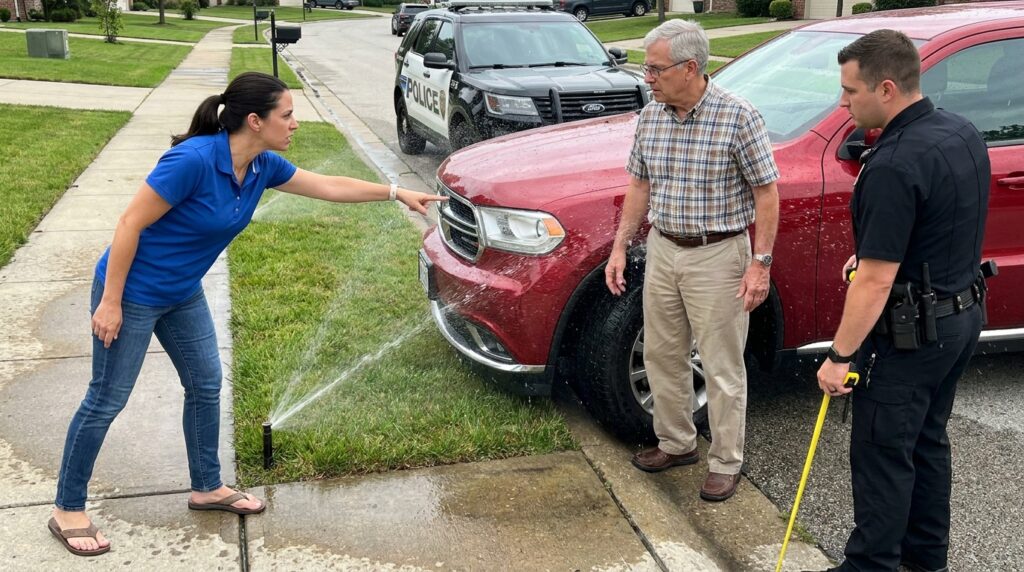
The patrolman stepped laterally, his uniform boots churning through the loose gravel that had begun to drift out of Brenda’s driveway apron and into the wash of the main road. His hand didn’t drop to his belt again; instead, he pointed a single, thick finger toward the small irrigation manifold hidden inside a dark green plastic housing near the edge of her porch steps.
“I’m not giving you an option for an administrative review this afternoon, ma’am,” he said, his voice flat, taking on the rigid rhythm of an official warning. “The structural displacement out here is no longer a civil easement issue. You’ve got active aggregate collapse hitting the driving lane. Step away from the phone and secure the valve.”
Brenda didn’t move toward the green box. Her sandals remained wedged into the softening sod line, the wet peat bubbling up around her soles in dark, mineral-heavy bubbles. She kept her phone angled upward, but her thumb was frozen over the top corner of the screen, her knuckles locked into a bloodless, grey shade that matched the weathered brick of her garage.
“The allocation is registered under the district’s drainage baseline,” she said, though her cadence had lost its flat, corporate certainty. Her chest rose and fell in short, sharp movements that strained the fabric of her blue polo shirt. “The structural integrity of this parcel was verified by the developer during the phase two rollout. If there’s an active void under this pavement, it’s a direct consequence of the municipal utility failing to concrete-seal the culvert line three doors down.”
Arthur didn’t answer her. He kept his attention focused on the split behind the boxwood.
The dark gray bead of sealant hadn’t just separated; it had uncoiled like an old wire. A slow, grinding friction was traveling beneath his own boots now, a dull skrr-skrr of fractured limestone bedding shifting three feet down beneath the asphalt crust. He knew that sound. It was the sound of river silt losing its friction under constant, pressurized saturation.
“It’s not the culvert, Brenda,” Arthur said, his voice low, retaining the unhurried weight of thirty years spent watching this soil settle. He reached down to the front bumper of his red SUV, his calloused palm catching the heavy, vibrating pulse of the water hitting the steel. “You’ve been running this zone four hours every night since May. You weren’t watering the sod. You were trying to fill the drop behind your service box before the county inspector routed through for the annual grade check.”
Brenda’s jaw tightened into a thin, white line, her ponytail twitching against her neck as she turned her head sharply toward the patrol car. The red and blue strobe of the light bar caught the sweat glistening along her jawline, turning the humid air between them into a rapid, pulsating mask.
“The documentation is on the server,” she whispered, her voice dropping out of its transactional register into something harsh and dry. “The application was submitted through the regional office. The board has no authority to revoke a stabilization variance once the physical application has been stamped by the coordinator.”
The officer didn’t wait for her to finish. He turned back to his cruiser, his hand reaching through the open window to unhook the heavy plastic microphone from the dashboard rack. His knuckles brushed against the knurled metal housing of his spotlight as he keyed the transmitter, his eyes staying fixed on the widening crack beneath the curb apron.
“Dispatch, this is Unit Four,” he muttered into the grill, his delivery clipped and devoid of drama. “Get the municipal water supervisor down to forty-two hundred block of Shady Pine Lane. We’ve got an active water main lateral failure or localized sub-grade washout under the roadway edge. Let them know they need to bring the steel-gauge line-testing pins.”
He dropped the mic back into the cradle with a dull, hollow thud that seemed to echo through the frame of the car. When he turned back around, he pulled a thick, steel-tipped yellow measuring tape from his secondary utility pouch, the metal housing scratched and oxidized from seasons of exposure to salt and road grime.
“Both of you stand clear of the front wheel well,” the officer directed, his boots splashing through three inches of mud-laden water as he approached the front tire of the red SUV. “I’m pinning the legal curb margin right now. If that tire is on public asphalt, this line goes off, and the city’s taking the valve out of the ground.”
Arthur stepped back two feet, his soles finding a dry, cracked ridge of asphalt further toward the crown of the road. He watched the metal tip of the tape drop toward the wet concrete lip, knowing the measurement wasn’t going to find what Brenda expected. The ground beneath the tape was already moving, a slow, silent displacement that was drawing the whole neighborhood’s common ground down into the dark.