CHAPTER 3: THE CALL TO THE PERIMETER
The distant wail of the siren dropped an octave as the emergency vehicle cleared the county line highway and turned into the secondary development grid. The sound ground through the humid air, low and heavy, vibrating against the aluminum siding of the uniform two-story houses.
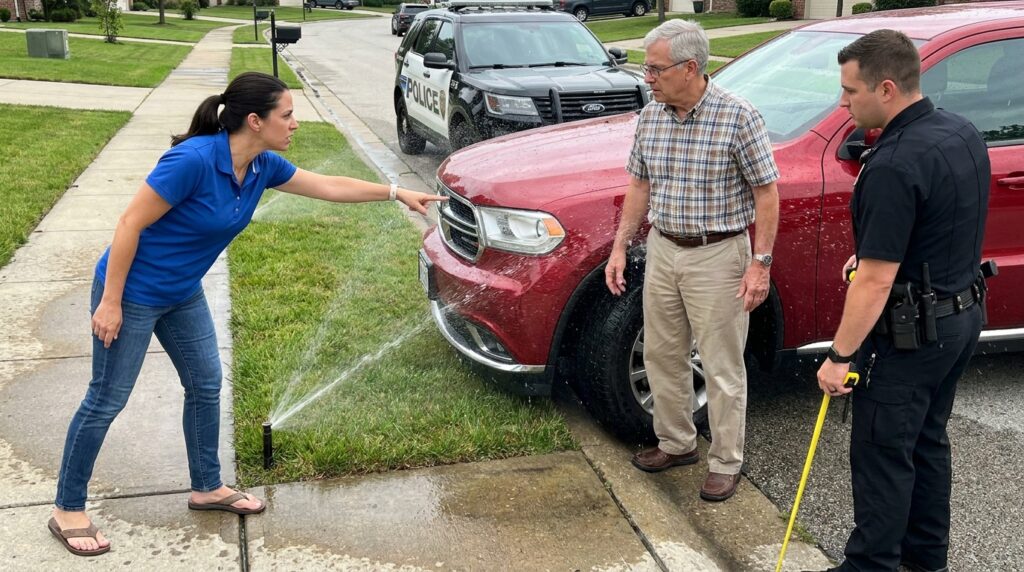
Brenda didn’t shift her position. Her silhouette remained wide, planted directly between Arthur’s line of sight and the vertical bead of dark gray sealant patching her garage brickwork. She adjusted the grip on her smartphone, her knuckles white against the black plastic frame, her thumb resting directly over the camera trigger. The hard, mechanical hiss of the sprinkler head completed another slow arc, dropping a fresh coat of hard, mineral-crusted water across the hood of Arthur’s red SUV.
“The log is open, Arthur,” she said. Her voice had gone exceptionally flat, matching the gray hue of the asphalt beneath her sandals. “I’ve uploaded the chronological sequence of your encroachment. The city doesn’t debate parking rights when an irrigation baseline is actively compromised by a vehicle’s tire load.”
Arthur didn’t pull his eyes away from the boxwood shrubbery where the patched foundation vanished into the parched earth. He reached into his pocket, his fingers tracking the cool, notched teeth of his house keys, feeling the grit of dry sand that seemed to inhabit every crease of his clothing on this block. He knew the structural layout of these homes; he’d helped pour the footings for the secondary phase across the street back when the soil was considered stable. The county had used uncompacted river silt as a sub-base, a cheap shortcut that left every driveway on the low side of the grade vulnerable to subsurface shifts.
“You’re using the non-emergency patrol to settle a boundary line you didn’t pay for, Brenda,” Arthur said. He stepped closer to his driver’s side door, his hand resting on the warm, water-slicked handle. The metal felt rough, scored by years of fine limestone sediment carried in the local water grid. “The municipal code gives three feet of clearance from the curb lip for utility access. My bumper isn’t within eight inches of your water lateral.”
“The lateral isn’t the primary asset,” she replied instantly, her posture tightening as the sound of the approaching cruiser grew distinct enough to locate two blocks north. “The neighborhood covenants require a continuous, uniform frontage. You’ve been notified three times by the board’s automated mailing system that your registration doesn’t align with the assigned street allocation for this sector.”
Arthur looked at the small, swallowing whirlpool at the edge of the concrete apron. The water was entering the fissure faster now, the surface tension breaking into a constant, hollow gurgle that was barely audible beneath the rhythmic clicking of the plastic sprinkler head. The soil beneath the concrete wasn’t just damp; it was losing its cohesion, washing out into whatever subterranean void was drawing it down.
“I didn’t get an automated notice,” Arthur muttered. His boots ground against a loose patch of loose aggregate near the wheel line. “I got a generic envelope with a hand-stamped county seal three days ago. No board header. No signature.”
Brenda’s eyes narrowed behind her wire-framed sunglasses, the lens reflecting two distorted, miniature versions of Arthur’s red SUV. She pulled her phone closer to her chest, her fingers covering the lower half of the device where a small, blue status light was flashing rhythmically.
“The delivery protocol is managed by the administrative tier,” she said, her delivery accelerating slightly as the white-and-black nose of the police cruiser finally rounded the corner of the cul-de-sac, its emergency lights turning the humid, sun-bleached air into a shifting strobe of red and blue. “If you have an exception to file, you do it at the district office, not by blocking my primary utility line with five thousand pounds of unrated steel.”
The patrol car slowed as it neared the curb, its tires producing a long, wet crunch as they rolled through the wide fan of water Brenda’s sprinkler was continuing to cast across the public road. The driver’s side window rolled down before the vehicle had even come to a complete stop, revealing the stocky silhouette of an officer whose dark hair was cropped short enough to expose the graying skin at his temples. The heavy nylon of his duty belt groaned against the vinyl seat as he shifted his weight, his eyes already tracking the wet boundary line between the resident woman’s lawn and Arthur’s front bumper.
Arthur stayed motionless by his vehicle door, his thumb hooked into the pocket of his khakis, waiting for the officer’s boots to hit the wet pavement. He could feel the small vibration of the idling cruiser through the soles of his shoes, but beneath that, there was a secondary, deeper hum—the faint, resonant thrum of hundreds of gallons of water rushing into the dark spaces beneath Brenda’s immaculate green grass.