CHAPTER 5: THE BLUE LIGHT CLOSES IN
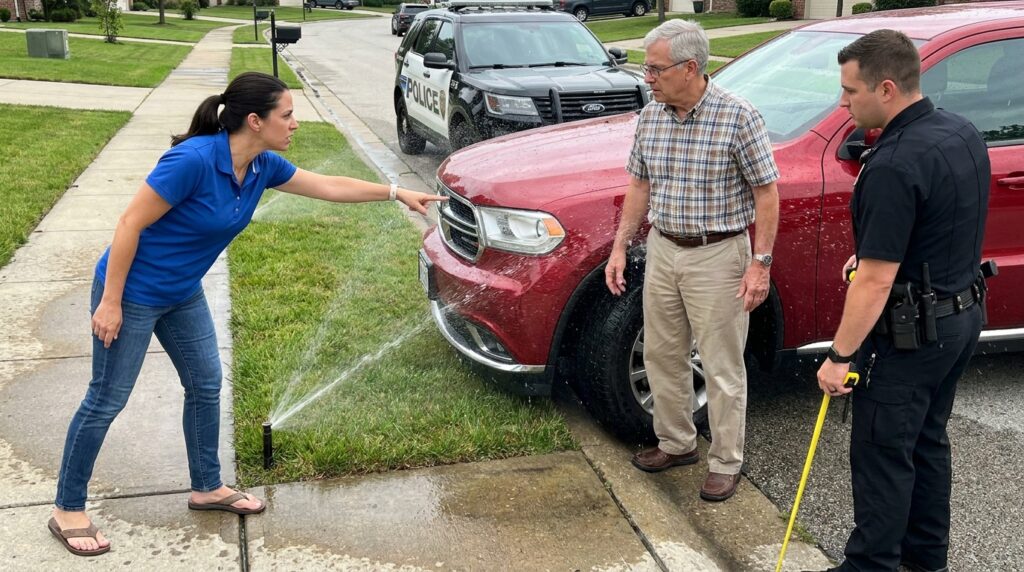
The officer’s leather-bound boots took two slow, calculated strides into the heavy fan of the sprinkler spray, his uniform pants instantly darkening into a sodden, heavy wool as he positioned himself squarely within the contested line of sight. He didn’t reach for his sidearm, but his hand hovered with trained, transactional precision near the heavy composite clip of his utility case.
“Ma’am, I am instructing you a second time to turn off the valve at the main manifold,” the officer said. His voice was clipped, a dry municipal baritone that didn’t rise to meet Brenda’s defensive cadence. “The volume of runoff is creating a visible puddle depth inside the driving lane. That constitutes a traffic hazard under Section Nine.”
Brenda’s sandals didn’t move. She stood perched on her manicured lawn line, the wet soil beginning to ooze slightly over the thin white straps of her shoes as her weight shifted. Her phone was still raised, the blue indicator light blinking like an automated beacon against the gray backdrop of her garage door.
“The volume is calibrated to meet the baseline drainage index, Officer,” she said, her chin tilting upward with a sharp, mechanical tightness. Her voice carried the practiced, rhythmic tone of someone reciting a corporate ledger. “The documentation is right here. The application was stamped by the regional zoning coordinator on the fourteenth. If you interfere with the saturation cycle before the log is complete, the municipal data layer becomes unverified for the district hearing.”
Arthur watched the folded stock paper in her left hand. The paper was getting soft now, the edges curling under the persistent spray of the lawn sprinkler, the heavy black ink of the official-looking stamp beginning to run in thin, dark lines across the unprinted margins. He stepped closer to the hood of his red SUV, his hand resting on the hot, wet metal. He could feel a distinct vibration beneath his boots—not the steady purr of the idling cruiser, but a lower, hollower frequency that seemed to travel directly along the concrete line of the curb.
“Let me see that document, Brenda,” Arthur said. He didn’t reach for it, keeping his arms low and guarded at his sides, but his eyes stayed locked on the signature line. Through the blur of the falling mist, the line where the district surveyor’s approval should have been scratched remained a smooth, blank white.
“This is an internal residential notification, Arthur,” she snapped back, her thumb sliding down the glass screen of her phone to change the display layout. “You’re not a verified party to the variance. Your primary parcel is registered three hundred feet outside the immediate catchment boundary.”
The officer turned his stocky frame toward Arthur, his sun-strained eyes squinting through the wet haze. “Sir, I need you to step back toward the rear panel of your vehicle while I verify the curb clearance. If your front axle is resting within the city’s utility margin, we’re going to have to clear the road regardless of the document status.”
Arthur didn’t pull his boots back. Instead, he leaned down slightly, his fingers trailing the rough, mineral-crusted edge of the asphalt where it met the concrete apron. “Look at the tire line, Officer. I’m not over the margin. The asphalt itself is dropping. Every gallon she dumps out here is pulling the sub-base straight under her lawn.”
As if responding to the weight of his words, the automatic sprinkler head paused at the absolute peak of its southern arc. With a heavy, pressurized thud-clack, the plastic mechanism locked. A solid, uninterrupted stream of hard city water hit the front wheel well of the SUV, the heavy fluid driving straight into the crumbling crack in the gutter.
The sound wasn’t a splash anymore. It was a deep, gargling suction.
The officer took a half-step closer, his eyes dropping to the wet, dark line where the aggregate was turning into a loose, shifting silt. His mouth opened to issue a directive, but before the words could clear his lips, a sharp, metallic snap echoed from behind Brenda’s manicured boxwood shrubbery. The vertical bead of dark gray sealant patching her garage wall didn’t just split—it tore, a thin shower of dried red brick dust spraying out over the green turf as the house foundation gave a low, grinding groan against the shifting earth.
Brenda didn’t look back at the wall, but her smartphone jerked downward, the blue status light suddenly disappearing as her fingers squeezed the frame. Her face went entirely pale, the rigid muscles of her jaw locking into a tight, desperate line that had nothing to do with county parking guidelines.
“The cycle is automated,” she repeated, her voice dropping into a lower, harsher register that sounded frayed around the edges. “The board approved the saturation baseline. It’s on the server.”
“Shut it down, ma’am,” the officer said, his hand finally snapping the heavy leather retention strap off his utility case as he stepped out of the water lane. “Now.”