CHAPTER 4: THE SPRINKLER CLASH
“Keep your hands where I can see them, sir, and step back from the driver’s side panel.”
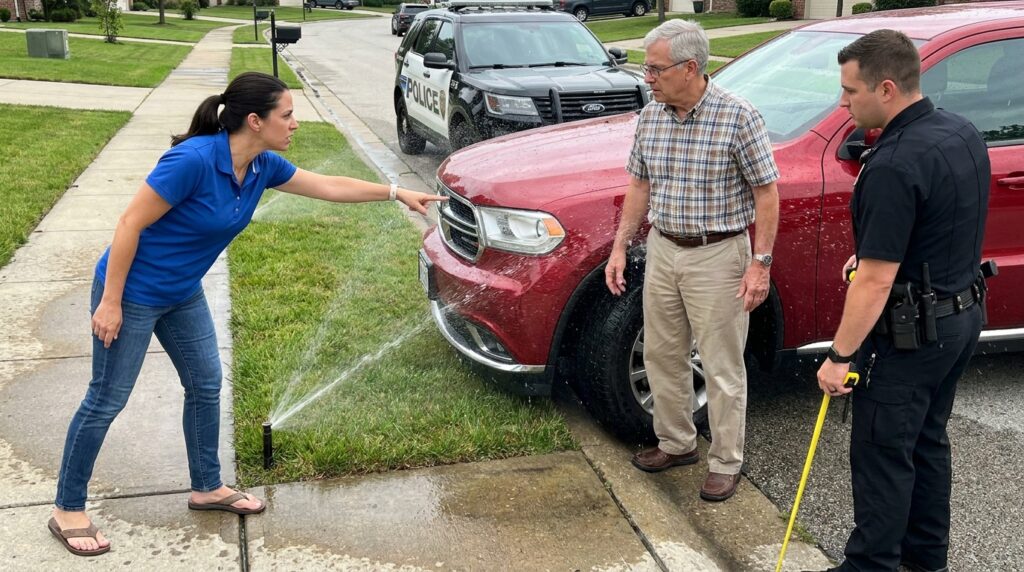
The patrolman’s voice didn’t rise above the localized hiss of the sprinkler, but it carried the unyielding weight of an official directive. His boots hit the wet pavement with a thick, rubbery crunch, instantly soaking the lower leather of his uniform gear as he stepped into the path of the fine irrigation mist. The heavy nylon of his duty belt rasped against his utility vest, a sound Arthur recognized from decades of municipal personnel routing through the lower tracts of the development.
Arthur slowly withdrew his thumb from his pocket, raising his palms slightly but keeping his heels planted firmly near the edge of the red SUV’s front wheel line. “Afternoon, Officer. I’m just waiting for the water line to clear.”
“He’s obstructing an active utility layout, Officer,” Brenda interrupted, her sandals taking two rapid, aggressive strides down the turf until her front strap was touching the concrete curb apron. She held her smartphone up, the screen tilted down toward the officer’s badge line while that persistent blue status light continued its rhythmic, low-frequency pulse. “I filed the initial priority log ten minutes ago. The vehicle’s registration doesn’t match the designated sector allocation, and his tire load is currently causing localized structural displacement to the municipal drainage infrastructure.”
The officer didn’t look at Brenda’s phone. He stopped between the two of them, his stocky frame cutting off the direct line of sight between Arthur and the hidden foundation crack behind the boxwood shrub. His eyes, small and tightly pocketed behind sun-strained lids, went straight to the dark, swallowing vortex where the water was continuing to drain beneath the concrete lip.
“Your name is Arthur?” the officer asked, his attention remaining on the small whirlpool.
“Arthur Vance,” he replied, his voice flat, matching the gray aggregate of the road. “I live at forty-two ten down the block. This space has been a public curb easement since ninety-six. I’ve parked here every Tuesday for five years while the utility crews clear the lower culvert.”
“The easement parameters were systematically revised under the spring zoning review,” Brenda said, her delivery accelerating into a sharp, transactional clip. She shifted her smartphone to her left hand, her right hand reaching into the rear pocket of her jeans to pull out a folded piece of heavy, high-grade stock paper that had been creased into precise thirds. The paper lacked the official blue grid-lines of a standard city document, but it bore a heavy, dark municipal stamp near the top margin. “The sector board has reserved the immediate frontage for automated surface runoff stabilization. He was served with a certified notice of restriction three days ago.”
Arthur’s eyes traced the folded document in her hand. The title at the top, barely visible through the airborne water mist, didn’t read like a standard city citation. It was marked Application for Sovereign Easement Variance.
“Let me see the document, ma’am,” the officer said, extending a thick, short-fingered hand toward Brenda.
“It’s already logged in the district database,” she replied, her arm tightening against her side as she held the paper just out of his immediate reach, her thumb remaining firmly fixed over the lower sub-text where a signature line appeared completely blank. “The physical copy is for residential verification only. The point is the encroachment. Look at the water line. His vehicle is actively diverting the required flow rate away from the primary catchment basin.”
As she spoke, the oscillating sprinkler head reached the northern limit of its track. With a loud, pressurized pop-click, the plastic arm stalled, then began to cast a thick, unbroken fan of hard water directly across the officer’s shoulder and the SUV’s windshield. The fluid hit the safety glass with a heavy, drumming roar, masking the sound of the idling cruiser’s engine and sending a fresh stream of silt-laden gutter runoff directly toward the officer’s boots.
Arthur didn’t pull his eyes away from Brenda’s phone. As the water hit her arm, her screen flared to life, revealing a PDF document title that hadn’t been closed: Pet_ReZone_Drain_04_26. The date on the file string was current, but the county seal on the background image was missing its outer border line—the telltale mark of a digital draft, not an approved statute.
“Turn the irrigation valve off, ma’am,” the officer muttered, his head dipping slightly as a heavy drop of hard city water rolled down the bridge of his nose.
“The cycle is automated under section four of the covenant,” Brenda countered, her posture locking into a rigid, defensive block that completely obscured the boxwood shrub behind her. “If I interrupt the volume pressure now, the system’s internal alignment log resets, and the baseline variance becomes unverified for the court record.”
The officer’s hand moved slowly down toward the heavy leather snap of his duty utility case, his fingers brushing against the knurled metal edge of a tool casing. “I’m not asking about the covenant, ma’am. I’m telling you to shut down the water line so I can establish the physical clearance baseline on this asphalt.”
Arthur took one slow, deliberate step backward, his boot heel coming into direct contact with the red SUV’s front tire. The rubber felt warm, but the concrete directly beneath the tread gave a tiny, distinct crunch—a shifting of loose gravel that signaled the void beneath the road apron was expanding under the steady weight of the continuous water pressure.