CHAPTER 1: THE IRRIGATED LINE
“You’re tracking mud across the easement, Arthur!”
The words didn’t just carry; they cut clean through the rhythmic, metallic hiss-click of the plastic sprinkler head slicing across the boundary.
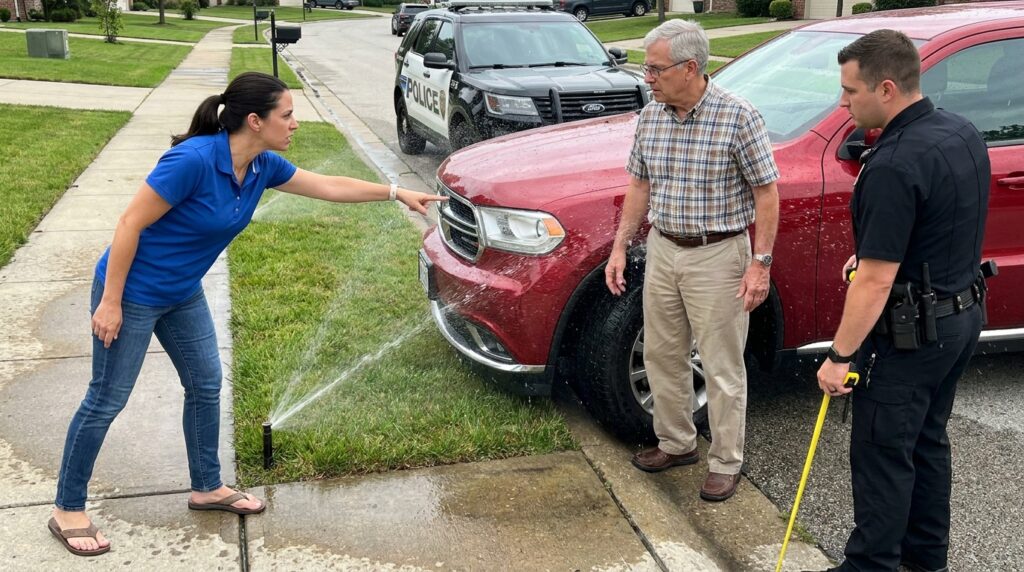
Arthur didn’t look up immediately. He kept his grip firm on the textured steering wheel of his red SUV, letting the engine idle with a low, heavy rumble that vibrated through the floorboards. Through the windshield, the world was a desaturated stretch of cracked American asphalt, baking under a humid July sky that made the horizon shimmer with heat. At the edge of his vision, the water came—a heavy, deliberate arc of high-pressure mist that slapped against his passenger-side door with a sound like throwing a handful of gravel.
He cut the ignition. The silence that followed was dense, heavy with the smell of wet earth, hot rubber, and the metallic tang of hard city water hitting sun-baked metal.
When he finally pushed the driver’s door open, the friction of the hinges groaned in the humid air. He swung his boots out onto the street, his soles finding the exact point where the dry pavement gave way to a dark, spreading stain of artificial runoff. Across the strip of vibrant green turf, she was already waiting.
The resident woman stood with her heels dug into the absolute edge of her lawn, her dark hair pulled back into a ponytail so tight it seemed to strain the skin around her eyes. She wore a blue polo shirt, crisp and uncreased, and her arms were crossed tightly over her chest like a padlock. Between her fingers, she clutched a sleek, black smartphone—her weapon of choice, always held at an angle that suggested a recording was either active or seconds away.
“This is the third time this week, Arthur,” she said, her voice dropping into a transactional, hard-edged register. She didn’t shout, but she stepped forward, her sandals stopping barely an inch from the muddy mud-line where her grass bled into the public concrete. “You’re deliberately blocking the pattern. The county guidelines are clear about uniform irrigation access.”
“It’s a public curb,” Arthur said. His voice was sparse, sanded down by thirty years of living on the same block. He adjusted his wire-rimmed glasses, his eyes tracking the silver arc of the sprinkler as it swung back toward his vehicle, the fine mist coating his front bumper in a glossy, wet sheen. “My house is three doors down, and there isn’t a square foot of dry asphalt left on the street.”
“Your parking issues aren’t my structural priority,” she snapped back, her thumb tapping the screen of her phone with a dull, rhythmic click. “Move the vehicle, or I let the city code enforcement handle the obstruction.”
Arthur didn’t back down, but as he reached down to close his door, his eyes caught something down in the dark gutter line—a tiny, deep fissure in the asphalt where the water was pooling unnaturally, disappearing down into a small, jagged hole beneath the curb edge that hadn’t been there yesterday.