
CHAPTER 2: THE CRUNCH OF THE CURB
Arthur knelt. The heat from the dark asphalt came off the street in thick, dizzying waves, radiating straight through the worn denim of his jeans. Up close, the smell of the road was different—less about the humid summer air and more about the baking chemistry of old tar, sulfur, and the sour iron tang of hard city water that had dried and crusted over the concrete for seasons.
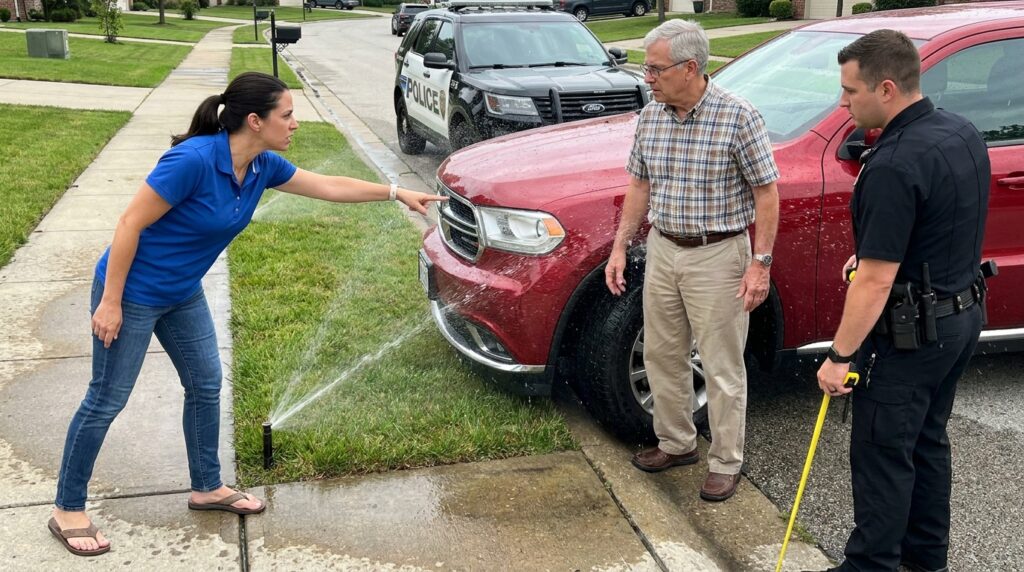
He didn’t look back up at her porch. He kept his attention down, his knuckles nearly brushing the dark, weaponized torrent of the sprinkler spray as it swept overhead, catching the back of his plaid shirt with a fine, freezing mist.
The fissure wasn’t just a crack. It was an intake.
The water from the high-powered oscillating head was hitting his SUV’s side panel, pooling in sheets down the crimson paint, and dumping straight into the gutter. But instead of running down the block toward the storm drain near the intersection, the flow was twisting. It formed a miniature, granular whirlpool, pulling loose grit and fragments of gray road stone down into a jagged, tooth-shaped gap right beneath the curb’s concrete apron. Arthur extended a thick, calloused finger, pressing it into the lip of the asphalt near the hole. The ground gave slightly—a soft, spongy hollow beneath a crust of sun-brittle aggregate.
“I told you to step away from the easement, Arthur.”
Her voice was closer now. The crunch of her sandals on the dry gravel edge of her lawn was sharp, rhythmic, and entirely devoid of hesitation. She had come down the three concrete steps of her walkway, her blue polo shirt vivid against the pale, over-fertilized green of her turf. The smartphone in her right hand was raised slightly, the dark lens pointing down toward the crown of his gray head like a barrel.
“You’re trespassing on a monitored perimeter,” she said. Her delivery was clipped, defensive, a calculated sequence of words designed to sound like a legal notice. “The county has strict codes regarding municipal property management. You’re tampering with the local water distribution.”
Arthur stood up slowly. His joints made a dry, popping sound that felt entirely in sync with the grit beneath his boots. He wiped his damp palm against the side of his khakis, leaving a dark, muddy streak across the fabric. He looked her dead in the eyes, his wire-rimmed glasses catching the glare of the high, white sun.
“The county didn’t pave this street for your private irrigation, Brenda,” he said, his voice flat, retaining the sparse, unyielding weight of a man who had watched three decades of neighbors move in and out of these identical floor plans. “And the water isn’t distributing. It’s sinking. You’ve got a void opening up right under your mailbox lane.”
A precise, microscopic flicker passed over Brenda’s face—a sudden freezing of the small muscles around her jaw before she pulled her lips back into a hard, defensive line. Her ponytail shifted as she tilted her head, her posture adjusting with the rigid, mechanical precision of her own sprinkler system.
“The drainage on this lot is fully certified,” she said, her thumb sliding down the side of her phone with an intentional, loud click that signaled a screen lock. “Any structural displacement out here is the direct result of your vehicle’s gross axle weight resting on the unreinforced curb edge. I’ve already submitted the formal notation to the board. If that tire is still touching the concrete when the patrol car routes through here, it’s an automatic municipal citation.”
“The curb is city property,” Arthur replied, his voice dropping into a lower, heavier register that didn’t rise to meet her defensive energy. He took one slow step toward the front bumper of his SUV, his body cutting off her phone’s view of the small, swallowing whirlpool in the gutter. “And a standard utility vehicle doesn’t displace six inches of road grade unless the earth underneath is already gone.”
Behind them, the low, steady hiss-click-click-hiss of the plastic sprinkler head reached the end of its arc. It paused for a single, mechanical micro-second, then reversed, throwing a solid sheet of cold city water straight across the narrow gap between them. The spray hit the hot hood of the SUV with a loud, spitting hiss, sending a cloud of fine white steam rising between Arthur and the resident woman.
Through the white mist, Arthur didn’t look at her angry, rigid expression. His eyes drifted past her shoulder, toward the pristine concrete foundation of her garage. There, half-hidden behind a heavily manicured boxwood shrub, a fresh, jagged line of dark gray sealant ran vertically up the brickwork—a thick, ugly scar where the house was quietly trying to tear itself away from the driveway.
Brenda noticed his gaze. Without a word, she stepped laterally, her wide silhouette completely blocking the shrubbery, her clipboard-like phone raised once more as the distant, metallic wail of a siren began to drift through the heavy, humid air from the main highway.








