CHAPTER 7: THE CODE ENFORCEMENT INSPECTION
The neon-green powder didn’t dissolve immediately when the inspector dropped it down Harold’s cellar drain; it hissed, foaming into a vibrant, toxic chartreuse that smelled intensely of industrial mint and scale-remover. Less than five minutes later, that same artificial green began hemorrhaging through the fractured mud at the center of Maya’s pollinator garden, bright as road-flare smoke against the parched clay.
“There it is,” the city code inspector muttered. He was a lanky man named Miller, wearing a sweat-stained high-visibility vest that rattled with brass snap-buttons whenever he bent over. He knelt on a square of rubber matting right at the boundary line, his thumb pressing a digital camera lens down toward the bubbling slurry. “That’s not storm runoff. That’s pure industrial-grade tracer dye coming straight from his basement wash-basin. He’s bypassed the municipal sanitary main entirely on this side.”
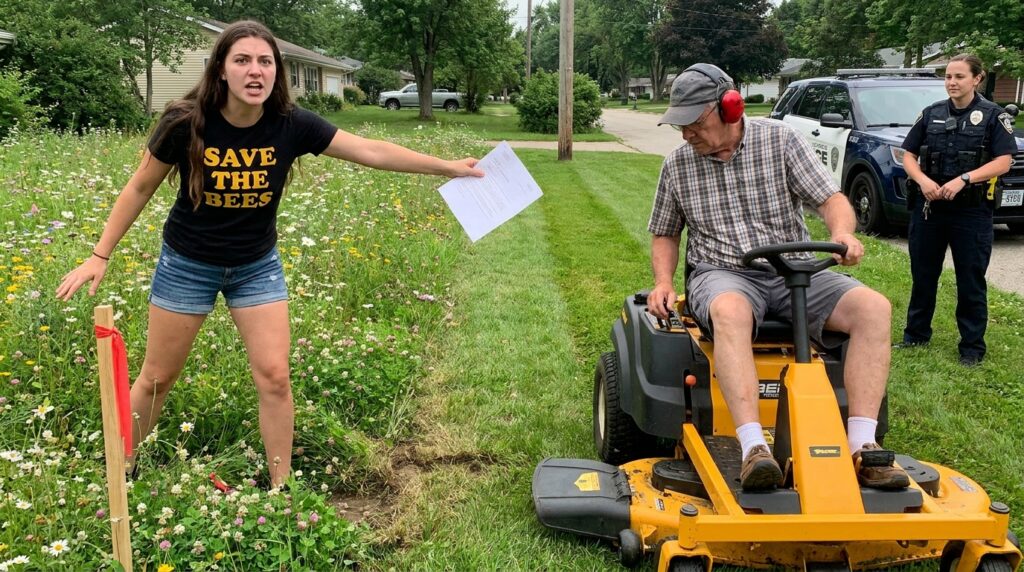
Maya stood three feet back, her bare shins dusted with the white lime powder the surveyor had left behind. The heat was still radiating off the concrete curb, thick and gasoline-scented, but the conflict had shifted from a neighbor’s loud overreach to the quiet, mechanical documentation of a city citation. Across the line, Harold’s yellow riding mower sat locked behind his closed garage door, its cooling block silent, but the side curtain of his basement window twitched every time Miller’s camera flash clicked.
“Is the pipe structural?” Maya asked. Her voice was flat, her fingers tracing the tear in her county plat map where she had gripped it too hard during the confrontation.
“It’s unpermitted clay tile, probably dropped into the trench during the eighty-four subdivision grading before the inspectors signed off on the street links,” Miller said, his boots scraping against a rusted iron water-key sticking out of the turf. He stood up with a heavy grunt, his clipboard clipping against his belt. “He used your garden as a drainage field because his foundation sits three feet lower than the grade of the city main. If he had to pump it up to the street line legally, it’d cost him an eight-thousand-dollar lift station. So he just let it bleed into your topsoil.”
The screen door on Harold’s porch didn’t slam this time. It opened an inch, the rusted spring giving a low, metallic whine that cut through the idling rumble of Miller’s city utility truck. Harold didn’t come down to the grass. He remained behind the wire mesh, a shadow holding a blue plastic clipboard of his own, his gray cap a sharp, dark wedge against the interior light of his kitchen.
“The eighty-four rider allows for municipal runoff, Miller!” Harold’s voice came through the screen, more raspy and strained than it had been during the morning duel. He didn’t monologue; he was aiming for the inspector’s regulatory line. “The previous owner signed the carbon sheet. It’s an approved easement corridor!”
“Runoff is rain, Harold,” Miller called back without looking up from his citation log. His ballpoint pen made a sharp, tearing sound against the carbonless paper forms. “This is laundry discharge and cellar sump overflow. You’ve got an illegal tie-in to an abandoned transit line under this girl’s milkweed, and it’s actively undermining her foundation slab. I’m tagging this a Class II environmental violation before I clear the curb.”
The green dye continued to well up, staining the white roots of the clover a deep, permanent chemical emerald. Maya looked past the inspector’s boots toward the center of the sinkhole, where the weight of the water had exposed another three inches of the buried gray iron casing below the clay tile. A micro-discrepancy caught her eye—the iron casing didn’t terminate at Harold’s line. It had a heavy, industrial-grade flange bolted to the side that faced her house, its rusted hex-nuts covered in a thick layer of old, black pitch that hadn’t been disturbed since the day the subdivision was carved out of the limestone. Harold’s illegal orange pipe was just an amateur tap into something much larger, older, and strictly locked beneath her feet.